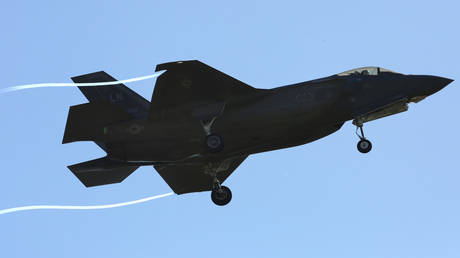
The fog of war over the Persian Gulf has thickened into a dense, digital haze where pixels are weaponized as frequently as missiles. On Friday, Iranian state media erupted with a definitive claim: the Islamic Revolutionary Guard Corps (IRGC) had successfully downed a second U.S. F-35 Lightning II over central Iran. Tehran’s narrative describes a catastrophic explosion from a new, undisclosed air defense system, suggesting the pilot had no chance to eject.
This is the high-stakes theater of Operation Epic Fury, where the perceived invincibility of fifth-generation stealth is being tested against a decentralized, persistent Iranian defense network. However, a forensic look at the evidence reveals a far more complex and sobering reality for the Pentagon. While Iran is aggressively marketing a "stealth-killer" narrative, the physical debris appearing on social media tells a different story—one that involves a verified American loss, but perhaps not the one Tehran is boasting about.
The Disconnect Between Debris and Doctrine
The IRGC’s Khatam al-Anbiya Headquarters was quick to broadcast what they termed "undeniable proof" of the F-35's demise. Yet, aviation analysts and OSINT investigators have spent the last twelve hours dissecting the circulated imagery. The results are inconvenient for the Iranian propaganda machine. The wreckage, specifically the vertical stabilizers and engine nozzle fragments visible in several verified frames, does not match the clean, angular profile of a Lockheed Martin F-35.
Instead, the jagged metal and heat-scarred titanium point toward a Boeing F-15E Strike Eagle.
The Strike Eagle is a formidable, dual-role fighter, but it lacks the stealth coatings and integrated sensor fusion that make the F-35 the crown jewel of the U.S. Air Force. Misidentifying the aircraft might seem like a minor clerical error in the heat of combat, but it exposes the central tension of this conflict. Iran needs the F-35 "kill" to shatter the aura of American technological supremacy. In reality, they likely intercepted a legacy platform—or a Strike Eagle flying a high-risk mission to protect a crippled F-35—and inflated the results for a domestic and global audience.
Passive Sensors and the Stealth Myth
Despite the misidentification of the specific airframe, the Pentagon faces a genuine crisis. We are seeing the limits of radar-based stealth in a theater saturated with passive infrared search and track (IRST) systems.
Stealth aircraft are designed primarily to vanish from radar screens. They use complex geometric shapes to bounce radio waves away from the source. However, even the most advanced F-35 cannot hide the thermal signature of its engine or the friction heat generated by moving through the atmosphere at high speeds. The IRGC has spent years refining a "layered" defense strategy that does not rely on active radar emitters, which would be immediately targeted and destroyed by U.S. anti-radiation missiles.
Instead, they are using:
- Passive Infrared Sensors: These home in on the heat bloom of a jet without emitting a signal of their own, making them invisible to the aircraft’s early warning systems.
- Bistatic and Multistatic Radar: These systems separate the transmitter from the receiver, allowing them to catch "scattered" radar waves that a stealth jet deflects.
- Persistent Drone Surveillance: Cheap, expendable Iranian drones act as a distributed eyes-only network, providing visual confirmation of low-flying or damaged aircraft.
The previous March 19 engagement, where an F-35 was forced to make an emergency landing after sustaining shrapnel damage from a surface-to-air missile (SAM) barrage, was the first crack in the armor. It proved that while you might not be able to "lock" an F-35 in the traditional sense, you can fill the sky with enough guided and unguided munitions to achieve a "proximity kill."
The Search and Rescue Crisis
While Tehran celebrates, a more desperate drama is unfolding in the mountains of southern Iran. White House Press Secretary Karoline Leavitt confirmed that President Donald Trump has been briefed on a downed fighter jet, and search-and-rescue (SAR) efforts are underway. This confirms a hardware loss, even if the Pentagon remains silent on the specific model.
The current situation is precarious. Initial reports from Israeli military sources indicate that one pilot was rescued in a high-risk extraction, but a second crew member—likely the Weapon Systems Officer (WSO) from an F-15E—remains missing. Iranian local television is already offering rewards for the capture of "enemy pilots" alive.
This isn't just about losing an $80 million jet. It’s about the vulnerability of the CSAR (Combat Search and Rescue) infrastructure. If Iran can down the rescue helicopters or the drones providing cover, the political cost for the administration becomes astronomical. We saw this in the March 2 "friendly fire" incident where three F-15Es were lost; the recovery of those crews was a chaotic, near-miss operation. Now, with Iran claiming a capture, the psychological warfare has entered a new phase.
Strategic Consequences of a Confirmed Loss
If it is eventually confirmed that a stealth asset was indeed lost to hostile fire—not just damaged but destroyed—the global arms market will feel the tremor. The F-35 is not just a plane; it is a multi-national economic and security pact.
- Allied Confidence: Countries like Israel, Japan, and the UK have bet their national defense on the F-35's ability to operate in contested airspace. A verified shoot-down by Iranian systems would force an immediate, global re-evaluation of tactics.
- Electronic Warfare Escalation: The U.S. will likely have to deploy more EA-18G Growlers and other electronic attack platforms to "blind" even the passive sensors Iran is using, further cluttering the electromagnetic spectrum.
- Economic Volatility: Brent Crude has already hit $141 in response to the escalation. A prolonged war of attrition over Iranian soil, where American jets are falling from the sky, could push the global economy toward a breaking point.
The Propaganda Trap
The IRGC’s insistence on the "F-35" label, despite the F-15E debris, is a deliberate trap. They want the U.S. military to be forced into a "well, actually" response. If the Pentagon corrects the record by saying "You only shot down an F-15E," they are still admitting to a loss of a multi-million dollar aircraft and potentially two crew members. It is a win-win for Tehran’s information operations.
This conflict has moved beyond the era of massive tank battles or carrier strikes. It is a war of attrition played out in 4K resolution and social media threads. The U.S. military is learning, at a painful price, that stealth is a capability, not a cloak of invincibility. As the search for the missing crew continues, the "brutal truth" is that the air superiority once taken for granted in the Middle East is being dismantled piece by piece—sometimes by advanced missiles, but more often by the relentless reality of a motivated, adaptive adversary.
The F-35 may still be the most advanced aircraft in history, but in the skies over Iran, it is just another target.