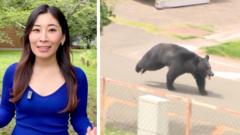
The asphalt in Hokkaido’s mountain towns always smells a certain way just before summer takes hold. It is a mix of damp cedar needles, melting snowpack from the peaks, and the faint, sweet scent of wild garlic. For generations, the people living on the northern edge of Japan knew exactly where they stood with the wilderness. There was the town, with its low-slung roofs and morning markets, and there was the forest. A line existed. It was invisible, but it was absolute.
Then, the locks started clicking open.
It began not with a roar, but with a quiet, terrifying display of comprehension. In the early morning mist of a small northern community, a heavy sliding door on a residential shed did not rattle under a brute force attack. It slid smoothly along its metal track. Inside, sacks of grain were meticulously sorted. This was not the work of a chaotic force of nature. It was the work of an analyst.
The standard news wire reports the data points with a clinical chill: an exceptionally large Asian black bear, four people injured across a jagged line of encounters, and a police force struggling to track an animal that seems to anticipate their every move. The media calls it "extremely intelligent." But out here, where the treeline meets the porch light, intelligence isn't a headline. It is a threat that changes the way you turn a doorknob.
The Break in the Mirror
To understand the panic gripping these communities, you have to understand the creature itself. The Asian black bear is historically a phantom. It is smaller than its ferocious cousin, the Ussuri brown bear, which also roams Hokkaido, but it possesses a dense, muscular frame and a white crescent moon slashed across its chest. For centuries, it lived by a strict code of avoidance. If it heard a human bell, it melted into the bamboo grass.
But something has shifted in the ecology of fear.
Consider a hypothetical resident—let us call her Miyako—living on the fringes of Asahikawa. For decades, Miyako’s daily ritual involved hanging laundry on the line, checking the vegetable patch, and glancing occasionally at the dark wall of the forest. The forest was a neighbor that kept to itself.
Now, imagine Miyako looking out her kitchen window into the twilight. The shadow moving across the gravel isn’t stumbling. It isn't raiding the garbage bin like a desperate raccoon. It stops. It observes the house. It notes which doors are used, which windows are left cracked for the evening breeze, and where the dogs are tied.
This specific bear has bypassed the primal instincts of its species. When authorities set standard box traps—massive iron cages baited with sweet fruit or honey—the bear did not walk inside. It walked around them. In two distinct instances, track marks showed the animal had approached the rear of the trap, inspected the mechanism from the outside, and left without touching the trigger.
It is learning. Fast.
The four individuals who crossed paths with this animal were not deep-woods hikers or reckless trophy hunters. They were ordinary people doing ordinary things: one was tending a garden, another was walking toward a parked car before dawn. The encounters were swift, violent, and precise. The bear did not stay to feed or defend a carcass. It struck to clear its path and vanished back into the brush before the echo of the screams could fade.
The Anatomy of an Outsmarted Landscape
The authorities are frantic, and their traditional toolkit is failing. In Japan, the management of wildlife conflicts relies heavily on local hunting associations, known as the Ryofukai. These are not young, high-tech trackers. For the most part, they are aging men, many in their seventies, who possess an intimate knowledge of the mountains but are facing an unprecedented adversary.
The problem is that the modern rural fringe has become an unintended training ground for apex intelligence.
+-------------------------------------------------------------+
|              THE EVOLUTION OF URBAN ADAPTATION               |
+-------------------------------------------------------------+
| PAST BEHAVIOR                 | PRESENT INNOVATION          |
|-------------------------------|-----------------------------|
| Avoided human scent entirely. | Tracks scent to find food.  |
| Frightened by loud noises.    | Ignores sirens and bells.   |
| Disoriented by fences.        | Navigates drainage ditches. |
| Trapped by simple bait.       | Recognizes iron enclosures. |
+-------------------------------------------------------------+
When a bear learns that a human settlement is a concentrated laboratory of calories, its brain chemistry changes. Every unsecured compost bin is a puzzle solved. Every sliding glass door is a barrier waiting to be tested. The bear currently eluding capture has graduated from foraging to engineering. It uses the deep concrete drainage ditches that line Japanese rural roads as a subterranean highway system, moving beneath the streets, out of sight of thermal drones and police cruisers.
It is a ghost in the infrastructure.
Local schools have suspended outdoor activities. Children walk to the bus stop in tight, silent groups, escorted by parents carrying air horns and heavy wooden staff weapons. The cheerful, rhythmic ringing of bear bells—once a reassuring soundtrack of the Japanese countryside—now sounds hollow. If an animal is smart enough to associate the chime of a bell not with danger, but with the presence of a slow-moving, easily startled food source, the bell becomes a dinner gong.
The psychological toll on these communities is immense. It forces a complete reassessment of what it means to live alongside nature. We like to view the wilderness through a lens of romantic harmony or absolute dominance. We rarely prepare for a scenario where the wilderness looks back at us, calculates our routines, and decides it is no longer afraid.
The Price of the Forest's Return
How did the line between us and them blur so catastrophically? The answer lies in the shifting demographics of Japan itself.
As rural villages empty out due to an aging population and youth migration to Tokyo or Osaka, the buffer zones are dissolving. Abandoned rice paddies turn into overgrown brushlands. Unharvested persimmon trees become neon signs flashing "free buffet" to the hillsides. The forest is reclaiming the land, and with it come the predators.
But this isn't just a story about land use. It is about the limits of human certainty.
We have spent the last century wrapping our lives in concrete, convenience, and predictable routines. We assume that because we have mapped every square inch of the mountains via satellite, we control them. Then, a single three-hundred-pound animal reminds us that maps are just paper.
The hunt continues through the dense undergrowth of Hokkaido's foothills. The rain is coming down now, washing away paw prints and scent trails, turning the clay soil into a slick, treacherous soup. The police officers, the veteran hunters, and the anxious residents all know the same unspoken truth.
The bear is out there, somewhere in the green canopy, watching the flashing red lights of the patrol cars. It isn't running in panic. It is waiting for the town to go to sleep.



:max_bytes(150000):strip_icc()/how-many-types-of-dwarfism-are-there-2860725-v1-8dae2c531b4b47d9ae36ae404d3308a0.png)