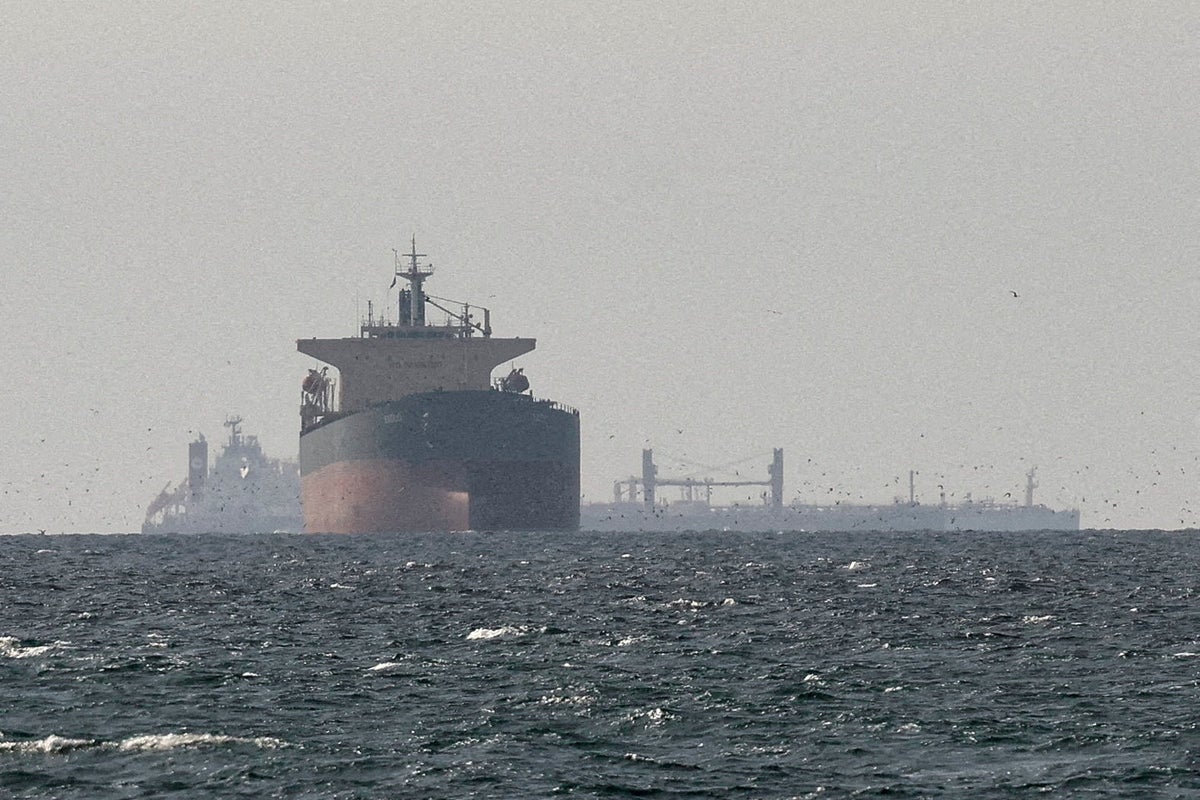
The passage of a Very Large Crude Carrier (VLCC) through the Strait of Hormuz is not merely a logistical event; it is a high-stakes exercise in kinetic and economic risk management. When a Chinese-flagged supertanker carrying two million barrels of Iraqi crude enters this corridor, it triggers a complex sequence of geopolitical and insurance-based variables. The Strait of Hormuz represents the world's most significant oil transit chokepoint, facilitating the movement of approximately 21 million barrels per day (bpd), or roughly 21% of global petroleum liquids consumption.
Understanding the implications of this transit requires a structural decomposition of the operational environment, the physics of maritime vulnerability, and the economic feedback loops that dictate global energy pricing.
The Triad of Transit Vulnerability
The risk profile of a VLCC in the Strait of Hormuz is defined by three intersecting vectors: geographic constriction, asymmetric threats, and jurisdictional ambiguity.
1. Geographic Constriction
The Strait of Hormuz is approximately 21 miles wide at its narrowest point, but the shipping lanes—consisting of two-mile-wide channels for inbound and outbound traffic, separated by a two-mile buffer zone—are significantly more restricted. A vessel of this magnitude, often drawing 20 meters of water when fully laden, has limited room for maneuver. This lack of sea room transforms the vessel into a "fixed" target for coastal defense systems and small-craft swarming tactics.
2. Asymmetric Threats
The primary threat to heavy tonnage in these waters is not a peer-level naval engagement, but rather gray-zone tactics. These include:
- Limpet Mines: Magnetic explosives attached to the hull below the waterline, designed to disable propulsion or cause localized flooding without sinking the vessel.
- Uncrewed Aerial Vehicles (UAVs): Loitering munitions that target the bridge or manifold area to disrupt operations.
- Fast Inshore Attack Craft (FIAC): Small, highly maneuverable boats used for harassment or boarding operations.
3. Jurisdictional Ambiguity
The transit occurs within the Territorial Waters of Oman and Iran. While the 1982 United Nations Convention on the Law of the Sea (UNCLOS) provides for "transit passage" through straits used for international navigation, the interpretation of these rights is frequently contested. Iran, which has signed but not ratified UNCLOS, asserts specific regulatory rights over the strait that can lead to vessel detentions under the guise of environmental or safety violations.
The Calculus of Two Million Barrels
A VLCC typically carries two million barrels of crude oil. To quantify the impact of a single vessel’s passage, one must look at the "Energy Density of Risk."
$$Risk_{Density} = \frac{Value_{Cargo} + Value_{Hull}}{t_{Transit}}$$
At a hypothetical price of $80 per barrel, the cargo alone is valued at $160 million. When adding the replacement cost of a modern VLCC (approximately $120 million to $150 million), a single transit represents nearly $300 million in floating assets. The disruption of this single transit does not just impact the immediate stakeholders; it sends a price signal through the Brent and WTI futures markets.
The "Hormuz Risk Premium" is a measurable fluctuation in oil prices that reflects the perceived probability of a closure or significant disruption. Historically, a localized incident in the Strait can trigger an immediate 3% to 5% spike in front-month futures, as traders price in the possibility of a supply chain rupture.
Logistics of the Iraqi-Chinese Energy Axis
The specific nature of this transit—Iraqi crude on a Chinese vessel destined for Chinese refineries—highlights a deepening dependency within the BRICS+ framework. Iraq is the second-largest producer in OPEC, and China is the world's largest crude importer.
Supply Chain Mechanics
The crude is typically loaded at the Al Basra Oil Terminal (ABOT) or the Khor al-Amaya Oil Terminal (KAAOT). These offshore facilities are the nodes from which Iraq exports the vast majority of its Kirkuk and Basra grades. The journey from these terminals to the Strait of Hormuz takes approximately 24 to 36 hours at a standard transit speed of 13 knots.
The Role of China's "Blue Water" Ambitions
The use of Chinese-flagged tankers for this route serves two strategic purposes. First, it reduces reliance on third-party Western shipping conglomerates, thereby mitigating the impact of potential sanctions. Second, it provides a justification for the presence of the People's Liberation Army Navy (PLAN) in the region under the umbrella of "anti-piracy" or "escort" missions. This presence is a critical component of China's "String of Pearls" strategy, intended to secure energy sea lines of communication (SLOCs) from the Persian Gulf to the South China Sea.
The Insurance Bottleneck: War Risk Premiums
A critical but often overlooked factor in these transits is the maritime insurance market, specifically Lloyd’s of London’s Joint War Committee (JWC). The JWC designates the Persian Gulf and the Gulf of Oman as "Listed Areas."
Vessels entering these zones must notify their underwriters and pay an "Additional Premium" (AP) for War Risk cover. These premiums are not static; they fluctuate based on the daily security environment. For a VLCC:
- Baseline War Risk: Often a fraction of a percent of the hull value.
- Escalated Risk: During periods of heightened tension (e.g., following a tanker seizure), the AP can surge to 0.5% or even 1.0% of the vessel's value for a single seven-day transit.
This creates a massive operational cost. A 0.5% premium on a $120 million hull adds $600,000 to the cost of a single voyage. These costs are eventually passed down the supply chain, impacting the "landed cost" of crude at the refinery gate.
Strategic Infrastructure and Bypass Limitations
The global focus on the Strait of Hormuz exists because current bypass options are insufficient to handle the total volume of Persian Gulf exports.
- The Habshan–Fujairah Pipeline (UAE): This pipeline can transport approximately 1.5 million bpd to the Gulf of Oman, bypassing the Strait. While significant, it handles less than 10% of the total flow through the water.
- The East-West Pipeline (Saudi Arabia): This 745-mile line has a capacity of roughly 5 million bpd, moving crude to the Red Sea. However, this merely trades one chokepoint (Hormuz) for another (Bab el-Mandeb).
- Iraqi Infrastructure: Iraq currently lacks a viable, high-volume bypass for its southern exports. The Kirkuk-Ceyhan pipeline to Turkey is frequently offline due to geopolitical disputes between Baghdad and the Kurdistan Regional Government (KRG), as well as technical damage.
The lack of redundancy makes the VLCC transit through Hormuz a mandatory risk for Iraqi exports.
Technical Analysis of Vessel Vulnerability
A VLCC is a marvel of engineering, but it is not built for combat. Its vulnerabilities are structural and systemic.
Inert Gas Systems (IGS)
Crude oil is volatile. To prevent explosions within the cargo tanks, an IGS replaces atmospheric oxygen with non-combustible gases (usually scrubbed exhaust). If a kinetic strike damages the IGS or the tank venting system, the risk of a catastrophic explosion increases exponentially.
Single Point of Failure: The Rudder and Propeller
A VLCC has massive inertia. Stopping a fully laden tanker takes miles. A small, targeted strike on the steering gear or the single propeller shaft renders the vessel "Not Under Command" (NUC). A NUC vessel in a two-mile-wide shipping lane becomes a navigational hazard that can effectively block the channel for other deep-draft vessels.
The Shift Toward "Dark Fleet" Logistics
As geopolitical pressure mounts, a bifurcation of the tanker market has emerged. While this specific Chinese vessel is operating overtly, a significant portion of regional trade has shifted to the "Dark Fleet" or "Shadow Fleet"—older vessels with obscured ownership and questionable insurance.
This creates a secondary risk layer: the "Environmental Externalities." Shadow fleet vessels often disable their Automatic Identification Systems (AIS) to avoid detection. In the congested waters of the Strait of Hormuz, this dramatically increases the probability of collisions. A major spill in the Strait would not only be an ecological disaster but would likely force the closure of desalination plants along the coast, turning an energy crisis into a humanitarian one for the GCC states.
The Geopolitical Endgame
The transit of two million barrels of Iraqi crude to China is a pulse check on the global economy. The stability of this route relies on a fragile "Deterrence Equilibrium." On one side, the U.S. Fifth Fleet and its allies attempt to maintain the "Freedom of Navigation." On the other, regional actors utilize the threat of disruption as a lever in broader diplomatic negotiations.
The strategic play for energy importers is no longer just about volume; it is about "Transit Resilience." This involves:
- Diversifying Discharge Points: Moving away from centralized mega-refineries to more distributed coastal nodes.
- Increased Strategic Petroleum Reserves (SPR): China has aggressively expanded its SPR to buffer against a total Hormuz closure, which some analysts estimate could last between 30 to 90 days before military intervention or diplomatic resolution.
- Enhanced Escort Protocols: The shift from passive monitoring to active sovereign escort for high-value energy assets.
The movement of this tanker confirms that despite the global transition toward renewables, the world’s industrial machinery remains tethered to the security of a few miles of seawater. The risk is not a bug in the system; it is a fundamental feature of global energy geography.