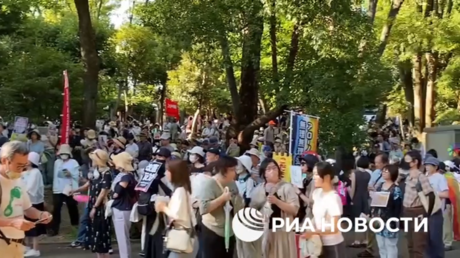
Tens of thousands of people are surrounding the National Diet building in Tokyo, chanting anti-war slogans under the blistering summer heat. They are holding handwritten banners reading "NO WAR" and "Protect Article 9."
It is a striking sight.
For decades, international observers viewed Japanese politics as quiet and consensus-driven. That view is officially outdated. Outside parliament, crowds stretching along city blocks are voicing deep anger at the government's military expansion plans.
What is driving this sudden surge in public unrest?
The immediate trigger is a fierce clash over national identity, government priorities, and the country's postwar pacifist constitution. Prime Minister Sanae Takaichi and the ruling Liberal Democratic Party (LDP) are pushing hard to expand military spending, export weapons, and officially revise Article 9. Meanwhile, ordinary citizens are watching inflation eat their savings while the state diverts tax dollars into missile systems.
This isn't just a political debate in hearing rooms. It is a massive grass-roots pushback happening on the streets.
The Breaking Point Behind Tokyo Anti-War Demonstration
To understand why thousands of citizens are taking to Tokyo's streets, you have to look at what has changed in recent months. The Japanese government has systematically loosened restrictions on its armed forces. It rebranded defence policies, approved record military spending, and laid the groundwork to rewrite the constitution.
Protesters argue the government is abandoning seventy-five years of pacifism without a clear mandate from the public.
The numbers tell a story of rapid change. Organisers reported around 27,000 in-person attendees at a recent demonstration outside parliament, with another 110,000 joining online rallies. Monthly demonstrations known as the "19th Action"—a movement started after controversial security legislation passed in 2015—regularly draw massive crowds.
When you stand in front of the Diet during these rallies, you see a wide cross-section of society. You see college students standing next to retirees who lived through the aftermath of World War II. You see union members, local ward councillors, and families with young children.
They aren't just protesting defense policy. They are furious about daily life.
Japan faces severe economic pressures. Prices for basic groceries, electricity, and imported fuel have climbed steadily. Yet, while social security and healthcare budgets face strict scrutiny, defence appropriations keep growing. Citizens feel ignored.
"We should be spending money on healthcare, education, and jobs, not on more weapons," says Megumi Koike, a local Tokyo councillor who attends the rallies regularly. That exact feeling echoes through almost every conversation on the ground.
How Article 9 Became the Core Battleground
At the center of this clash lies Article 9 of the Japanese Constitution. Written after World War II, the clause explicitly renounces war as a sovereign right of the nation and forbids the maintenance of land, sea, and air military forces for offensive purposes.
For generations, Article 9 served as a sacred pillar of post-war identity. It reassured neighboring nations and kept Japan out of foreign conflicts.
Current leadership sees things differently. Government officials argue that deteriorating regional security—specifically growing tensions around China, North Korea, and the Taiwan Strait—requires a stronger military stance. They argue that Japan's Self-Defense Forces (SDF) need legal clarity and broader authority to operate alongside foreign partners.
Proponents of constitutional change want to formally recognize the SDF inside Article 9. Critics argue that adding a formal military clause completely neutralizes the original pacifist guarantee.
If you re-read the clause, the friction becomes obvious. Article 9 states that "war potential will never be maintained." However, Japan already possesses one of the world's most advanced defense forces. Revisionists say updating the text simply acknowledges reality. Opponents argue that formal recognition opens the floodgates to unrestricted foreign deployments and offensive strikes.
That argument isn't theoretical to the people on the streets. Protesters view Article 9 as a shield that protected the country from fighting in foreign wars for eight decades. Once that shield breaks, they fear there is no going back.
Inflation Taxes and Military Spending Priorities
The economic side of this conflict deserves way more attention than mainstream coverage gives it. You cannot separate the anti-war movement from Japan's current cost of living crisis.
The government pledged to raise defense spending toward two percent of gross domestic product, mirroring NATO targets. Funding that shift requires immense resources. To pay for long-range missiles, naval vessels, and advanced aircraft, the state has considered tax hikes and budget reallocations.
Think about how that hits an average family in Tokyo or Osaka.
Your utility bills jump. Food prices jump. Your wage growth stays sluggish. Then you turn on the news and see parliament approving billions for counterstrike weaponry and weapon exports.
It creates deep resentment.
During demonstrations outside the Diet, protesters explicitly link defense spending to economic hardship. Placards call out the gap between military spending and social welfare. Workers point out that while pensions stagnate, defense contractors secure multi-year government deals.
The frustration is compounded by legislative maneuvers in parliament. The LDP has used its lower house majority to push through bills establishing central intelligence bodies and expanding arms export guidelines. Opposition parties have repeatedly tried to stall these measures, but the government's legislative numbers allow them to override pushback.
That dynamic drives people out of parliament chambers and into the streets. When legal debate feels rigged by party majorities, public rallies become the primary venue for dissent.
The Human Toll and Regional Friction
The push for military expansion creates intense local friction, particularly in places like Okinawa. Though Tokyo hosts the largest headline-grabbing rallies, the southern prefecture of Okinawa feels the direct impact of military construction.
Okinawa hosts a massive concentration of defense infrastructure. Local residents have protested base construction, aircraft noise, and safety hazards for decades. Now, as the central government strengthens island bases along the southwestern island chain, locals feel their homeland is being converted into a potential front line.
Protest chants regularly ring out during official visits by government ministers to Okinawa. When officials preach about deterrence and security, local crowds often drown out speeches with anti-war chants.
Residents remember history. Okinawa suffered devastating destruction during World War II. Older generations know firsthand what happens when a residential area becomes a military battleground. They reject the idea that stockpiling missiles brings safety.
In Tokyo, protesters emphasize this regional perspective. They point out that expanding deployments along outer islands heightens regional tension instead of diffusing it.
There is also a growing push to restrict arms exports. Historically, Japan maintained strict self-imposed bans on selling weapons abroad. Recent policy shifts opened the door to exporting jointly developed fighter jets and defense equipment to foreign nations. Opponents view this as a direct profit-driven shift toward a military-industrial complex.
What Media Coverage Misses About Japanese Activism
Outside observers often misinterpret Japanese political movements. Western media sometimes frames these protests as minor fringe gatherings or routine political theater. That misses the structural shift taking place right now.
Japanese anti-war activism is evolving in three distinct ways.
Diversity of Participants
First, the demographic composition has broadened significantly. Historical protests in the mid-twentieth century were dominated by radical student groups and organized labor unions. Today's demonstrations are noticeably decentralized. You see independent citizens, neighborhood groups, peace activists, and young professionals who never participated in rallies before.
Integration of Digital Organizing
Second, digital networks are amplifying physical protests. During major events in Tokyo, thousands tune in via live streams from across the country. Online petitions and decentralized social media campaigns mobilize supporters far beyond the capital. When 27,000 people line up around parliament, over 100,000 people are actively following and sharing the feed online simultaneously.
Focus on Everyday Issues
Third, the rhetoric has shifted from abstract ideology to concrete quality of life. Protesters aren't just reciting foreign policy theory. They talk about groceries, healthcare costs, civil liberties, and freedom of expression. They argue that a militarized state inevitably restricts civil rights, increases state secrecy, and squeezes domestic funding.
This isn't a single-issue protest movement. It is a broad coalition demanding a complete reevaluation of where the country is heading.
Why Public Opinion Remains deeply Divided
Despite the massive turnout in Tokyo, public opinion across Japan is not unanimous. The government's defense agenda draws backing from voters who fear shifting geopolitical dynamics in East Asia.
Proponents of military expansion raise several key points:
- Regional Security Risks: Escalating naval activities, missile tests, and maritime disputes nearby make a purely defensive force seem insufficient to some voters.
- Alliance Commitments: Stronger military capabilities reinforce Japan's alliance with key partners like the United States, providing a credible deterrent against aggression.
- Technological Advancement: Modernizing defense infrastructure stimulates research in aerospace, cybersecurity, and advanced manufacturing.
These arguments resonate with a significant portion of the electorate that feels genuinely anxious about external threats. Polling shows that while majorities oppose changing the core anti-war clause of Article 9, many citizens support incremental upgrades to defensive hardware.
That divide creates a tense political environment. The government uses security fears to justify budget hikes and policy changes. The peace movement counters by arguing that militarization creates a self-fulfilling security dilemma—where buying weapons makes neighbors feel threatened, triggering an arms race that makes everyone less safe.
How to Follow and Evaluate the Peace Movement Moving Forward
If you want to track where this issue goes next, paying attention to official press releases isn't enough. You need to follow real-time developments across legislative and community channels.
Here are practical ways to monitor this evolving story:
- Watch the Parliamentary Schedule: Key legislative votes on security document revisions and defense budget allocations happen during regular Diet sessions. Keep an eye on committee votes where opposition parties challenge defense line items.
- Follow Regional News Outlets: Local papers like the Okinawa Times and Ryukyu Shimpo offer ground-level coverage of defense infrastructure impacts that national media often gloss over.
- Track Monthly Mobilizations: The "19th Action" rallies occur on the nineteenth day of every month around parliament and municipal centers. Watching turnout at these events provides a reliable gauge of public momentum.
- Monitor Constitutional Review Committees: The Diet's constitutional commissions meet periodically to debate revision proposals. Watch whether proponents can build the necessary two-thirds majority in both houses required to put a referendum to voters.
The debate over Japan's military trajectory is reaching a critical junction. As the government attempts to balance security commitments with severe economic headwinds, the crowds gathering around parliament in Tokyo are making one thing clear: the future of Japanese pacifism won't be decided quietly behind closed doors.