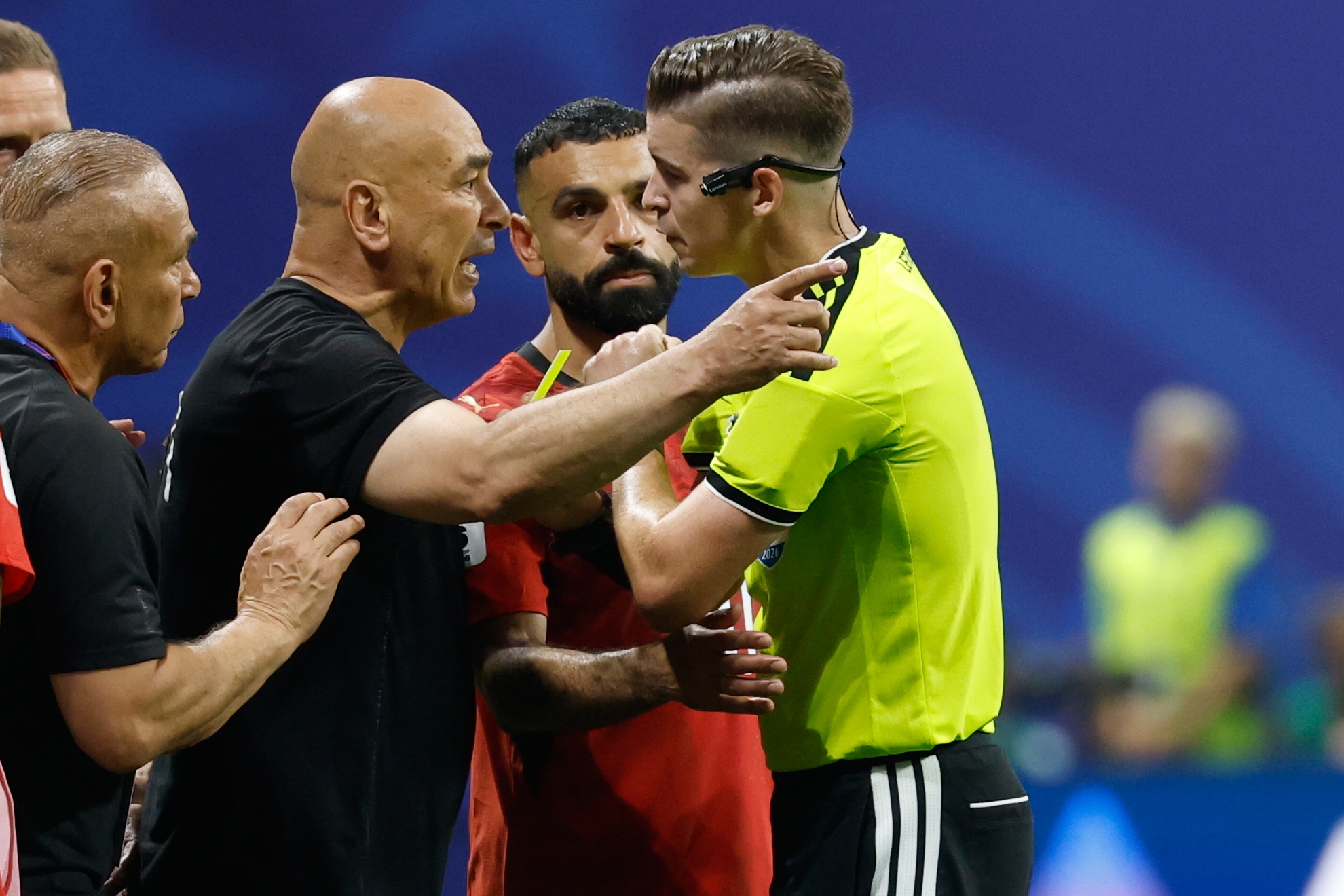
The breakdown of trust in World Cup officiating is not caused by technical failures. It is caused by an impossible promise. When FIFA integrated the Video Assistant Referee (VAR) system into the global game, the governing body implicitly promised fans, players, and coaches a new era of objective perfection. Instead, the current tournament has exposed a bitter reality. Football is an inherently fluid, deeply subjective sport, and trying to govern it with forensic, slow-motion precision has only amplified controversy.
Fans do not trust the system because the system has changed the terms of engagement. It has replaced the human error of a referee with the corporate ambiguity of a video booth. The outrage following Egypt's eliminated goal against Argentina, or the political fallout after Folarin Balogun's red card for the United States against Bosnia and Herzegovina, proves that technology has not settled arguments. It has merely shifted the battlefield.
The Death of Spontaneity and the Rise of Forensic Football
The most immediate casualty of the video review era is the collective emotional release that defines the sport. A goal is scored. The net ripples. The stadium explodes.
Then, everything stops.
This prolonged waiting period has altered the psychological relationship between supporters and the match. Fans inside the stadium are left stranded in a vacuum, staring at a giant screen waiting for lines to be drawn across a pitch. By the time a decision is rendered, the raw, unadulterated joy of the moment has been completely drained.
For a marginal offside call, the technology works with remarkable accuracy. Semi-automated offside systems can pinpoint a stray shoulder blade or a millimeter of boot turf. Yet, this very accuracy feels emotionally hollow. When a goal that looks perfectly fine to the human eye is disallowed because a striker wears a larger boot size than the defender, the spirit of the rule is violated in favor of its literal, computerized text.
- The Offside Paradox: Technically perfect decisions are creating a sense of emotional injustice.
- The Delay Factor: Lengthy reviews kill match momentum and give defensive teams an artificial breathing room.
- The Stadium Disconnect: While television audiences see multiple angles, match-going fans are left in the dark, breeding suspicion.
The Myth of the Clear and Obvious Threshold
If offside calls are a matter of geometry, fouls and handballs remain a matter of philosophy. This is where the structural integrity of VAR completely collapses. The protocol dictates that the video official should only intervene in the case of a clear and obvious error.
Nobody actually knows what that means anymore.
Consider the wildly divergent application of refereeing thresholds across different matches in this World Cup. In Germany's fixture against Ecuador, Leroy Sané’s goal stood despite his teammate Aleksandar Pavlovic catching Pedro Vite with a high boot in the buildup. The VAR team deemed it below the intervention threshold. Conversely, during the high-stakes Round of 16 clash between Argentina and Egypt, Frenchman François Letexier disallowed a crucial Egyptian goal for a marginal, soft contact foul earlier in the phase of play.
This inconsistency proves that multiplying camera angles does not eliminate human bias. Slow-motion replays distort reality. A standard, routine physical tangle looks like a premeditated assault when slowed down to 24 frames per second. Contact that is a natural consequence of two athletes running at full tilt suddenly carries the appearance of intent.
"When you add the fact that the process was misapplied by how VAR was initiated: for contact fouls, you cannot actually utilize the slow motion in the VAR, and they did that," noted political observers weighing in on the United States' exit.
While the administrative critique may miss the finer points of the referee's manual, the sentiment behind it is universal. Fans feel the rules are being bent depending on who is looking at the screen.
Global Parity and the Weighted Whistle
The intense scrutiny on officiating at this World Cup is tied directly to an unprecedented tactical shift in international football. The historical talent gap has completely vanished. The so-called minnows of world football no longer collapse under physical or tactical exhaustion in the 70th minute.
Because sports science, recovery analytics, and tactical video software have been thoroughly democratized, organized underdogs can defend at peak intensity for over 90 minutes. This has resulted in tight, low-scoring, low-margin matches.
Imagine a hypothetical match where a traditional powerhouse plays a deeply organized, defensive side. In the past, the elite team might win 4-1, meaning a missed penalty or a soft yellow card in the first half became a minor footnote. Today, that same match ends 1-0 or 0-0.
In a world of razor-thin margins, every single whistle becomes outcome-determinative. Because VAR is reserved strictly for match-changing moments—red cards, penalties, and goals—its footprint lands exclusively on the scales of destiny. When a match is decided by a single subjective review, fans cannot help but look for conspiracy. The system was supposed to protect small nations from big-team bias. Instead, it has made the inevitable human errors of refereeing look deliberate, calculated, and corporate.
Moving Beyond the Screen
The path forward requires FIFA to abandon the pursuit of an elusive, digital perfection that football cannot support. Technology should serve the referee, not the other way around.
First, the audio between the on-field referee and the VAR bunker must be broadcast live in the stadium and on television, just as it is in rugby and cricket. Transparency kills conspiracy theories. If fans hear a referee explain exactly why they believe a hand was in an unnatural position, they may still disagree with the judgment, but they will understand the process.
Second, slow-motion replays must be banned for assessing the intensity of tackles and contact fouls. Replays should only be viewed at full match speed to determine the true force of an impact. Slow motion should be reserved exclusively for point-of-contact verification, like checking if a foul occurred inside or outside the penalty box.
Football is an imperfect game played by imperfect humans. It cannot be governed by an algorithm. Until FIFA accepts that subjectivity is part of the sport’s DNA, the video booth will continue to be viewed not as a tool for justice, but as an engine of distrust.