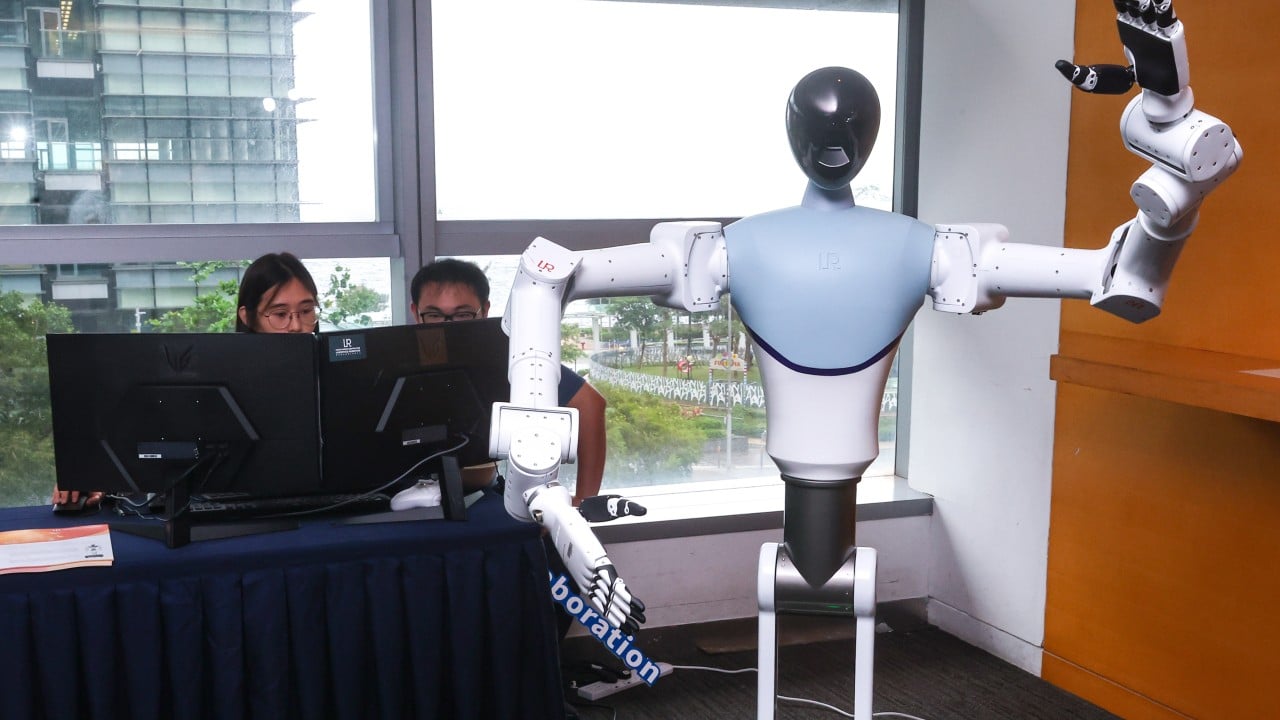
The Chinese University of Hong Kong (CUHK) officially inaugurated the city’s first full-stack Embodied AI Laboratory, attempting to shift the regional tech narrative from purely digital algorithms to physical, hardware-integrated intelligence. Backed by the government’s InnoHK initiative and housed within the Hong Kong Centre for Logistics Robotics (HKCLR), the facility launched alongside an ambitious coalition of 24 industry partners, venture capital firms, and commercial enterprises. The lab's primary mission is to break the barrier between abstract artificial intelligence and physical execution, showcasing a flagship locally developed humanoid dual-arm platform, an AI-powered quadrupedal robot, and a lightweight robotic arm.
Yet, beneath the optics of the ribbon-cutting ceremony lies a deeper, systemic tension threatening the global robotics race. While Silicon Valley pouring billions into OpenAI and Figure AI captures headlines, Hong Kong’s new initiative highlights a critical vulnerability that academic labs worldwide are desperate to solve. They are building highly sophisticated cognitive brains, but the mechanical bodies required to execute those thoughts are still laggy, fragile, and prohibitively expensive. Meanwhile, you can explore similar developments here: The Capital Allocation of Municipal Efficiency: Analyzing Silicon Valley's Gubernatorial Intervention.
The Gap Between Digital Reasoning and Physical Chaos
For the last three years, generative AI has thrived in a frictionless digital vacuum. Large Language Models (LLMs) can write code, draft legal briefs, and generate photorealistic images instantly because their environment is nothing but bits and data. When an AI makes an error in a text document, the cost is a simple backspace.
Embodied AI changes the stakes completely. In the real world, an error means a half-million-dollar humanoid robot loses its balance, falls forward, and crushes its own titanium actuators. The CUHK initiative centers on "full-stack" development, an industry term meaning the lab intends to build both the software brain and the mechanical body simultaneously. This is an immense engineering challenge. To see the full picture, check out the recent report by Ars Technica.
The primary mechanism driving this research is the integration of vision-language-action (VLA) models with reinforcement learning. In a typical digital setup, an LLM processes a command like "clean the table" by breaking it down into text-based steps. In an embodied framework, that text must be instantly converted into spatial geometry, torque values, and constant feedback loops. If a robot reaches for a glass bottle, it cannot just rely on visual data. It needs real-time haptic feedback to determine exactly how many newtons of force are required to lift the glass without shattering it.
The Illusion of Simulation
To bypass the slow, dangerous process of teaching a physical robot how to move in the real world, researchers rely heavily on simulation. CUHK's team utilizes generative world models to create ultra-realistic virtual environments. Inside these digital simulators, a virtual robot can practice climbing stairs, navigating ice, or dodging obstacles millions of times in a matter of hours.
This process, known as sim-to-real transfer, is the foundational pillar of modern legged and humanoid robotics. The robot learns through a mathematical trial-and-error process called reinforcement learning, accumulating rewards for stable motion and penalties for falling.
Once the digital policy is optimized, it is flashed onto the physical robot’s onboard computer.
The reality on the ground is rarely that simple. The transition from simulation to the real world is notoriously imperfect, a phenomenon roboticists call the sim-to-real gap. Virtual environments struggle to accurately replicate the sheer chaos of physical reality. The microscopic layer of dust on a warehouse concrete floor, the subtle degradation of a rubber foot over a four-hour shift, or a sudden draft of wind are variables that physics engines cannot perfectly predict. When the algorithm encounters these unmodeled dynamics, the system can freeze or overcorrect violently.
The Precision Actuator Bottleneck
While CUHK showcased its M1 quadrupedal robot and its dual-arm humanoid platform executing tasks like handling tools and navigating uneven terrain, the broader industrial reality is caught in a severe hardware bottleneck. The bottleneck is not the AI model; it is the actuator.
A humanoid robot requires dozens of high-performance electric actuators to mimic human joints. These components require specialized harmonic drives, frameless torque motors, and high-resolution encoders. Currently, the global supply chain for these high-precision mechanical parts is tightly constrained, concentrated heavily in a few specialized manufacturing hubs in Japan and mainland China.
+------------------+     Simulation Data      +-------------------+
|  Virtual World   | -----------------------> | Digital Policy    |
|  (Physics Engine)|                          | (RL Training)     |
+------------------+                          +-------------------+
         ^                                              |
         | Sim-to-Real Gap                              |
         | (Friction, Wear, Latency)                    v
+------------------+                          +-------------------+
|   Real-World     | <----------------------- | Physical Robot    |
|   Environment    |    Onboard Deployment    | (Hardware/Sensors)|
+------------------+                          +-------------------+
Because academic labs and early-stage startups cannot buy these components in massive automotive-scale volumes, the cost of building a single highly capable humanoid platform remains astronomically high. This reality limits the amount of physical hardware available for testing. If a lab only has two prototype humanoids, their data collection is limited by the physical hours in a day, slowing down progress compared to software-only companies that can scale their testing across thousands of cloud servers simultaneously.
The Commercialization Trap
The ultimate metric of success for the Hong Kong Embodied AI Lab will not be academic papers, but its ability to move technology out of the university and into commercial operations. CUHK has already spun out a venture called Lightyear Robotics Limited to target the logistics and industrial sectors.
This path is fraught with commercial hurdles. The logistics sector operates on razor-thin margins. For a warehouse operator to replace a human worker or a standard automated guided vehicle (AGV) with an embodied AI humanoid, the financial return on investment must be clear and immediate.
- The Cost Problem: Standard warehouse automation, such as conveyor systems and fixed robotic arms, is relatively cheap, predictable, and runs continuously for years with basic maintenance. A humanoid robot introduces immense mechanical complexity, meaning more points of failure, expensive replacement parts, and specialized technicians to fix them.
- The Speed Flaw: Humanoid robots currently move at a fraction of human speed when performing complex manipulation tasks. Watch a state-of-the-art humanoid pick up a box in a lab, and you will see a series of deliberate, hyper-cautious movements. In a fast-paced sorting facility, that lack of speed translates directly to lost revenue.
- The Battery Limit: Heavy limbs and continuous torque calculation require significant power. Most modern humanoids can only operate for one to two hours before requiring a battery swap or a lengthy recharge cycle, severely limiting their utility in 24-hour industrial operations.
The Battle of Form Factors
A fundamental philosophical debate divides the robotics industry, and the new CUHK lab is trying to hedge its bets by developing both quadrupeds and humanoids. The debate centers on a simple question: Does the world actually need humanoid robots?
Advocates argue that because our entire global infrastructure—stairs, door handles, factory workstations, and kitchen counters—was built by humans for humans, a general-purpose robot must be shaped like a human to seamlessly integrate into society.
The counter-argument is deeply practical. Bipedal locomotion is inherently unstable. Keeping a two-legged robot balanced while it lifts a heavy, shifting object requires immense computational power and energy consumption.
Quadrupedal robots, like the lab's M1 platform, offer four points of contact, making them vastly more stable, structurally simpler, and significantly cheaper to manufacture. For industrial inspection, last-mile delivery, and security patrolling, four legs or simple wheels are vastly superior to two.
By building a dual-arm system separately from its legged platforms, CUHK is acknowledging that the immediate future of industrial automation might not be a unified Hollywood-style humanoid. Instead, it will likely be a fragmented ecosystem of specialized machines: wheels for flat warehouse floors, quadrupeds for rugged outdoor terrain, and static dual-arm stations for intricate assembly lines.
Hong Kong's heavy financial commitment to this space is an explicit attempt to leverage its unique position as a bridge between mainland China’s massive supply chain and global academic networks. The success of the Embodied AI Lab will depend entirely on whether its software can break through the limitations of current mechanical engineering, transforming these expensive university showpieces into reliable, self-correcting tools capable of surviving the unpredictable wear and tear of the real world.