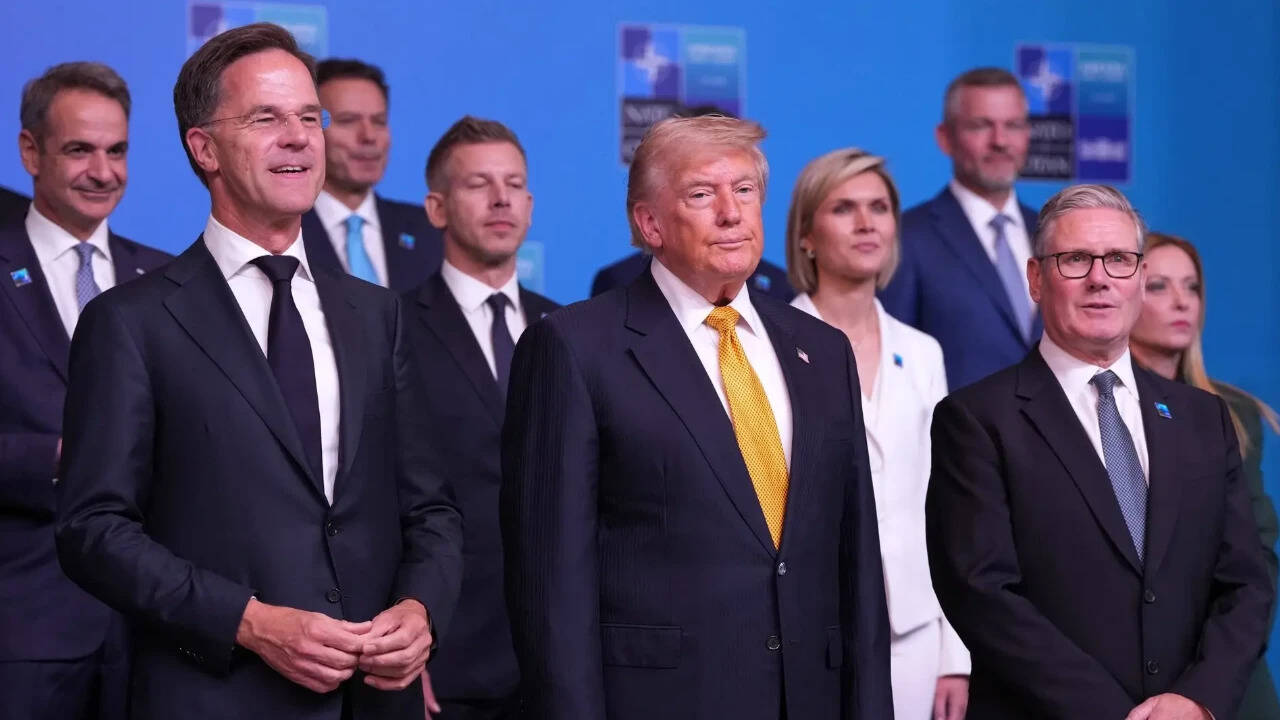
The strategic friction between the United States and its European allies has shifted from structural budget disputes to a highly transactional calculation of mutual leverage. At the North Atlantic Treaty Organization (NATO) summit in Ankara, the public reconciliation between U.S. President Donald Trump and European heads of state reveals a fundamental behavioral modification in transatlantic diplomacy. The core mechanism driving this change is a explicit trade-off: Washington demands institutional legitimacy for its unilateral military actions against Iran, while European capitals sacrifice strategic autonomy to guarantee the survival of the Article 5 collective defense framework.
Understanding this operational shift requires separating performative rhetoric from structural policy decisions. The superficial language of "unity" and "love" observed during closed-door sessions obscures a highly quantitative realignment of burdens, expenditures, and sovereign liabilities.
The Transactional Exchange Model
The stabilization of the alliance relies on a clear, bilateral exchange mechanism. The United States provides a nuclear umbrella and conventional deterrence; in return, European members provide diplomatic cover, operational basing rights, and capital outlays for American defense manufacturing.
[European Procurement Commitments ($50B+)] ---> [U.S. Defense Industrial Base]
                                                        |
                                                        v
[Strategic Endorsement of Iran Strikes] ---------> [U.S. Geopolitical Legitimacy]
                                                        |
                                                        v
[Reaffirmation of Article 5 Commitments] <-------- [Transatlantic Security Guarantee]
This exchange operates through three primary mechanisms:
1. The Validation of Unilateral Action
The immediate catalyst for European compliance was the decision by NATO Secretary General Mark Rutte to declare the recent U.S. Central Command (CENTCOM) strikes on Iranian missile, drone, and coastal surveillance infrastructure as "absolutely necessary." By framing these strikes as a direct penalty for Iranian violations of the June 17 interim ceasefire—specifically the drone and projectile attacks on commercial vessels in the Strait of Hormuz—Rutte integrated unilateral American military action into the broader framework of international maritime security. This endorsement minimizes the diplomatic isolation of the United States, neutralizing European resistance to a conflict initiated without prior alliance-wide consultation.
2. Accelerated Burden-Shifting Metrics
The financial structural adjustment of the alliance has accelerated. European allies and Canada announced over $50 billion in new defense procurements alongside a joint pledge of €70 billion ($80 billion) in military assistance to Ukraine for 2026. This capital injection directly addresses the long-standing U.S. critique of European defense under-investment. By tying these procurements to the stabilization of the transatlantic theater, European states are actively offsetting the fiscal and operational demands that Washington faces globally.
3. The Weaponization of Interoperability
A critical, unpublicized dimension of the Ankara discussions involves the continuity of supply chains. Sources familiar with the closed-door proceedings indicate that the United States remains prepared to sell advanced weaponry to NATO members regardless of their operational deployment profiles. This policy maximizes the output capacity of the U.S. defense industrial base while entrenching European dependence on American military technology, creating a long-term structural anchor that outlasts short-term political friction.
The Strategic Escalation Calculus in the Persian Gulf
While the Ankara summit established a temporary diplomatic equilibrium in Europe, it simultaneously heightened the stakes of the conflict in West Asia. The underlying logic of U.S. actions against Iran reflects a strategy of asymmetric escalation control, which now clashes with Tehran's doctrine of proportional retaliation.
The breakdown of the June 17 memorandum of understanding follows a predictable escalatory feedback loop:
$$E_{t+1} = f(C_t, S_t)$$
Where escalation ($E$) is a function of chokepoint disruption ($C$) and retaliatory kinetic strikes ($S$). The operational variables are strictly defined by geography and infrastructure.
The Chokepoint Bottleneck
The Strait of Hormuz represents a critical vulnerability for the global energy supply chain. Recent kinetic operations targeting commercial vessels—including a drone strike on a Panama-flagged tanker—demonstrate Iran's capability to impose immediate economic costs on global markets. Shipping data confirms the operational impact of this risk: at least four major oil and gas tankers reversed transit paths rather than risk the passage. The resulting spike in crude prices and the subsequent decline in global equities demonstrate that tactical actions in this narrow waterway yield immediate global macroeconomic consequences.
The Target Selection Matrix
The U.S. military response, consisting of precision strikes against anti-ship cruise missile batteries, drone launch facilities, and Islamic Revolutionary Guard Corps (IRGC) naval assets, aims to degrade Iran’s capacity for maritime denial without triggering a full-scale regional land war. However, the announcement by the White House that the interim accord is effectively "over"—coupled with explicit threats to seize Kharg Island, which processes roughly 90% of Iranian crude exports—signals a shift toward targeting civilian and economic infrastructure.
The Retaliation Loop
Tehran’s response establishes a secondary front. By targeting U.S. military installations in Bahrain and Kuwait via drone and missile salvos, Iran is attempting to test the resilience of regional host nations. The condemnation of these attacks by Bahraini and Kuwaiti authorities underlines a secondary risk: the potential horizontal expansion of the conflict into a broader regional confrontation, drawing in peripheral states and forcing the reallocation of U.S. defensive assets like Patriot and THAAD missile batteries.
Institutional Flattery as a Diplomatic Tool
The diplomatic management of these twin crises reveals a distinct operational approach employed by NATO leadership. Facing explicit U.S. demands for "loyalty" over fiscal contributions, Secretary General Rutte has replaced traditional consensus-driven diplomacy with targeted transactional flattery.
This approach uses specific operational data points to disarm American criticism. During bilateral meetings, NATO leadership highlighted that European bases supported up to 5,000 U.S. military sorties prior to the April ceasefire, demonstrating the indispensable value of European geographic access for American power projection. Furthermore, presenting data showing a $300 billion backlog in European orders for American military hardware reframes NATO not as a financial drain on Washington, but as a major driver of domestic manufacturing jobs within the United States.
+--------------------------------------------------------------+
|               TRANSACTIONAL DIPLOMACY MATRIX                 |
+--------------------------------------------------------------+
| Operational Assets Provided:   | Commercial Incentives:      |
| • 5,000+ European Sorties     | • $300B Weaponry Backlog    |
| • Bilateral Basing Rights     | • $50B New Procurements     |
+--------------------------------------------------------------+
|                     Strategic Outcome:                       |
|      Preservation of the Article 5 Deterrence Umbrella       |
+--------------------------------------------------------------+
This data-driven reassurance strategy has successfully maintained the core U.S. commitment to collective defense. The final summit declaration explicitly reaffirmed the "ironclad commitment" to Article 5. Yet, the systemic vulnerability remains clear: the credibility of the transatlantic deterrent now depends heavily on managing the personal political requirements of the U.S. executive branch.
Systemic Risks and Operational Constraints
The strategic compromises made in Ankara introduce three critical vulnerabilities into the international security architecture:
The Deterrence Credibility Gap: The Pentagon's recent decision to reduce the baseline allocation of warships, aircraft, and personnel earmarked for European contingencies degrades the structural readiness of the alliance. This reduction occurs exactly as external state actors increase gray-zone operations, including provocative drone incursions near European military facilities. The gap between verbal commitments to Article 5 and actual troop levels creates an opening for tactical miscalculations along NATO's eastern flank.
✨ Don't miss: The Metal Canopy Over MoscowThe Asymmetric Sanctions Vulnerability: Revoking Iranian oil export licenses and threatening key energy infrastructure risks forcing Iran into a corner. Deprived of formal economic channels, hard-line factions within the Iranian leadership gain leverage over pragmatists who favor negotiated settlements. This shift increases the probability of asymmetric countermeasures, such as cyber warfare against Western financial infrastructure or coordinated sabotage of regional desalination plants.
The Fragmentation of Maritime Security: While Pakistan and Qatar attempt to mediate a return to safe passage frameworks, the operational reality is defined by fragmentation. If commercial shipping companies conclude that the alliance cannot guarantee freedom of navigation without triggering escalatory kinetic cycles, the permanent rerouting of maritime traffic around the Cape of Good Hope will become structurally embedded. This change would permanently increase global shipping costs and disrupt just-in-time manufacturing chains.
Strategic Recommendation
The optimal path forward for corporate and state actors requires preparing for prolonged volatility in energy markets and international shipping corridors. Organizations must decouple their logistics from high-risk maritime chokepoints and build redundancy into their supply chains.
Rather than expecting a return to a stable ceasefire, strategic planning must assume a continuous cycle of targeted kinetic disruptions and retaliatory strikes in the Persian Gulf. This state of constant tension will maintain elevated risk premiums for commodities and require European states to steadily increase their independent defense capabilities. Transatlantic solidarity is no longer an automated, values-based certainty; it is a transactional arrangement that requires continuous, capital-intensive maintenance by its European members.
For a deeper analysis of the operational realities on the ground during this summit, consider reviewing the Ankara Summit Security Briefing, which provides direct visual documentation of the escalating naval countermeasures and missile deployments affecting these critical global shipping channels.