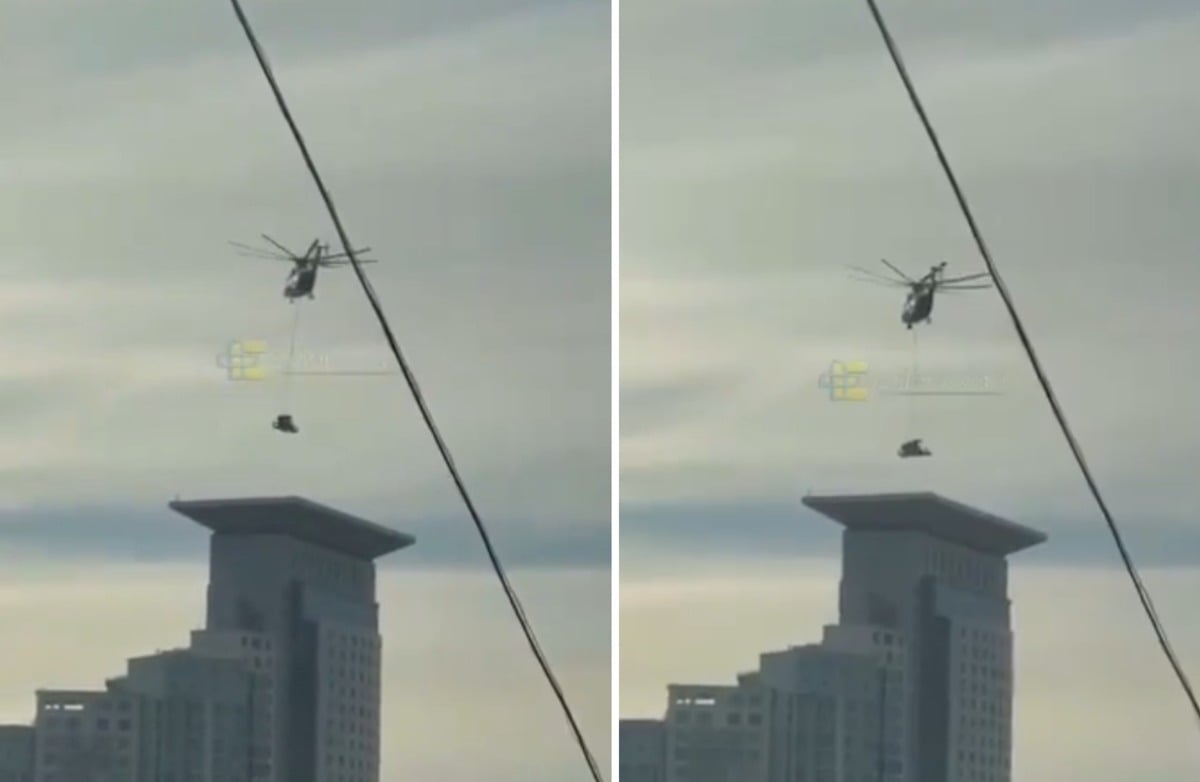
A commuter stepping off the metro at Taganskaya Station glances up, squinting against the pale morning sun. Beyond the familiar, imposing facade of the heavy Stalinist architecture, something new disrupts the skyline. It sits atop an administrative building, harsh and angular against the soft morning clouds. A boxy, olive-drab shape. Two long, thin barrels point toward the stratosphere, flanked by the flat face of a radar dish slowly panning across the horizon.
Most people walk past. They have groceries to buy, shifts to start, lives to live. But the metal shape remains, watching.
This is the Pantsir-S1. To military analysts, it is a self-propelled, medium-range surface-to-air missile and anti-aircraft artillery system. To the people walking the streets below, it is a silent, terrifying reminder that the frontline is no longer somewhere else. It is right above their heads.
The appearance of these air defense systems on the rooftops of the Russian capital marks a profound shift in the geography of modern warfare. For decades, air defense was something hidden in the forests, deployed on the flat horizons of distant steppes, or stationed along heavily fortified borders. It was invisible. Now, it occupies the same urban space as office workers, coffee shops, and apartment complexes.
To understand why a multi-million-dollar military asset is sitting on a roof in the middle of a dense metropolis, you have to understand the changing nature of the threat. The sky used to belong to massive, expensive machines. Jets. Bombers. Helicopters. Heavy, roaring metal that required advanced radar networks just to track.
Not anymore.
Today, the greatest threat to a capital city can be built in a garage. It can weigh less than a suitcase. It can fly low, hugging the contours of the terrain, slipping beneath the traditional radar net like a ghost. Drones have democratized aerial warfare, turning the sky into a chaotic, unpredictable space where cheap, exploding plastic can bypass conventional defenses.
Consider the logistical nightmare this creates for a defender. If an adversary launches a wave of loitering munitions—often called kamikaze drones—toward a city, how do you stop them? You cannot easily use long-range systems like the S-400. Those systems are designed to swat down supersonic fighter jets hundreds of miles away. Firing an S-400 missile at a small, low-flying drone is the tactical equivalent of trying to kill a mosquito with a sniper rifle. It is ruinously expensive, and worse, it is ineffective. The missile might simply fly right past the tiny target.
That is where the Pantsir comes in.
The Last Line of Defense
The Pantsir was built for the ugly, close-quarters brawl of short-range air defense. It is a hybrid weapon, combining two distinct methods of destruction. First, it carries up to twelve radio-command-guided missiles designed to intercept targets up to twenty kilometers away. If those fail, or if the target gets too close, the system switches to its twin 30mm automatic cannons.
These guns are brutal. They can fire up to 5,000 rounds per minute, creating a literal wall of shredded lead in the sky.
When you see a Pantsir bolted to a specially constructed platform on top of a Moscow ministry building, you are looking at a desperate insurance policy. It is the final layer of a dense, nested defense network. If a drone evades the electronic warfare jammers at the border, slips past the fighter patrols, and navigates around the outer missile rings, the rooftop Pantsir is the last line of defense before the weapon hits its target.
But placing these systems in a crowded city center introduces a terrifying calculus.
Every missile that goes up must eventually come down. Every 30mm shell fired into the sky that misses its target will obey the laws of gravity. In a traditional battlefield, missed rounds fall harmlessly into the mud or the trees. In a city of twelve million people, those rounds fall on rooftops, through apartment windows, and onto crowded streets.
There is an inherent tension in urban air defense. To protect a building of high strategic importance—a ministry, a command center, a communications hub—the state must accept the risk that the defense process itself could cause civilian casualties. The fragments of a destroyed drone, mixed with the shrapnel of an interceptor missile, create a deadly rain that falls indiscriminately over a radius of several city blocks.
The Machinery of Anxiety
The physical installation of these systems is an engineering feat born of urgency. A Pantsir system typically weighs up to thirty tons when mounted on its standard combat vehicle. You cannot simply drive it onto a roof.
Instead, giant cranes must block off city streets in the dead of night. Crews work under the cover of darkness to hoist the massive tracking radars and weapon stations onto reinforced concrete platforms constructed on top of the buildings. The structures themselves must be surveyed to ensure they can withstand not just the static weight of the system, but the violent, vibrating recoil of the 30mm cannons firing in bursts.
The result is a surreal juxtaposition of the domestic and the militarized.
Imagine looking out your kitchen window on the tenth floor and seeing a crew of soldiers in camouflage maintaining a missile launcher twenty yards away. You hear the low, constant hum of the system's generator. You watch the radar dish spin, over and over, searching for a threat that you cannot see.
This changes the psychological fabric of a city. Security is no longer an abstract concept managed by professional soldiers somewhere far away. It is loud. It is visible. It occupies the skyline. Every time a resident looks up to check the weather, they are confronted with the reality that their city is a potential target.
The state attempts to project an aura of total control through these deployments. The message is clear: We are ready. We can protect you. But the underlying subtext is far more unsettling: The threat is close enough that we need to do this.
The Geometry of the Modern Sky
The drone war has forced a reassessment of how military forces protect critical infrastructure. In the past, defending a city meant holding a line on a map. Today, the line is three-dimensional. It is a sphere.
This geometry favors the attacker. A drone swarm can be launched from multiple directions simultaneously, overwhelming the tracking capabilities of a single radar system. The Pantsir is highly capable, featuring an phased-array radar that can track dozens of targets at once, but it has limits. It can run out of ammunition. It can be distracted by decoys.
This creates a high-stakes game of technological cat-and-mouse. Attackers use carbon fiber and plastic to reduce the radar cross-section of their drones, making them appear as small as a bird on a monitor. Defenders tweak their software algorithms, trying to teach the radar how to tell the difference between a flock of migratory geese and an incoming payload of high explosives.
It is a exhausting, invisible war fought in the electromagnetic spectrum, punctuated by sudden, violent bursts of kinetic activity.
When the system does engage, it happens in seconds. The radar locks on. The automated fire control system calculates the intercept trajectory. The missiles launch with a deafening roar, leaving a thick trail of white smoke drifting between the skyscrapers. If the guns engage, the sound is like tearing canvas, a deafening roar that shatters windows and echoes through the concrete canyons of the city.
The Normalization of the Abnormal
Human beings possess an incredible, sometimes frightening capacity to adapt to the intolerable.
A week after the air defense systems appear on the roofs, the residents of Moscow stop staring. The office workers in the buildings opposite the launchers no longer point out the window. The children playing in the courtyards below don't interrupt their games when the radar dish shifts its angle.
The extraordinary becomes ordinary. The machinery of war blends into the background of urban life, becoming just another piece of city infrastructure, no more remarkable than a cell phone tower or an air conditioning unit.
But the normalization is an illusion. The tension remains, buried just beneath the surface of the daily routine. It manifests in the way people glance at the sky when they hear a sudden, loud noise—a car backfiring, a firework, a low-flying commercial jet. It is a collective, unspoken anxiety that settles over the population.
The metal canopy over Moscow is not just a collection of missiles and radar dishes. It is a monument to the end of civilian distance from conflict. It proves that in the modern era, the battlefield is wherever the drone can fly, and the frontline is wherever you happen to look up.