The dust gets into everything. It settles in the creases of your knuckles, coats the back of your throat, and turns the simple act of swallowing into a reminder of what is missing.
On the slopes of Mount Boutmezguida, a peak rising nearly 4,000 feet above the arid landscape of southwest Morocco, water is not something that flows from a tap. It is a daily negotiation with distance and gravity. For decades, this negotiation fell squarely on the shoulders of women and young girls.
Every morning, before the sun could burn away the cool mountain air, they would walk. They walked for hours, leading donkeys down treacherous, rocky paths to distant, failing wells. The water they brought back was often brackish, heavy with sediment, and carrying the quiet threat of waterborne disease. It was a life measured in jerrycans and miles. Education was a luxury that surrendered to the immediate, desperate need for hydration.
Then came the nets.
The Ocean in the Air
To understand how a community trapped in a drought-stricken region found water, you have to look at the sky. Southwest Morocco is flanked by the Atlantic Ocean and the Sahara Desert. This collision of intense heat and vast moisture creates a unique meteorological phenomenon: dense, heavy fog that blankets the mountains for roughly half the year.
For generations, this fog was viewed as a nuisance. It obscured vision, chilled the bones, and mocked the parched earth below by carrying millions of gallons of water just out of reach. It was a tantalizing tease of moisture that refused to fall as rain.
The breakthrough did not come from an expensive, high-energy desalination plant or a massive pipeline project. It came from a deceptively simple technology that mimics nature.
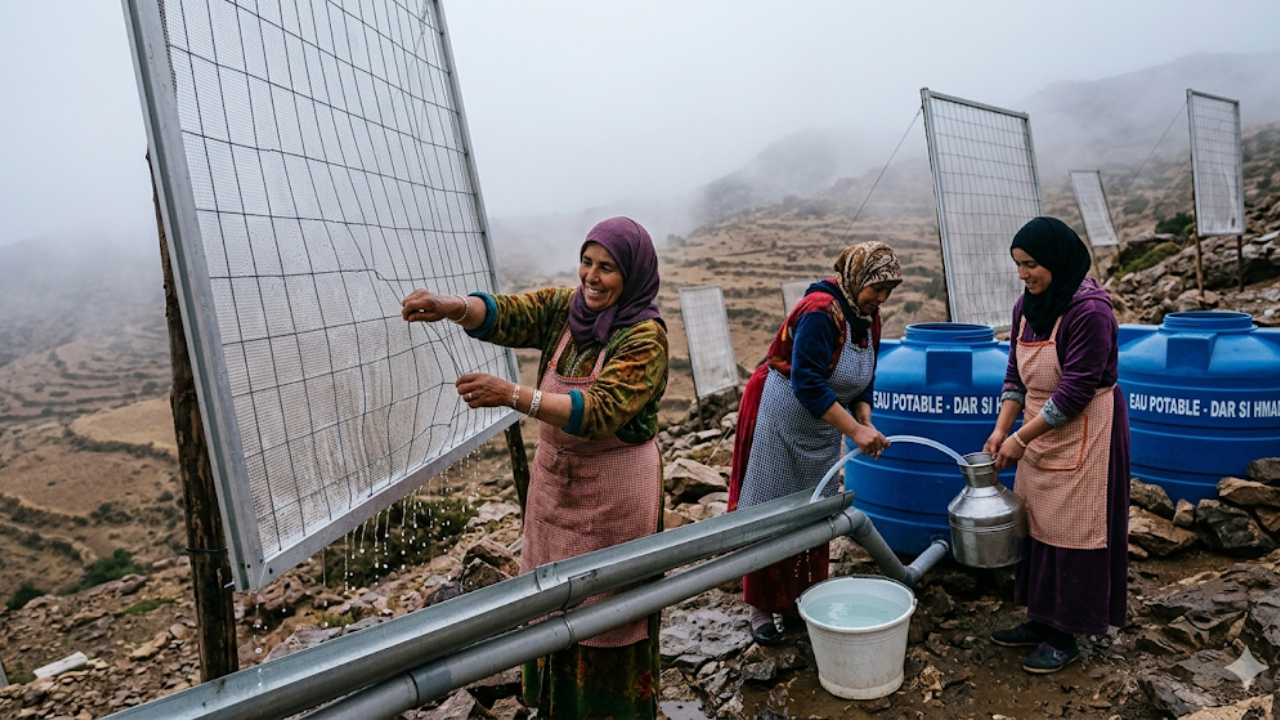
The concept of fog harvesting relies on specialized, vertical mesh nets suspended between steel poles. As the wind drives the dense fog through the mesh, microscopic droplets of water catch on the polypropylene fibers. These tiny droplets coalesce, growing larger and heavier, until gravity takes over. They slide down the netting into a system of gutters, pipes, and filtration units, eventually collecting in massive storage reservoirs at the base of the mountain.
It is a passive system. No electricity. No massive carbon footprint. Just engineering aligned with the geography of the wind.
The Physics of a Miracle
The scale of this transition is staggering, yet the mechanics are beautifully straightforward. The project, pioneered by a local non-profit organization called Dar Si Hmad, utilizes hundreds of square meters of specialized netting developed in partnership with German engineers.
Consider the mathematics of the mist. A single square meter of this advanced mesh can harvest up to 22 liters of pure water on a high-fog day. When scaled across vast arrays on the mountaintop, the system generates tens of thousands of liters of drinking water daily.
But collecting the water was only half the battle. The true genius of the initiative lay in the distribution.
Instead of requiring the villagers to hike up the mountain to the reservoirs, the project team laid miles of pipelines connecting the mountaintop system directly to the homes of over a dozen Berber villages. For the first time in history, the indigenous Amazigh families of these remote communities had access to clean, running water inside their own walls.
The water is remarkably pure. Because it is harvested directly from the atmosphere before it ever touches the contaminated ground, it requires minimal filtration to be perfectly safe for consumption. A simple UV treatment and a basic filtration system ensure that the water flowing into the village homes meets strict safety standards.
The Architecture of Trust
Technological triumphs mean nothing if the community rejects them. In the early phases of the project, skepticism ran deep. Water from the sky, caught in nets? It sounded like sorcery, or worse, a fleeting promise from outsiders that would break down and leave the villages more vulnerable than before.
This is where the human architecture of the project proved superior to the engineering. The organizers did not simply install the nets and leave a instruction manual. They handed the keys of the operation over to the women who had spent their lives carrying the water.
A committee of local women was trained to manage the infrastructure. They learned how to monitor the pipeline pressures, calculate usage rates, and handle the mobile-app-based payment system used to fund the ongoing maintenance of the grid. By charging a nominal, highly subsidized fee for the water, the community established a self-sustaining utility that did not rely on perpetual charity.
This shift altered the social fabric of the villages. The women, previously marginalized by the grueling physical labor of water collection, became the stewards of their community’s most vital resource. They were no longer just survivors of the drought; they were managers of the solution.
What Happens When the Burdens Fall Away
The arrival of running water triggers a profound domino effect within a community. When you subtract three to four hours of grueling manual labor from a woman's daily routine, you unlock an entirely new economy of time.
Consider what happens next:
- Educational Renewal: Young girls, who previously skipped school to assist their mothers with water collection, experienced a massive spike in school attendance.
- Economic Independence: Women began using their newly acquired free time to cultivate argan oil cooperatives, weaving traditional textiles, and generating independent income for their families.
- Health Stabilization: Cases of waterborne illnesses plummeted. Skin conditions eased, and the chronic back and joint pain associated with carrying 40-pound jerrycans across mountain terrain began to fade.
The environmental benefits are equally profound. With a steady supply of clean water, families no longer need to chop down local argan trees to burn for firewood to boil and purify contaminated well water. The fragile ecosystem of the anti-Atlas region receives a chance to breathe, recover, and stabilize.
A Blueprint for a Thirstier Planet
The success in southwest Morocco is no longer a localized anomaly. It has become a global proof of concept. As climate change accelerates desertification and traditional groundwater reserves dry up across the globe, the lessons learned on Mount Boutmezguida are being exported to other arid, fog-heavy regions in Chile, Peru, and South Africa.
It forces us to redefine what we view as a resource. We are conditioned to look down for water—to drill deeper wells, build larger dams, and pump from depleting aquifers. This project proves that sometimes, the solution requires us to look up.
The fog still rolls across the peaks of the Anti-Atlas mountains every morning, thick and silent. But it no longer signals a cold, damp start to a day of heavy lifting. Now, as the mist presses against the dark mesh nets, a soft, steady dripping echoes through the pipes—the sound of a community claiming its future from the air.