Rain in Cardiff does not fall; it sweeps sideways off the Bristol Channel, blurring the glass facade of the Senedd until the parliament building looks less like a seat of government and more like a stranded ship. On mornings like this, the flags outside provide the only violent burst of color against the grey Welsh sky.
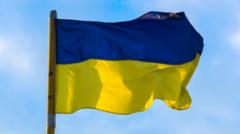
For over two years, the blue and yellow of Ukraine has snapped in the wind alongside the Welsh dragon. It is a sight that most passersby have absorbed into the background architecture of their daily commute. They glance up, perhaps feel a fleeting, quiet knot of empathy for a war thousands of miles away, and then bury their faces back into their scarves.
But inside the warm, slate-lined corridors of power, that same piece of cloth has become a lightning rod for a furious debate about what, exactly, a nation’s parliament is supposed to do.
The row erupted when the Reform UK group within the Welsh Parliament officially called for the removal of the Ukrainian flag. Their argument was not delivered with a hushed whisper, but with the sharp, calculated strike of a political gavel. They labeled the continuous flying of the foreign standard as nothing more than "virtue signaling."
This is not a story about international diplomacy. It is a story about the finite nature of human attention, the theater of modern politics, and the quiet frustration of a public wondering why their leaders seem more adept at choreography than construction.
The Choreography of Compassion
Walk through any capital city today and you will see a landscape of symbols. We paint crosswalks, light up monuments in neon hues, and pin ribbons to lapels. It is a visual language designed to show the world that we care.
But care is an active verb.
The Reform MSs (Members of the Senedd) argued that a parliament building should reservedly fly the flags of the nation it represents, and those alone. To hoist another country's flag indefinitely, they suggested, is to engage in a form of moral grandstanding that costs nothing but yields a high return in political self-congratulation. It is an easy win. You pull a halyard, a flag rises, and suddenly you are on the right side of history.
Meanwhile, the real, grinding work of governance sits in trays on mahogany desks, gathering dust.
Consider a hypothetical citizen. Let’s call her Elen. She lives in a valley town just forty minutes north of the Senedd's gleaming glass roof. Elen’s grandmother has been waiting fourteen months for a hip replacement, living in a state of constant, dull agony. Elen's local school is struggling with a crumbling budget, and the trains she relies on to get to work are cancelled with a predictability that has ceased to be funny.
When Elen sees the Welsh government debating the geopolitical significance of a flagpole, a cynicism takes root. It is not that she lacks empathy for the people of Kyiv or Kharkiv. She has likely donated blankets or tucked a five-pound note into a charity bucket at her local supermarket.
Her frustration stems from a deeper, more unsettling realization: the symbols are flourishing while the substance is failing.
The Anatomy of an Easy Gesture
Why do politicians gravitate toward the symbolic? Because the alternative is incredibly difficult.
Fixing the Welsh National Health Service cannot be achieved with a press release. It requires years of grueling legislative labor, structural overhauls, budget reallocations, and the political bravery to make unpopular decisions. It is a messy, unglamorous process that rarely looks good on an evening news broadcast.
A flag, however, is photogenic. It requires no committee meetings, no treasury sign-offs, and no accountability if things go wrong.
When Reform UK challenged the presence of the flag, the backlash from opposing parties was swift and predictable. Accusations of callousness and a lack of international solidarity were tossed across the chamber. The debate quickly devolved into a familiar tribal skirmish, where one side claimed the moral high ground and the other claimed the mantle of pragmatic common sense.
But the real problem lies elsewhere. By focusing the national conversation on a piece of fabric, both sides managed to avoid talking about the things that actually dictate the quality of life in Wales. The flag became a convenient shield, protecting politicians from the uncomfortable scrutiny of their own track records.
It is a pattern we see repeated across western democracies. We are trapped in an era of performative governance, where the expression of an opinion is treated as the equivalent of an achievement. We measure our leaders by the intensity of their empathy rather than the efficacy of their policies.
The Weight of the Dragon
There is a historical irony to this debate that shouldn't be overlooked. For centuries, the Welsh language and identity were suppressed, pushed to the margins by a larger, more dominant neighbor. The establishment of the Senedd in 1999 was supposed to be the culmination of a long, arduous journey toward self-determination. It was a space where the unique challenges of Wales could finally be addressed by people who lived them.
The red dragon flying over Cardiff Bay is not just a decoration; it is a hard-won receipt for a century of political struggle.
When you place another nation’s flag on an equal footing for an indefinite period, you inadvertently dilute the specific purpose of that institution. The Senedd was not built to be a mini-United Nations. It was built to ensure that the roads in Powys are paved, the schools in Swansea are staffed, and the hospitals in Wrexham can care for the sick.
When a parliament takes on the mantle of global moral arbiter, it often does so at the expense of its domestic duties. It is far easier to condemn aggression on the world stage than it is to fix the social care crisis in the South Wales Valleys. One requires a righteous speech; the other requires money, patience, and bureaucratic genius.
The argument put forward by Reform UK tapped into a growing, unspoken sentiment among a segment of the electorate: the feeling of being left behind by an elite that is looking at the horizon rather than the street beneath their feet.
The View from the Street
If you stand outside the Senedd long enough, the wind eventually forces you to move. The politicians leave the chamber, stepping into waiting cars that whisk them away to media studios or constituency offices. The flags continue to flap, oblivious to the speeches made in their honor or their detriment.
The debate over the Ukrainian flag is not an isolated incident of political pettiness. It is a symptom of a deeper malaise in our public life, a moment where the theater of politics collided head-on with the reality of governance.
Tomorrow, the rain will likely continue to fall on Cardiff Bay. The blue and yellow fabric will soak through, growing heavy and still against the pole, before the wind catches it again. Inside, the debates will rage on, words bouncing off the Welsh oak and glass, while outside, the real world waits for something more substantial than a gesture.


