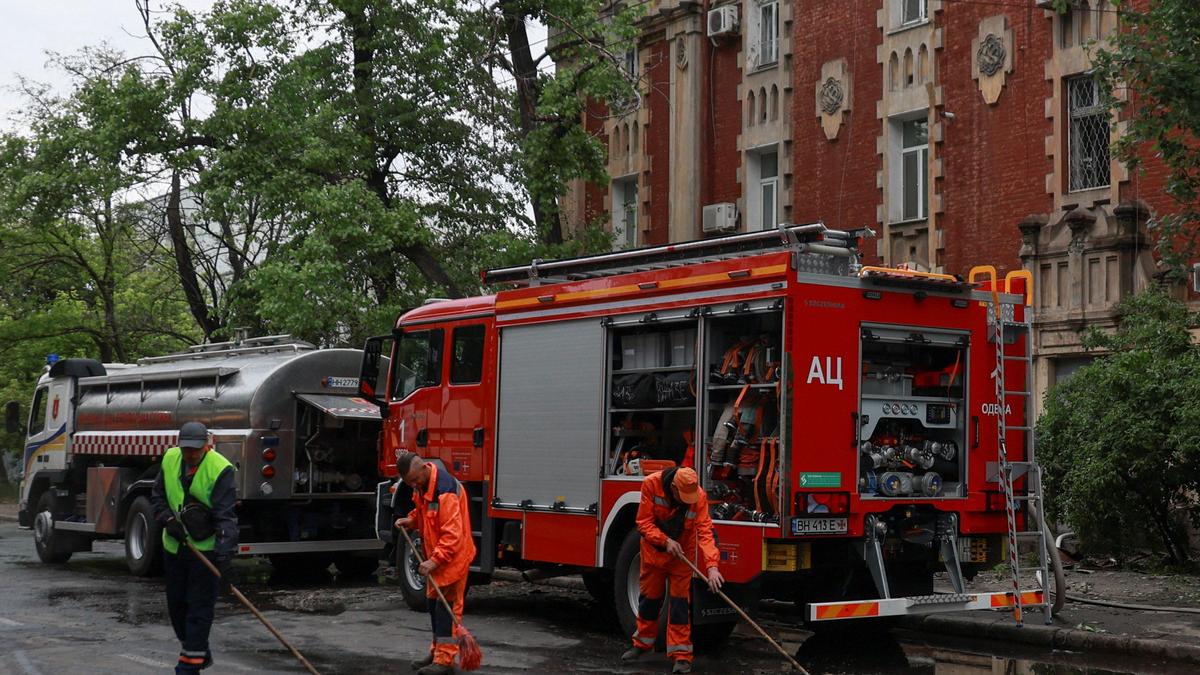
Mainstream newsrooms are running the exact same headline they have used for four years. "More than 30 wounded in Russian attacks on Ukraine overnight." They tally the casualties. They photograph the shattered brickwork of an apartment block. They record the statements of local officials condemning the brutality.
It is a comfortable, predictable narrative formula. It treats an industrial air war like a series of isolated, tragic hate crimes.
But if you are analyzing this conflict through the lens of pure emotional outrage, you are asking the wrong questions entirely. You are mistaking the tragic, localized fallout for the actual strategic objective.
The media focuses on the 30 wounded because civilian blood generates clicks. They ignore the hundreds of cheap Shahed drones and decoys that forced Ukraine to burn millions of dollars in Western-supplied interceptor missiles over those same 24 hours. They miss the macro-level attrition strategy. Russia is not launching hundreds of long-range weapons across 14 regions just to terrify a suburb. They are doing it to empty Ukraine’s air defense magazines before the summer.
The Economics of Asymmetric Attrition
I have spent years analyzing defense procurement and military logistical chains. If there is one thing that becomes obvious when you look at the raw data, it is that modern warfare is an exercise in accounting. The side that manages its balance sheet better wins.
When Russia unloads an overnight barrage consisting of nearly 800 drones and dozens of cruise and ballistic missiles, the Western media treats every missile that gets shot down as a total victory for Ukraine. This is mathematically illiterate.
Consider the basic unit economics of the current air defense battle:
| Weapon Type | Estimated Production Cost (Russia) | Interceptor Cost (Ukraine / West) | Cost Ratio |
|---|---|---|---|
| Shahed-136 Drone / Decoy | $20,000 - $40,000 | $1,000,000 - $4,000,000 (NASAMS/Patriot) | Up to 1:200 |
| Kh-101 Cruise Missile | $13,000,000 | $2,000,000 - $4,000,000 (PAC-3) | ~3:1 |
| Iskander-M Ballistic | $3,000,000 | $4,000,000+ (Two Interceptors) | ~1:2 |
Look at those numbers closely. Every time a $30,000 Iranian-designed loitering munition coaxes a million-dollar Western missile out of its launch canister, the Kremlin wins a financial and industrial victory. It does not matter if the drone hits its target or gets blown to pieces over Kyiv. The interception itself is the utility.
By reporting solely on the human toll—the dozens wounded, the damaged civilian infrastructure—the media creates a false impression of a failed Russian operation. In reality, Russia's defense industry has shifted to a permanent wartime footing, churning out cheap mass-produced hardware while the West struggles with sclerotic manufacturing lines for highly complex interceptors.
Dismantling the Low Stock Myth
For three years, defense pundits have claimed that Russia is running out of missiles. "They are down to their last 10%," we were told in late 2022. "They are pulling microchips out of washing machines," they claimed in 2023.
The data from recent campaigns tells a completely different story. The UN Human Rights Monitoring Mission in Ukraine recently noted that civilian casualties from long-range strikes in early 2026 are actually higher than in the same period over the last three years. This isn't the behavior of an army running dry. It is the behavior of a state that successfully bypassed Western sanctions by creating domestic supply chains and establishing deep manufacturing dependencies with foreign partners.
Imagine a scenario where a corporate manager tells you a competitor is about to go bankrupt, yet that competitor keeps lowering prices and doubling production output. You would fire your manager for bad intelligence. Yet, Western audiences continue to consume the narrative that Moscow’s air campaign is a desperate, unsustainable spasm.
The hard truth nobody wants to admit is that Russia has achieved an economy of scale in long-range precision strike assets that the West did not anticipate.
The Fatal Flaw in Proportional Retaliation
Ukraine is not staying passive. Recent reports confirm that Kyiv launched one of its largest drone strikes of the war, sending hundreds of drones into 14 Russian regions, including Moscow.
The media frames this as a triumphant evening of the score. "Ukraine strikes back," the chyrons read.
But this symmetry is an illusion. Ukraine’s domestic drone production is an incredible feat of engineering and volunteer willpower. But it relies heavily on fragmented, decentralized workshops and erratic western financial aid cycles. Russia’s air defense grid, despite its gaps, is deeply layered and backed by a state that treats human replenishment as a limitless resource.
When Ukraine strikes a refinery or a military airfield deep inside Russia, it inflicts genuine tactical damage. But it does not alter the fundamental asymmetry of the war of attrition. A few dozen casualties in the Moscow region do not force the Kremlin to rethink its grand strategy; it merely provides the state apparatus with domestic propaganda to justify the next wave of mobilization.
Stop Asking if the Air Defense Worked
The standard "People Also Ask" query after an overnight strike is always some variation of: How effective is Ukraine's air defense?
This is the wrong question. It assumes efficiency is measured by the shoot-down rate. If Ukraine shoots down 90% of an incoming wave, the press declares it a resounding success.
The brutal, honest question we should be asking is: How many interceptors does Ukraine have left, and how fast can NATO replace them?
If a battery shoots down 18 out of 20 cruise missiles but fires its last remaining missiles to do so, that battery is now useless. The air space is open. The next wave will achieve a 0% shoot-down rate.
By focusing on the immediate daily survival of cities like Kyiv, we ignore the fact that air defense assets are being slowly pulled away from the front lines to protect civilian centers. This leaves frontline Ukrainian units vulnerable to Russian glide bombs—heavy, unguided munitions converted with cheap wing kits that are currently leveling defensive positions with zero risk to Russian aircraft.
The downsides to acknowledging this reality are obvious. It feels defeatist. It sounds cynical. It cuts through the carefully curated morale-boosting messaging coming out of both Kyiv and Brussels. But ignoring the structural reality of industrial warfare does not change its outcome.
We are witnessing an industrial meatgrinder that extends into the stratosphere. Every morning you read a headline counting the wounded in an apartment complex, remember that the real target of the attack wasn't the building. It was the missile that shot it down.