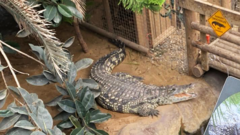
The hospital room smelled of floor wax and cold machinery. It is a scent known to anyone who has ever sat by a metal bed, watching the rhythmic rise and fall of a tiny chest, waiting for a sign that the world has stopped tilting. On the bed lay a three-year-old boy. To look at his face, soft with the unblemished innocence of early childhood, you would never guess the shadow he had just walked through. But beneath the crisp white sheets lay the evidence of a nightmare: heavy bandages covering a leg that had recently been caught in the jaws of an apex predator.
Survival is rarely a clean event. We read headlines that tell us a child survived an attack, and we feel a momentary wave of relief. We turn the page. We click the next link. But for the family inside that room, the survival was not the end of the story. It was merely the prologue to a long, exhausting marathon.
Five times.
That is how many times the boy was wheeled down the long, bright corridor toward the operating theater. Five separate occasions where a team of surgeons scrubbed in, adjusted their masks, and worked to repair what nature had tried to tear apart. When a crocodile strikes, the damage is not merely a matter of lacerations. It is a complex puzzle of crushed bone, torn tendons, and the constant, invisible threat of deep-tissue infection from the murky water. Every surgery was a battlefield. Every successful closure was a minor miracle.
The Invisible Stakes
Consider the reality of a pediatric intensive care unit. For an adult, a major trauma is a test of endurance. For a toddler, it is a confusing disruption of a world that is supposed to be safe. A three-year-old does not understand the concept of a surgical graft. He only knows that his leg hurts, that he cannot run outside, and that the adults around him look at him with eyes full of fierce, protective sorrow.
The mother sat in the vinyl chair beside the bed, her fingers intertwined with his small, uninjured hand. She had not slept a full night since the afternoon the banks of the river turned from a place of play into a place of terror. In the immediate aftermath of an animal attack, adrenaline carries you through. You run. You scream. You fight. You do whatever it takes to pull the child free.
But when the dust settles and the ambulance doors close, the adrenaline fades, leaving behind a cold, heavy reality. The real fight begins in the quiet hours of the morning, watching the intravenous lines drip life-saving antibiotics into a tiny vein.
The medical team faced a monumental task. The human body is remarkably resilient, but a child’s body is still growing. Surgeons cannot simply patch the wound and move on; they must reconstruct the limb in a way that allows for future growth. A single misstep in aligning a growth plate or repairing a nerve could mean a lifetime of complications. They were playing a high-stakes game of biological chess against time and trauma.
The Anatomy of Recovery
During the first operation, the focus was purely on stabilization and cleanliness. The jaws of a crocodile carry bacteria that can trigger aggressive, fast-moving infections. The tissue must be meticulously cleared. It is painful, delicate work.
By the third surgery, the doctors were looking at reconstruction. The family watched the clock in the waiting room, counting the ticks, knowing that every hour passed meant the surgeons were fighting to save not just the boy’s life, but his ability to walk, to kick a ball, to chase his friends through the grass.
It is easy to look at medical statistics and see numbers. Five surgeries sounds like a lot, but to truly understand it, you have to picture the physical toll. It means five times waking up from anesthesia, confused and groggy. It means five times managing the delicate balance of pain medication for a child who cannot fully articulate where or how much it hurts.
Yet, children possess a strange, almost magical capacity for adaptation. While an adult might spend weeks processing the psychological weight of the event, a three-year-old lives entirely in the present moment. On the days between the procedures, when the pain subsided to a manageable dull ache, he would look up and ask for his favorite toy car. He would smile at the nurses. He would remind everyone in the room that life, stubborn and bright, refuses to be dimmed easily.
Beyond the Headline
We live in a culture that consumes tragedy quickly. A headline flashes across our screens about a crocodile attack, and we immediately seek the sensational details. How big was the animal? Where did it happen? Who was watching? We look for someone to blame or a monster to fear because it makes us feel like we can control the uncontrollable.
But the true story isn't about the predator. The predator was just doing what it has done for millions of years in the waterways. The true story is about the human ecosystem that stood up to protect the boy. It is about the bystander who reacted without thought for their own safety. It is about the paramedics who stabilized a tiny patient whose blood pressure was plummeting. It is about the surgical team that refused to give up on a mangled limb, spending hours under the hot lights of the operating room meticulously reattaching microscopic structures.
The boy’s father stood by the window, looking out at the city below. He spoke of the future not with fear, but with a quiet determination. They knew the road ahead was long. There would be physical therapy. There would be scars—thick, silver lines that would grow with him, permanent reminders of the day the river fought back. But there would also be steps.
A few days after the fifth and final surgery, the lead doctor walked into the room. He didn't look at the charts right away. Instead, he leaned down and tapped the boy gently on the nose. The swelling was down. The color in the foot was good. The infection had been defeated.
The battle was won, not in a single dramatic moment, but in increments of millimeters, stitched together over days of meticulous care. The boy would walk out of the hospital on his own two feet.
The afternoon sun began to stream through the window, casting a warm glow across the room. The boy had fallen asleep, his breathing deep and even, holding tight to a plastic dinosaur his father had bought him from the gift shop. Outside the hospital walls, the world moved on at its usual frantic pace. People rushed to meetings, traffic hummed, and the river where it all happened continued its slow, silent pull toward the sea. But inside that small room, the only thing that mattered was the quiet, steady rhythm of a small boy healing, ready to take his first steps into a long and beautiful life.