The fan above Amadou’s desk does not cool the room; it merely redistributes the heavy, humid air of a Dakar afternoon. Amadou is fifty-two. His hands are calloused from decades of running a small printing shop near the Place de l’Indépendance, but today his fingers are ink-stained for a different reason. He is holding a copy of the official government gazette, fresh off a press that isn't his.
Outside his window, the street murmurs with the sound of traffic, street vendors chanting prices, and the distant, rhythmic thumping of political slogans echoing from a passing campaign truck. Senegal is changing. Or perhaps, it is trying to decide if it wants to change at all.
The headlines across the continent describe it in the clinical, detached language of international journalism: "Senegal's National Assembly adopts a controversial constitutional reform project to be submitted to a referendum."
To the analysts in Paris or Washington, this is a matter of legal text, parliamentary majorities, and institutional framework. They count the votes in the hemisphere of the Assembly. They analyze the legal mechanisms of a referendum. But for Amadou, and for the millions of Senegalese who will soon stand in lines that stretch down dusty sidewalks under a searing sun, this is not a legal exercise. It is an existential question.
The document in Amadou’s hands represents a fundamental rewriting of the rules of the game.
To understand the tension humming through the streets of Dakar, one must understand how deeply the Senegalese people revere their democracy. In a region where transitions of power are too often marked by military intervention or disputed elections, Senegal has long stood as an exception. A beacon. A proud anomaly. The citizens here do not view their vote as a casual chore. They view it as a shield.
When the National Assembly passed the reform project, the debate inside the chamber was fierce. Deputies shouted over one another, pointing fingers, their voices echoing off the wood-paneled walls. The opposition claimed the reforms were a veiled power grab, a mechanism designed to tip the scales in favor of the ruling coalition. The government argued the exact opposite, insisting the changes were necessary to modernize the state, streamline governance, and ensure long-term stability.
This is the classic paradox of constitutional reform. It is always presented as a gift to the future, even when it looks to the cynical eye like a tool for the present.
Consider the mechanics of what is actually happening. A constitution is not a sacred, unchanging text delivered from a mountaintop. It is a living contract between the state and its citizens. When a government decides to alter that contract, it is essentially asking the population to sign a blank check, trusting that the details filled in later will benefit everyone, not just the authors of the text.
The controversy in Senegal centers on this very trust. The proposed changes alter the balance of power between the executive branch and the legislature. In a country where the president already holds immense influence, any shift that appears to weaken parliamentary oversight or alter presidential term limits sends a shudder through the civil society.
Amadou remembers the protests of years past. He remembers the smell of burning tires and the stinging tear gas that drifted into his shop during previous political flashpoints. He does not want to see that again. No one does. The memory of instability is a powerful deterrent, but so is the fear of a slowly eroding democracy.
The debate has moved from the air-conditioned halls of parliament to the tanganas—the ubiquitous roadside coffee stalls where locals gather to drink sweet, strong café Touba and debate the fate of the nation. Here, the language isn't constitutional law. It is survival, dignity, and representation.
"They want us to vote 'yes' or 'no' on a text most people haven't read," says Ibrahim, a twenty-four-year-old university student sitting across from Amadou's shop. He stirs his coffee with a plastic spoon, his movements sharp with frustration. "How can you ask a population to decide on its future when the arguments are trapped in legal jargon?"
Ibrahim’s frustration highlights the deep divide at the heart of this referendum. On one side are the institutionalists, who believe that progress is achieved through top-down legislative reform. On the other side is a young, connected, and increasingly impatient populace that feels disconnected from the political elite. Over sixty percent of Senegal's population is under the age of twenty-five. They do not look at constitutional amendments through the lens of historical tradition; they look at them through the lens of unemployment, opportunity, and accountability.
The government's strategy relies on the legitimacy of the referendum. By taking the issue directly to the people, they can claim the ultimate democratic mandate. If the citizens vote 'yes', the opposition's arguments are effectively neutralized. But a referendum is a blunt instrument. It reduces a complex, multi-layered constitutional overhaul to a binary choice. Yes or no. Progress or stagnation. Loyalty or betrayal.
But the real problem lies elsewhere. The true danger of a controversial referendum is not just the potential for an unfair outcome, but the risk of fracturing the underlying national consensus. Democracy functions because the losing side accepts the legitimacy of the winner. When the rules themselves are the subject of bitter dispute, that acceptance begins to fray.
The legal scholars will continue to debate the specific clauses regarding parliamentary terms and executive decrees. They will write white papers and give interviews on television stations broadcasting from the capital.
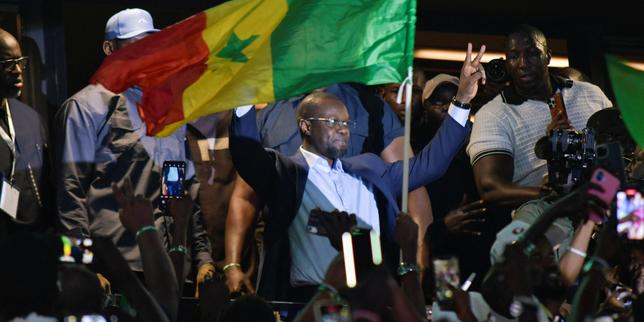
Meanwhile, the campaign machinery is spinning into motion. Billboards are being erected along the Corniche, showing smiling politicians set against the vibrant green, yellow, and red of the national flag. The airwaves will soon be flooded with songs and speeches, each side claiming to be the true defender of the Republic.
As the afternoon sun begins to dip below the Atlantic horizon, casting long, golden shadows across the pavement, Amadou folds the gazette and places it under a paperweight on his desk. He steps outside his shop to lower the metal metal awning for the evening.
An old woman walks past, balancing a basket of mangoes on her head, her stride steady and unhurried. She has lived through the presidency of Léopold Sédar Senghor, through Abdou Diouf, through Abdoulaye Wade, and through Macky Sall. She has seen constitutions written, amended, and rewritten. She, like millions of others, represents the quiet, enduring resilience of a country that has always managed to find its way back from the edge.
The upcoming vote is not just a test for the current administration, nor is it merely a challenge for the opposition. It is a mirror held up to Senegal itself.
When the day of the referendum arrives, the world will look at the final percentages, the turnout numbers, and the international observers' reports. But the true story will be found in the quiet moments inside the voting booths, where citizens like Amadou stand alone with a piece of paper and a stamp, holding the weight of a nation’s future in the palm of a single hand.