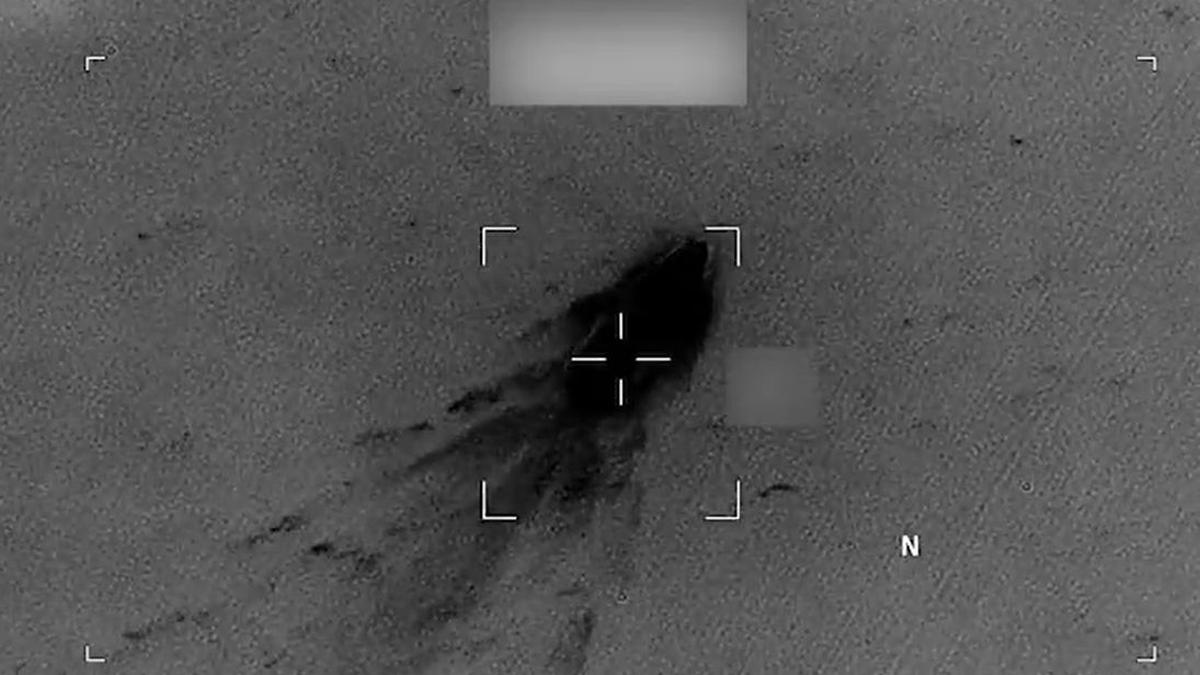
The standard reporting on high-seas drug interdictions follows a weary, predictable script. Two suspects die during a "kinetic encounter" in the Eastern Pacific. The Coast Guard or Navy seizes a few tons of white powder. Officials stand behind a table of shrink-wrapped kilos like it’s a high school trophy ceremony. They call it a win for national security. They call it "disrupting supply chains."
They are lying to you, or worse, they are lying to themselves.
When the U.S. military strikes an "alleged drug boat," they aren't winning a war. They are subsidizing the evolution of organized crime. These skirmishes in international waters are not tactical victories; they are a grotesque waste of taxpayer capital that ignores the brutal reality of logistics and free-market economics. If you think killing two low-level couriers on a panga boat moves the needle on American drug addiction, you don't understand how a globalized economy works.
The Myth of Interdiction Efficacy
Mainstream media loves the drama of the chase. They frame these events as a high-stakes chess match between law enforcement and cartels. In reality, it is a game of numbers where the house—the cartels—always wins because the U.S. government is playing with a broken deck.
The logic of interdiction is based on the flawed premise that seizing supply increases price and decreases purity on the street. Data from the Drug Enforcement Administration (DEA) and the United Nations Office on Drugs and Crime (UNODC) has shown for decades that despite record-breaking seizures, the street price of cocaine has remained remarkably stable or even dropped when adjusted for inflation.
Why? Because the "loss" of a three-ton shipment is already priced into the cartel’s business model.
In any legitimate logistics business, you account for "shrinkage"—damaged goods, theft, or logistical failures. Cartels treat a U.S. Navy destroyer exactly like a retail giant treats a shoplifter: as a predictable, manageable overhead cost. When the military sinks a boat, they aren't "breaking" the cartel. They are simply clearing out old inventory and making room for the next iteration of smuggling technology.
Evolution by Fire
Every time we successfully intercept a low-profile vessel (LPV) or a semi-submersible, we aren't stopping the flow. We are performing a Darwinian selection process. We kill the slow, the loud, and the technologically inferior.
The smugglers who survive are the ones who innovate.
Twenty years ago, a "drug boat" was a go-fast with four outboards. Today, we face carbon-fiber narco-subs with minimal thermal signatures and autonomous underwater vehicles (AUVs) that don't even require a human crew to die when the Navy shows up. By engaging in these high-seas theatrics, the U.S. military is essentially acting as a free R&D consultant for the Sinaloa and Jalisco cartels. We show them exactly where their vulnerabilities are, and they use their multi-billion dollar profits to patch those holes before the next run.
The Tactical Fallacy of Maritime Presence
The competitor’s article focuses on the "success" of the strike. But let’s look at the ROI.
A single Arleigh Burke-class destroyer costs roughly $1.8 billion to build and tens of thousands of dollars per hour to operate. We are using billion-dollar platforms and elite Special Operations forces to hunt down plywood boats powered by lawnmower engines.
This isn't a power projection; it's a parody.
When you factor in the fuel, the man-hours, the intelligence-gathering satellites, and the legal processing of detainees, the cost to the American taxpayer to seize one kilogram of cocaine often exceeds the actual street value of that kilogram. From a business perspective, this is a catastrophic failure. No private enterprise would survive a week with these margins. We are spending dollars to save pennies, and we’re doing it with the blood of sailors and "suspects" alike.
The Human Cost of Strategic Blindness
The "two killed" mentioned in these reports are rarely the kingpins. They aren't the financiers in Mexico City or the distributors in Chicago. They are replaceable labor. Most are impoverished fishermen from Ecuador or Colombia, recruited under duress or out of desperation.
Killing them achieves nothing. It creates a vacuum that is filled within hours.
The "lazy consensus" suggests that these deaths are a necessary deterrent. But you cannot deter a man who has nothing to lose. The cartel recruitment pool is functionally infinite. As long as the demand in New York, Los Angeles, and London remains insatiable, there will be a line of people willing to take that 5% chance of being blown out of the water by a Reaper drone for a payday that could feed their village for a decade.
The Balloon Effect is Real
If you squeeze a balloon in one place, the air just moves to another. This is the fundamental law of drug trafficking that Washington refuses to acknowledge.
When the U.S. increases pressure in the Eastern Pacific, the routes shift to the Caribbean. When we squeeze the Caribbean, the shipments move through West Africa and into Europe. When we crack down on maritime routes entirely, they move to commercial air freight and legal ports of entry, where less than 2% of containers are actually inspected.
The military’s "victory" in the Pacific is just a relocation notice. We are moving the problem, not solving it. We are chasing shadows while the substance of the issue—domestic demand and the failed policy of prohibition—remains untouched.
The Intelligence Industrial Complex
There is a deeper, more cynical reason why these stories keep appearing. These interdictions are the primary justification for the continued bloating of the "Southern Command" (SOUTHCOM) budget.
If the military admitted that high-seas seizures have zero impact on the availability of drugs in the U.S., they would lose a significant chunk of their funding. These strikes are essentially a marketing campaign. They provide the "action" footage needed for Congressional hearings. They allow generals to point at a map and say, "We are doing something."
Doing something is not the same as being effective.
I have seen operations where millions were spent to track a single panga boat for three days, only for the crew to dump the cargo the moment they saw a silhouette on the horizon. The military counts that as a "disruption." The cartel counts it as a Tuesday.
The Hard Truth About Supply
You want to stop the drug trade? You don't do it with a 5-inch gun on a destroyer.
The hard, contrarian truth is that international maritime interdiction is the least effective tool in the kit. It is the most expensive, the most dangerous, and the most easily bypassed. The cartels have already pivoted. They are moving into synthetics like fentanyl, which can be produced in small labs and shipped in envelopes through the mail.
A single shoebox of fentanyl has the same "hit potential" as an entire boatload of cocaine.
While our Navy is playing "Pirates of the Caribbean" in the Pacific, the actual threat has moved to a basement in Culiacán and a shipping container in Long Beach. We are fighting the last war with the wrong tools and the wrong mindset.
Stop The High-Seas Theater
We need to stop treating drug trafficking as a military problem and start treating it as a market problem.
The "War on Drugs" at sea is a vanity project for the Pentagon. It’s a way to keep hulls in the water and drones in the air during "peacetime." But the cost is too high—not just in money, but in the erosion of our strategic focus. We are wasting our most sophisticated assets on a problem that is fundamentally social and economic.
Every time you read a headline about a "successful strike" on a drug boat, remember this: the price of cocaine in your city didn't go up. The supply didn't go down. The only thing that changed is that the American taxpayer is a few million dollars poorer, and two more bodies are at the bottom of the ocean.
If you want to win, you have to stop playing the game the enemy wants you to play. The cartels love the maritime war. It keeps the U.S. busy, it keeps the competition out, and it ensures that only the most ruthless and technologically advanced smugglers—their friends—stay in business.
The U.S. military isn't the police of the Pacific. It’s the unintended quality-control department for the world’s most violent industry.
Stop celebrating the seizures. Start questioning the strategy.
The boat sank. The business didn't.