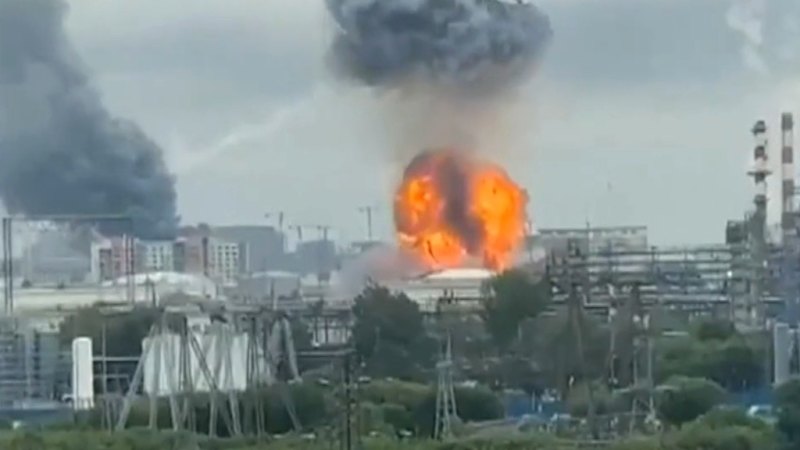
For years, people living in Moscow could pretty much ignore the war. Sure, there were occasional drone spooks, but the state media machine kept things looking normal. That illusion shattered early Thursday morning. Nearly 200 Ukrainian drones swarmed the Russian capital, blanking out airport radars, smashing into a massive oil refinery, and raining oily soot onto suburban streets.
This isn't the sporadic, symbolic pinprick testing of 2023. This is a massive, coordinated air campaign. If you want to understand why this matters, don't look at the front lines in the Donbas. Look at the Kapotnya oil refinery, just nine miles from the Kremlin, where a fuel tank blew its lid dozens of meters into the air.
Ukraine isn't just defending anymore. Kyiv is actively bringing the cost of this four-year invasion right to Vladimir Putin's doorstep.
Breaking the Iron Dome of Moscow
Moscow is supposed to have the densest, most sophisticated air defense network in Russia. Yet, Russian authorities admitted that their systems were completely overwhelmed by a multi-directional swarm. Nationwide, Russia claimed to have shot down 555 drones, with nearly 200 intercepted right on the approach to the capital.
That tells a massive story about numbers. Kyiv essentially used a saturation strategy to break through the layered defenses. Videos from local residents showed desperate Russian troops on the ground using shoulder-launched MANPADS, trying to pick off low-flying drones seconds before they slammed into target buildings. When you are relying on foot soldiers with shoulder missiles to protect your capital's primary energy infrastructure, your high-tech defense network has failed.
The immediate fallout was total chaos for travel and logistics. All four major Moscow airports, including Sheremetyevo, completely halted operations, evacuating passengers and canceling or delaying over 500 flights.
The Economic Target Hidden in Plain Sight
The real prize was the Kapotnya refinery. It isn't just any industrial site. This single facility supplies roughly 40% of Moscow’s gasoline and about half of its diesel fuel. Striking it for the second time in a single week means Ukraine is hitting Russia right in the gas tank.
Previous drone campaigns had already forced Russia, the world's third-largest oil producer, to scramble for fuel imports by sea to stave off domestic gasoline shortages. By knocking out a massive chunk of Moscow's own local supply, Ukraine is squeezing the state budget where it hurts most. Oil revenues fund at least a third of the Kremlin's war machine.
More than the money, the psychological shift is real. Residents in towns like Balashikha woke up to "black rain"—a heavy, oily residue coating cars and apartment windows. The air smelled of burnt fuel. For ordinary Muscovites, the conflict is no longer a distant news segment on state TV. It's a dark cloud hanging over their neighborhoods.
A Calculated Message to the Kremlin and the West
The timing of this attack wasn't an accident. President Volodymyr Zelensky called the operation "long-range sanctions," a direct retaliation for a Russian strike earlier in the week that heavily damaged the historic Kyiv Pechersk Lavra monastery. His message was blunt: "If Ukraine burns, your Moscow will burn."
The political backdrop is even more telling. The strike happened just after Zelensky secured fresh pledges of air defense and military aid at the G7 summit in France, noting a positive coordination call with US President Donald Trump and French President Emmanuel Macron. Meanwhile, Putin was 700 kilometers away in Kazan, trying to project strength while hosting Southeast Asian leaders. The smoke rising over Kapotnya made that strength look incredibly hollow.
Kremlin officials are already whining that these attacks push back any chance of peace talks. Honestly, that is exactly what Kyiv wants right now. They know talking from a position of weakness gets them nothing. By showing they can choke off Moscow's fuel, ground its flights, and panic its population, Ukraine is building the exact leverage they need to force real diplomacy on their own terms.
To protect yourself from the ripple effects of this escalation, keep a close eye on global energy markets. Refined fuel prices are bound to fluctuate as Russian domestic supply tightens, meaning pump prices worldwide could see sudden jumps. If you manage supply chains or logistics networks, diversifying your fuel dependencies away from regional volatility is no longer optional—it's a baseline requirement for survival in 2026.


