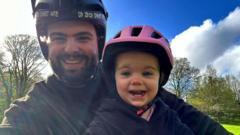
The viral video of a father and daughter cycling toward a herd of cattle serves as the perfect psychological sugar hit. It is short, visually clean, and emotionally uncomplicated. As the toddler asks, "Can we see the cows?" and the father captures the moment through a handlebar-mounted lens, millions of viewers find a temporary reprieve from a fractured social climate. But the meteoric rise of this specific brand of "wholesome content" is not accidental. It is the result of a sophisticated interplay between algorithmic preference for high-contrast emotional cues and a growing societal desperation for evidence of functional domesticity.
Behind the lens, these moments are rarely as spontaneous as the frame suggests. While the affection is real, the presentation is a byproduct of a specific technical setup designed to broadcast intimacy. The "dad-and-daughter" genre has become a powerhouse in the creator economy, moving away from the chaotic "vlog" style of the 2010s toward a curated, cinematic minimalism. By stripping away the noise of modern life and focusing on a singular, primal interaction—parent, child, nature—creators tap into a deep-seated nostalgia that bypasses the critical mind.
The Engineering of Wholesome Engagement
The mechanics of why a simple bike ride goes viral are found in the code. Platforms like TikTok and Instagram prioritize high watch-time and "shares to DM." Content that triggers a "warm glow" effect—a psychological phenomenon where individuals feel a sense of moral satisfaction by proxy—is highly shareable because it acts as a social currency. When you send a video of a child talking to cows to a friend, you aren't just sharing a clip. You are signaling your own values.
This specific video succeeds because it utilizes a "low-stakes narrative" structure. There is a clear objective—seeing the cows—a minor physical challenge—the bike ride—and a resolution. It is a complete story arc compressed into sixty seconds. For an audience suffering from information overload, these micro-narratives provide a cognitive reset. The brain processes the simplicity as a reward, triggering a dopamine release that keeps the user scrolling for the next hit of suburban or rural bliss.
The GoPro Dad Phenomenon
We are seeing the professionalization of fatherhood. The "GoPro Dad" is no longer just a hobbyist recording family memories for a dusty hard drive. He is an editor, a cinematographer, and a brand manager. To achieve the specific look of the "Can we see the cows?" video, one needs more than just a bike and a child. It requires stabilized 4K cameras, external microphones to capture the crisp audio of a toddler's whisper against the wind, and a keen understanding of "The Reveal."
The Reveal is a classic cinematic technique where the camera follows the subject's gaze to a payoff. In this case, the cows. By placing the viewer in the perspective of the child, the creator forces a regression in the audience. You are no longer an adult staring at a glass rectangle in a cubicle; you are three years old, on a bike, looking for animals. It is a powerful form of escapism that commands a premium in the advertising market.
The Invisible Infrastructure of the Rural Aesthetic
There is a certain irony in the fact that these videos, which celebrate a return to "simplicity," are entirely dependent on high-speed mobile networks and expensive hardware. The rural backdrop acts as a stage set. Viewers crave the green grass and the slow pace, but they consume it through the fastest technology available. This creates a filtered reality where the grit of rural life—the smell of the manure, the biting flies, the actual labor of farming—is edited out in favor of a sanitized, pastoral dream.
The cows in these videos aren't livestock; they are props in a play about modern parenting. They represent "The Outside," a place many viewers feel they have lost access to. This creates a feedback loop where creators are incentivized to seek out increasingly picturesque settings to maintain their engagement rates. The result is a skewed perception of the outdoors that prioritizes visual "vibe" over actual ecological or agricultural literacy.
Why We Are Addicted to the Parenting Proxy
The popularity of these videos points to a hole in the collective psyche. As birth rates decline and the age of first-time parenthood rises, a large segment of the population is experiencing "parenting by proxy." They consume the highlights of child-rearing without any of the sleepless nights or financial strain. It is a clean, sterilized version of family life that satisfies a biological urge for connection without requiring any actual sacrifice.
This shift has profound implications for how we value privacy. The children in these videos cannot consent to being the face of a global viral moment. While the content is "wholesome," the child is still being used as a tool for engagement. We have reached a point where the private bond between a father and daughter is treated as a public commodity, traded for likes and brand deals. The "purity" of the moment is compromised the second it is framed for an audience of millions.
The Cost of the Perfect Frame
To get the "perfect" shot of a child reacting to a cow, a parent often has to ignore the child to check the camera angle. This is the hidden cost of the creator economy. The child experiences the world through the lens of their parent's obsession with capturing it. If the cow doesn't look right in the frame, do they go back and do it again? Does the child start to perform for the camera instead of reacting to the animal?
We are raising a generation of children who understand that their most intimate moments are also their most valuable assets. This isn't just about one video of a bike ride. It is about a fundamental shift in the human experience where nothing is "real" until it is recorded and validated by strangers. The "wholesome" nature of the content masks the underlying transactional reality of the platform.
The Algorithm is the New Extended Family
In previous generations, the "audience" for a child's milestone was the extended family. Grandparents, aunts, and uncles provided the "warm glow" and the validation. Today, that role has been outsourced to the algorithm. The "likes" from strangers in different time zones have replaced the physical presence of a community. This isolation is what makes these videos so potent. They provide a fleeting sense of belonging to a world that feels increasingly fragmented.
The "Can we see the cows?" video is a symptom of a society that has forgotten how to be bored. We cannot simply go for a bike ride; we must document it. We cannot just look at a cow; we must ensure the world knows we looked at the cow. The danger is not in the video itself, but in the precedent it sets. When every moment of beauty must be digitized to be "useful," we lose the ability to inhabit our own lives.
The Evolution of the Digital Pastoral
The trend toward "wholesome" content is a direct reaction to the "rage-bait" era of the early 2020s. After years of being fed content designed to make them angry, users are pivoting toward anything that makes them feel safe. This has created a massive market for what is essentially digital chamomile tea. However, tea can be just as addictive as coffee.
We are seeing the emergence of a "Digital Pastoral" movement, where the aesthetic of the country is sold to the city. These videos are the 21st-century version of a landscape painting, but with the added layer of human performance. The "dad" figure in these videos is often portrayed as a stoic, present, and adventurous leader—a direct counter-narrative to the "bumbling dad" trope that dominated sitcoms for decades. It is a reclamation of a specific type of masculinity that is gentle yet active.
The Market for Authenticity
Advertisers are desperate to attach themselves to this perceived authenticity. A brand of bike helmets, a specific type of granola bar, or a rugged SUV—all of these products benefit from being associated with a "real" moment of father-daughter bonding. The challenge for the creator is to maintain the illusion of spontaneity while fulfilling the requirements of a sponsorship deal.
The moment a "link in bio" appears, the magic of the cow video begins to dissipate. The viewer realizes they aren't watching a memory; they are watching a commercial. This is the fine line that "wholesome" creators must walk. If they lean too hard into the business side, they lose the trust that made them viral in the first place. If they don't, they can't afford the gear required to keep the quality high.
The Quiet Crisis of the Background
Look closely at the background of these viral outdoor videos. You will often see the encroachment of suburbia, the power lines, the distant highways. The "nature" we are celebrating is frequently a small pocket of green surrounded by an ocean of gray. These videos are popular because they offer a glimpse of what we are losing. They are elegies disguised as entertainment.
The cows themselves are often the last remnants of a dying industry, kept on land that is waiting to be turned into a housing development. When the daughter asks to see the cows, she is asking to see a world that is rapidly disappearing. The tragedy is that we are so focused on the cuteness of her voice that we miss the context of the landscape. We are filming the end of an era and calling it a "heart-melting" moment.
Moving Beyond the Screen
The definitive response to this trend isn't to stop watching the videos, but to recognize them for what they are: highly processed emotional concentrates. They are not a substitute for the real thing. A digital cow is not a cow. A recorded bike ride is not a bike ride. The real value isn't in the video that "melts hearts" online, but in the ride that is never filmed.
The true "pro-move" for a parent isn't to buy a better camera to capture the cows. It is to leave the phone at home, take the daughter to the fence, and let the moment exist only in their shared memory. In an age of total surveillance and constant broadcasting, the only truly "wholesome" act left is silence. The most valuable moments of your life are the ones the algorithm never gets to see.
Put the camera down and look at the cow yourself.