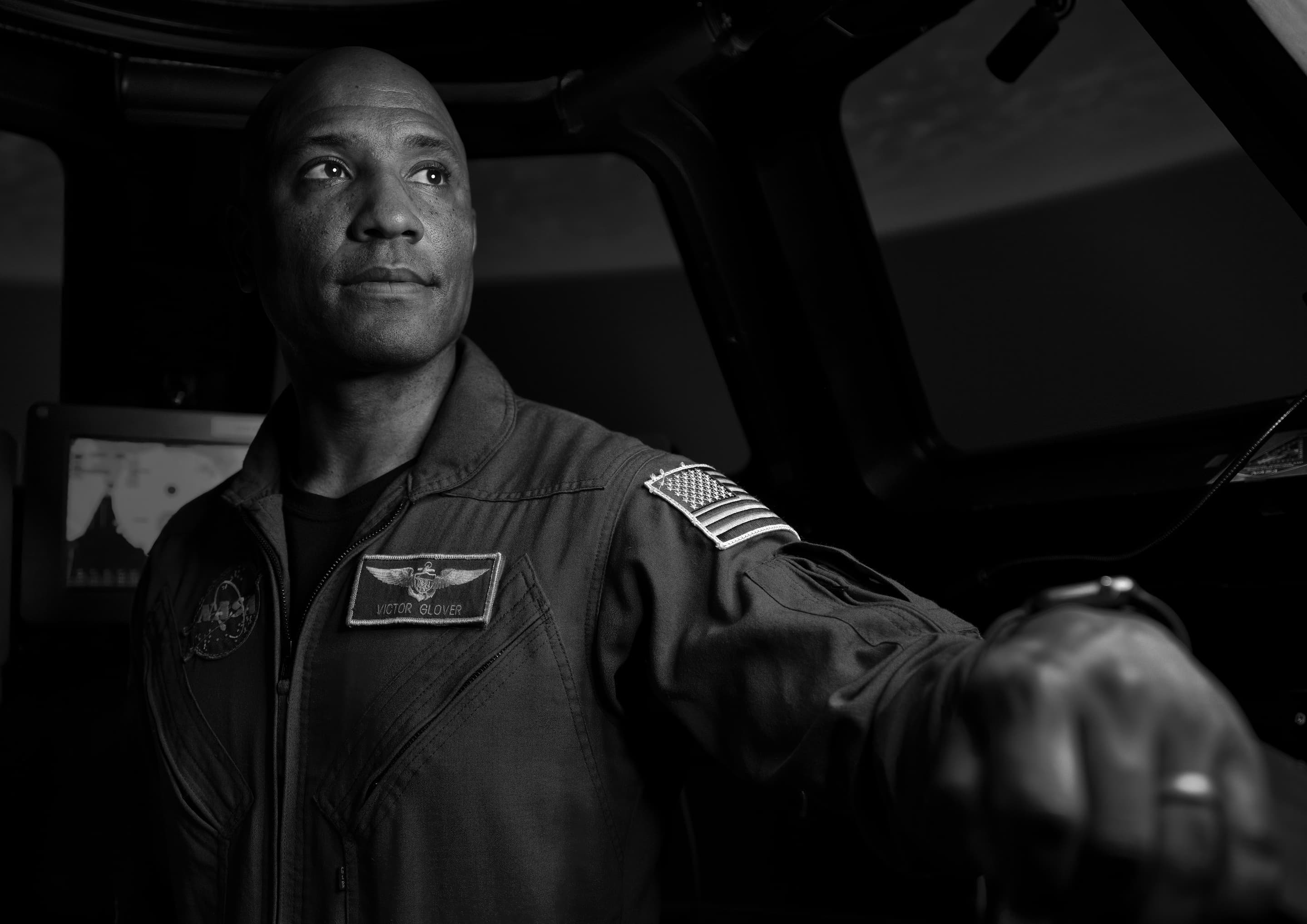
NASA is no longer just racing against the clock or a foreign superpower. It is racing against its own history. When Victor Glover climbs into the Orion spacecraft for the Artemis II mission, he will carry more than just the technical responsibilities of a pilot. He carries the weight of a multi-generational promise to make space look like the country that pays for it. This isn't a symbolic gesture or a PR stunt. It is a cold, calculated necessity for a space agency that spent decades justifying its existence to a public that felt increasingly disconnected from the lunar surface.
Glover is a Southern California native, a Navy captain, and an engineer. He is also the man chosen to be the first Black astronaut to leave Earth’s orbit. While the headlines focus on the demographic milestone, the technical reality of his mission is far more grueling than the simplified media narrative suggests. Artemis II is the first crewed test of the Space Launch System (SLS) and the Orion capsule. It is a ten-day mission designed to push the life-support systems to their breaking point before NASA attempts a landing with Artemis III. If Glover and his crew don't prove the hardware works in the deep-space environment, the entire lunar program collapses.
The Engineering of a Legacy
To understand why Glover was the inevitable choice for this seat, you have to look past the flight suit. The mission requires a pilot who can manage the interface between legacy physics and modern automation. The Orion capsule is a beast of a machine, far more complex than the Apollo command modules of the 1960s. It relies on a "glass cockpit" and a series of redundant flight controllers that must operate in the high-radiation environment of the Van Allen belts.
Glover’s background as a test pilot is the bedrock of his selection. In the high-desert testing grounds of California, he spent years breaking planes so that others wouldn't. That experience is vital because Artemis II is essentially a massive flight test. The crew will perform a proximity operations demonstration, essentially "parking" the Orion near the spent upper stage of the SLS rocket to test manual handling. This isn't automated docking; it is hands-on flying in a vacuum.
The "why" behind this mission isn't just about walking on the moon again. It is about the Gateway—a planned space station that will orbit the moon. NASA needs a pilot who can handle the transition from Earth-reliance to deep-space independence. Glover has already proven he can handle the psychological and physical toll of long-duration spaceflight during his 168 days on the International Space Station (ISS). But the ISS is 250 miles up. The moon is 240,000 miles away. There is no quick ride home if a seal leaks or a computer freezes.
Beyond the Demographic Milestone
Critics often point to "firsts" as a form of identity politics injected into science. That view ignores the structural reality of how NASA secures its funding. For decades, the Apollo era was criticized for being an elite club that excluded the very taxpayers who funded it. By the time the program ended, public interest had cratered. The Artemis program is an attempt to fix that structural flaw by ensuring the face of the mission matches the diversity of the modern workforce.
Glover himself has been vocal about this responsibility. He doesn't view his position as a trophy. He views it as a function of the mission's success. If the "Artemis Generation" is to be a real thing—a sustained movement of students entering STEM fields—they need to see that the path to the moon is open to everyone. This is a strategic move to ensure the longevity of the program across multiple presidential administrations. Consistency is the rarest resource in aerospace, and public buy-in is the only way to buy it.
The Fragile Architecture of Artemis
We should be honest about the risks. The SLS rocket is an expensive, non-reusable behemoth that costs roughly $2 billion per launch. While companies like SpaceX are moving toward rapid reusability, NASA is sticking with a traditional, expendable architecture for the heavy lifting of the crew. This creates an immense pressure on Glover and his three crewmates. There is no "test flight 2" if this goes wrong. Every component of the Orion, from the heat shield to the nitrogen-scrubbing systems, must perform perfectly on the first try with humans aboard.
The heat shield is a particular point of concern for analysts. During the uncrewed Artemis I mission, the shield experienced more charring and material loss than models predicted. NASA engineers have spent months dissecting that data. When Glover enters the atmosphere at roughly 25,000 miles per hour, he will be relying on a fix that has only been validated in labs and computer simulations. The margin for error is non-existent.
The Lunar Proving Ground
- Communication Lag: Unlike the ISS, where communication is nearly instantaneous, the moon introduces a noticeable delay. The crew must be more autonomous.
- Radiation Exposure: Artemis II will travel well beyond the protection of Earth’s magnetic field. This requires advanced shielding and solar storm shelters within the capsule.
- Life Support Scrubbing: On a ten-day mission, managing CO2 levels is a constant battle. The Orion uses a new "Amine Swingbed" system to remove carbon dioxide, which must be monitored manually if the automated sensors fail.
The California Connection
Glover’s roots in Pomona and his education at Cal Poly San Luis Obispo are not just biographical trivia. Southern California remains the heartbeat of the American aerospace industry. From the Jet Propulsion Laboratory to the private ventures in "Aerospace Valley," the region provides the intellectual and industrial horsepower that makes Artemis possible. Glover represents a homecoming of sorts—a local product of the California public education system heading to the furthest reaches of human exploration.
His trajectory from a high school athlete to a Navy Commander to a moon-bound pilot serves as a case study in the American meritocracy, but one that was nearly derailed by the very systems he now represents. Glover has spoken candidly about the "double consciousness" of being a Black man in high-stakes, historically white institutions. He is not just flying a ship; he is navigating the complexities of being a pioneer in a world that didn't always want him there.
The Economic Reality of the Moon
The goal isn't just to leave footprints. The goal is the lunar economy. NASA is looking for water ice in the permanently shadowed craters of the lunar south pole. If they find it, they can break it down into hydrogen and oxygen—rocket fuel and air. This would turn the moon into a "gas station" for missions to Mars.
Glover’s role in Artemis II is the preamble to this industrial future. He is testing the taxi that will eventually take geologists, miners, and engineers to the surface. If he can prove the Orion is a reliable workhorse, the transition from exploration to exploitation can begin. This isn't about "science for science's sake." It's about the next frontier of resource acquisition and geopolitical dominance. The nation that controls the lunar fuel supply controls the solar system.
The Unspoken Danger
Spaceflight is often sanitized for the public. We see the slow-motion walks to the launchpad and the smiling faces on the video feeds. We don't see the brutal physical toll of high-G reentry or the constant, low-level anxiety of living in a pressurized tin can where a single faulty valve means certain death. Glover is a veteran of this environment, but the moon is a different beast entirely.
The Apollo astronauts often spoke of the "Earthrise" moment—the realization of Earth's fragility. But they also spoke of the absolute blackness of deep space. There is no horizon. There is only the ship and the void. Maintaining mental acuity in that environment is perhaps the most difficult part of the pilot's job. Glover’s primary task is to stay sharp enough to take over manual control if the computers succumb to a cosmic ray strike or a software glitch. He is the ultimate fail-safe.
The mission is scheduled for a trajectory that takes the crew thousands of miles past the far side of the moon, farther than any human has ever traveled. They will be "unreachable" in a way that is hard to fathom in our hyper-connected world. It is a lonely, dangerous, and essential journey.
When the SLS engines ignite, the roar will be felt across the Florida coast, but the impact will be felt globally. Victor Glover will be at the controls, not because he represents a demographic, but because he represents the pinnacle of flight proficiency in an era where we can no longer afford to fail. The moon is waiting, and this time, we are going there to stay.
Monitor the final integration of the Orion heat shield for the latest safety updates on the Artemis II launch window.