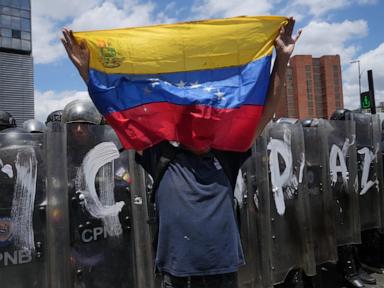
Student uprisings in Venezuela have ignited once more, following the suspicious deaths of political prisoner Leoner Azuaje Urrea and his mother, Rosalba Urrea de Azuaje. While the official state narrative points to suicide, the streets of Caracas tell a different story of systematic repression and the physical breaking of dissenters. This is not a simple protest over a single tragedy. It is a violent collision between a generation of students who have known only Chavismo and a state apparatus that has perfected the art of the "judicial accident."
Leoner Azuaje was not a typical firebrand. He was a cartographer and an official within the state-run company Cartones de Venezuela. His arrest in early 2023 was part of a sprawling anti-corruption sweep—Operation Anti-Corruption—that the Maduro administration used to purge perceived internal threats and settle scores within the United Socialist Party of Venezuela (PSUV). When he was found dead in his cell just days after his detention, the Public Ministry moved with lightning speed to declare it a suicide.
The subsequent death of his mother, who had been vocal about the torture her son allegedly endured, transformed a localized corruption scandal into a national symbol of state cruelty. For the university students now filling the plazas, the Azuaje case represents the ultimate vulnerability: the reality that even those within the system are not safe from its grinding gears.
The Anatomy of the State Purge
To understand why students are risking tear gas and detention today, one must look at how the Venezuelan state handles its "own." The arrest of Leoner Azuaje was framed as part of a moral crusade against the embezzlement of billions in oil revenue. However, the lack of due process and the secrecy surrounding his detention follow a pattern long documented by international human rights observers.
Azuaje was held in El Helicoide, the notorious headquarters of the Bolivarian National Intelligence Service (SEBIN). It is a place where the architecture of a shopping mall has been repurposed into a labyrinth of interrogation rooms. When a prisoner dies in such a facility, the burden of proof rests heavily on the state. The students are not merely mourning a man; they are rejecting the state’s monopoly on the truth.
The official autopsy report for Azuaje was released with unusual haste. It claimed he used bedsheets to end his life. This explanation is a recurring theme in Venezuelan custodial deaths, one that has been used in the cases of Fernando Albán and Raúl Isaías Baduel. Each time, the government provides a convenient medical conclusion while refusing independent forensic audits.
The Escalation of Student Resistance
The current wave of protests is distinct from the mass mobilizations of 2014 or 2017. Those movements were driven by middle-class political parties and a desire for immediate regime change. Today’s activists are more decentralized. They are driven by a visceral sense of abandonment.
University campuses in Venezuela, such as the Universidad Central de Venezuela (UCV), have become islands of resistance in a sea of state control. These institutions are crumbling physically—roofs are caving in and laboratories lack basic electricity—yet they remain the only spaces where the government cannot fully dictate the discourse.
Students are connecting the dots between high-level corruption and their own misery. They see the billions lost in the PDVSA-Crypto scandal—the same scandal that allegedly ensnared Azuaje—as the direct cause of their empty cafeterias and nonexistent scholarships. The death of a mother and son is the spark, but the fuel is a decade of accumulated grievances.
The Silence of the Prosecution
Tarek William Saab, Venezuela’s Attorney General, has built a career on the aesthetic of justice. He frequently appears on state television to announce "exemplary punishments" for those who betray the revolution. Yet, when it comes to the deaths of detainees, his office becomes a fortress of opacity.
In the Azuaje case, the Public Ministry ignored pleas from the family for an independent observer during the autopsy. This refusal is a calculated move. By controlling the forensic narrative, the state ensures that any counter-claims remain "conspiracy theories" in the eyes of the law, even if they are common knowledge in the streets.
The tragedy of Rosalba Urrea de Azuaje adds a layer of gothic horror to the political crisis. Her death shortly after her son’s suggests a family shattered by the weight of state pressure. Whether her death was due to the physical toll of grief or something more interventionist is almost irrelevant to the public perception. In the eyes of the protestors, the state killed them both. One with a rope, one with heartbreak.
Transnational Implications and the ICC
This domestic unrest is happening as the International Criminal Court (ICC) continues its investigation into crimes against humanity in Venezuela. The "Venezuela I" case focuses specifically on the treatment of detainees and the use of torture to extract confessions.
Every death in SEBIN or DGCIM (military intelligence) custody serves as fresh evidence for the Hague. The Maduro administration is currently engaged in a sophisticated diplomatic dance, trying to show the world that its justice system is capable of self-correction. The Azuaje "suicide" undermines this entirely. It proves that the culture of impunity is not a bug in the system, but its primary operating feature.
Beyond the Barricades
The street battles in Caracas are often portrayed as a struggle for democracy, but that is an abstraction. On the ground, it is a struggle for the right to exist without being disappeared. The students are fighting for a future where a "corruption probe" doesn't result in a body bag.
There is a grim irony in the fact that Leoner Azuaje was part of the revolutionary bureaucracy. His death signals to every mid-level official and every student leader that loyalty provides no shield. The revolution is eating itself, and it is doing so in the most public and brutal way possible.
Security forces have responded to the new protests with "Plan Zamora," a civil-military coordination designed to crush internal disorder. They use "colectivos"—armed pro-government gangs—to intimidate protestors before the National Guard even arrives. This two-tiered repression makes traditional protesting nearly impossible, yet the students continue to gather, using flash-mobs and digital coordination to stay one step ahead of the vans.
The Economic Context of Dissent
Venezuela’s economy has entered a state of "zombie dollarization." While there are luxury stores in Las Mercedes, the average student or worker lives on a minimum wage that doesn't cover a single day's worth of calories.
When the government announces that billions were stolen by its own officials, the cognitive dissonance for the population becomes unbearable. The students aren't just angry that people died; they are angry that they are dying of hunger while the elites squabble over the spoils of a failing state. The Azuaje case is the smoking gun of a regime that has lost its moral compass and is now losing its grip on its own ranks.
The Strategy of Attrition
The Maduro government relies on the exhaustion of its critics. They know that a student can only protest for so long before the need for food or the fear of a dungeon wins out. However, the death of a mother and son has touched a nerve that transcends political fatigue. It has re-humanized a struggle that had become bogged down in geopolitical rhetoric.
We are seeing a shift in tactics. Instead of massive marches that are easily blocked by shipping containers on the highways, students are targeting specific government buildings with "micro-protests." They are naming the torturers. They are documenting the faces of the officers who fire the pellets.
The government’s response will likely be more of the same: more arrests, more televised "confessions," and more suspicious suicides. But every time they use this playbook, the audience grows smaller and more cynical. The myth of the benevolent revolution died long ago; now, even the myth of its invincibility is looking shaky.
The international community often looks for a "tipping point" in Venezuela. History suggests there isn't one. Instead, there is a slow, agonizing erosion of legitimacy. The deaths of the Azuajes are a significant crack in the foundation. If the state cannot protect its own officials, and if it continues to treat grieving mothers as enemies of the state, it creates a class of opponents who have nothing left to lose.
The students in the street today are that class. They are the children of the crisis, and they are no longer afraid of the dark. They have seen what happens inside the Helicoide, and they have decided that the risk of the street is preferable to the silence of the cell. The state may have the guns, but it has lost the ability to explain why it is using them.
Stop looking for a peaceful resolution in the short term. The Venezuelan state is currently structured to prevent one. The only way forward is the continued, relentless documentation of these "accidents" and the refusal of the youth to accept a bedsheet as a valid cause of death. Justice in Caracas will not come from a courtroom; it will come when the cost of repression finally exceeds the benefit of control.