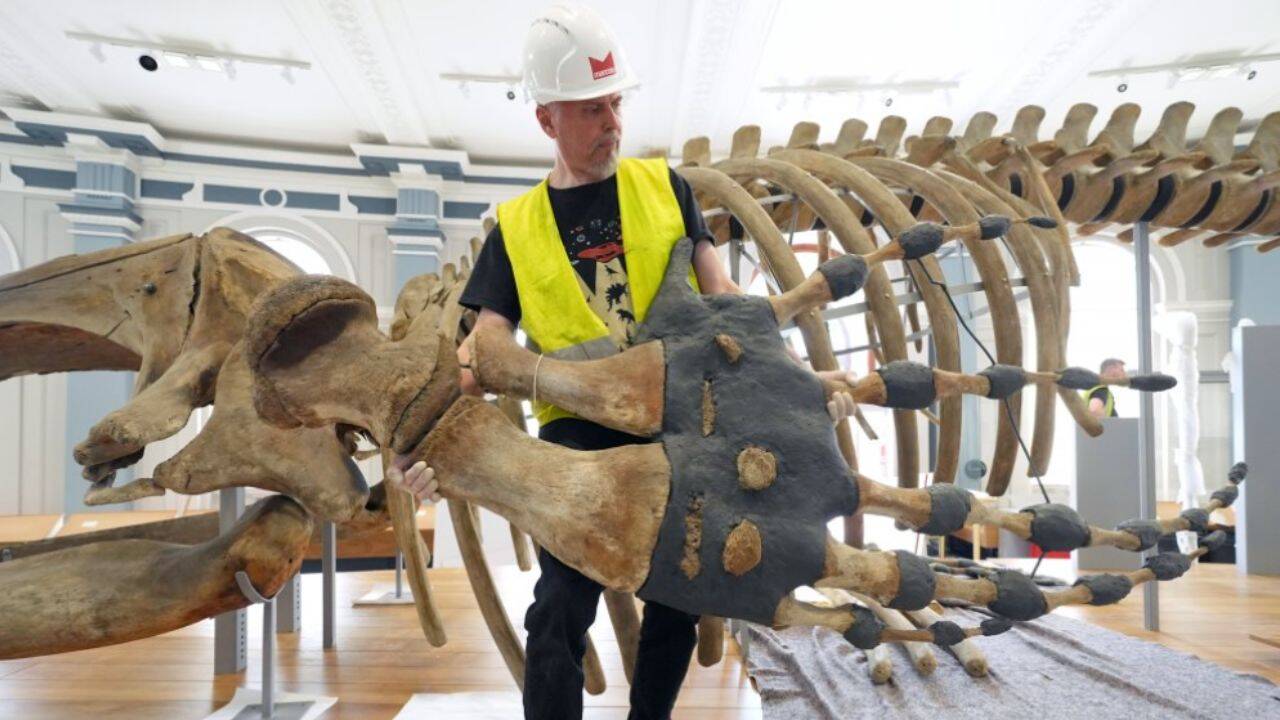
After six years away from the public eye, the 120-year-old North Atlantic right whale skeleton is returning to its home at the Hull Maritime Museum. This massive specimen, a relic of a bygone era when Hull was a dominant global whaling hub, has undergone an extensive conservation process designed to preserve its fragile, oil-soaked bones for future generations. While local officials celebrate this homecoming as a triumph of cultural preservation, the return of the giant carcass forces a deeper, more uncomfortable confrontation with the city's historical prosperity and the ongoing ecological crisis facing this critically endangered species.
The return of the skeleton is not just a standard museum update. It is a complex engineering feat and a stark reminder of how human industry reshaped the natural world. You might also find this connected coverage insightful: Why Russia Might Risk a Limited Kinetic Strike on NATO This Year.
A Dark Industrial Legacy Hanging from the Ceiling
To understand the weight of this skeleton, one must understand the city that claimed it. Hull did not merely participate in the whaling trade; the city was built on it. During the height of the Arctic whaling trade in the eighteenth and nineteenth centuries, fleets departed from the Humber estuary to hunt bowhead and right whales to the brink of extinction.
The oil harvested from these creatures lit the streets of London and lubricated the machinery of the Industrial Revolution. It was a brutal, bloody business that generated immense wealth for Hull's merchant class while systematically decimating marine ecosystems. As reported in recent reports by Reuters, the implications are significant.
This specific North Atlantic right whale did not die during the golden age of Hull's whaling fleet. It was stranded on the coast of Long Island, New York, in 1907. The museum acquired it shortly after, displaying it as a monument to a trade that had already begun to collapse.
By hanging the skeleton from the ceiling, the museum created a secular shrine to human dominance over nature. For over a century, visitors looked up at the massive ribs, often unaware of the grim reality of the whaling industry that made such an exhibition possible.
The Chemistry of Decay inside Century Old Bones
When the skeleton was lowered in 2020 to facilitate the museum's multimillion-pound refurbishment, conservators faced a silent, slow-motion disaster. Cetacean bones are unlike those of land mammals. They are incredibly porous and saturated with heavy oils.
In life, this oil provides buoyancy and energy storage. In death, and over a century of display in a drafty, poorly climate-controlled Victorian building, that oil presents a major preservation challenge.
Over decades, the residual oil inside the whale's bones slowly migrates to the surface. When it contacts oxygen, it oxidizes, turning a dark, sticky yellow-brown. This process is not merely unsightly. The oxidizing oil becomes highly acidic, gradually eating away at the calcium carbonate structure of the bone itself, turning solid skeletal elements into crumbly, fragile structures.
Conservators had to systematically extract this deeply embedded grease. The process involved wrapping the bones in poultices soaked in specialized solvents, allowing the oil to be drawn out of the deep pores without compromising the structural integrity of the skeleton.
Every single vertebra, rib, and jawbone had to be cleaned, stabilized, and consolidated with conservation-grade resins like Paraloid B-72. This painstaking work took years, revealing the true fragility of a specimen that appears, from a distance, to be indestructible.
The Logistical Nightmare of Moving a Leviathan
Reassembling a right whale skeleton is not a simple task of matching bone to bone. It is an industrial rigging operation that requires structural engineers, specialized transport, and custom-built steel supports.
The skeleton weighs several tons. Hanging such a massive weight safely inside a historic building, without damaging either the specimen or the architecture, requires precise calculations.
+-----------------------------------------------------------------+
|               CHALLENGES OF SKELETAL RECONSTRUCTION             |
+-----------------------------------------------------------------+
| 1. Structural Load Limits of Historic Ceilings                  |
| 2. Thermal Expansion and Contraction of Metal Armatures         |
| 3. High Humidity Accelerating Bone Decompression and Decay      |
| 4. Micro-vibrations from Urban Traffic Shaking Joints Loose     |
+-----------------------------------------------------------------+
The original iron armature that held the bones together since the early twentieth century was entirely outdated. Iron rusts, and as it rusts, it expands, causing internal pressure that can split ancient bones from the inside out.
An entirely new, bespoke stainless steel skeleton-within-a-skeleton had to be engineered. Each collar, sleeve, and support rod was custom-shaped to cradle the bones gently, distributing the weight evenly across the building's load-bearing structures rather than stressing individual points of the fragile bone.
Transporting these pieces back into the heart of Hull presented its own set of urban hurdles. Narrow streets, historic doorways, and delicate interior plasterwork meant the whale had to arrive in highly secure, climate-controlled crates, jigsawed together on-site by a team of specialist art handlers working at height.
The Silent Crisis in the North Atlantic
While Hull celebrates the preservation of its historic specimen, the living relatives of this whale are facing a swift path toward extinction. The North Atlantic right whale is one of the most endangered large whale species on Earth.
Current estimates suggest that fewer than 360 individuals remain in the wild. Of those, fewer than 70 are breeding females.
The threats they face today are no longer the harpoons of Hull's historic fleets, but modern industrial hazards that are just as lethal.
- Vessel Strikes: High-speed shipping lanes intersect directly with the whales' migratory routes along the eastern coast of North America, leading to catastrophic blunt-force trauma or fatal propeller lacerations.
- Entanglement: Commercial fishing gear, particularly heavy ropes used in lobster and crab fisheries, wraps around the whales' mouths, flippers, and tails, dragging them down, causing slow starvation or drowning.
- Ocean Noise: Noise pollution from shipping, sonar, and seismic exploration disrupts the low-frequency communication these whales rely on to find mates and navigate.
The preserved skeleton in Hull is a stark reminder of what happens when human economic interests are prioritized over ecological survival. The museum has an opportunity to use this exhibit not as a nostalgic celebration of Hull's maritime past, but as an urgent warning about the future of global marine life.
A Museum Reimagined for an Ecological Age
The return of the whale skeleton marks a critical moment for the Hull Maritime Museum as it prepares to reopen to the public. Museums are no longer expected to be passive cabinets of curiosity, displaying the spoils of empire and industry without context.
To truly honor this animal, the new exhibition must reject the romanticized myth of the heroic whaler. It must tell the story of the whale itself, the devastating impact of global whaling, and the current battle to save the remaining population from vanishing entirely.
The restored bones hanging in the gallery should not be viewed as a trophy of human achievement. They are a monument to a species we almost destroyed, and a reminder of the fragile thread by which the remaining North Atlantic right whales currently hang.