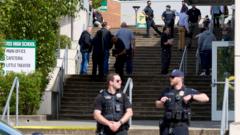
The linoleum in a high school hallway has a specific, clinical scent. It smells of lemon-scented industrial wax and the lingering, phantom salt of a thousand damp sneakers. On a normal Tuesday in Marysville, Washington, that smell is just the backdrop to the chaotic symphony of teenage life—the rhythmic slamming of lockers, the high-pitched burst of a laugh, the frantic shuffling of papers before a chemistry quiz.
But when the air changes, it doesn't happen all at once. It happens in the jagged edges of a scream that doesn't fit the melody.
We tend to consume the news as a series of data points. We see a headline that reads "Six injured in Washington state school stabbing" and our brains immediately begin a grim sort of accounting. We count the victims. We check the location. We look for a motive, as if a "why" could ever act as a tourniquet for a "what." We process the event as a tragedy, yes, but we process it as an abstraction. We read it through the glass of a smartphone screen, safe in the knowledge that our own hallways are silent.
To understand what happened at Marysville-Getchell High School, you have to move past the tally. You have to stand in the quiet that followed the noise.
The Anatomy of a Second
Time is elastic. For the students inside those walls, the seconds didn't tick; they stretched and snapped.
Imagine a student—we will call her Maya, a composite of the many who were there—sitting in a classroom, complaining about the fluorescent lights. She is thinking about lunch. She is thinking about a text she forgot to send. Then, the intercom crackles. It isn't the usual administrative drone. It is the sound of a voice stripped of its professional veneer, raw and vibrating with a primal urgency.
"Lockdown."
In that moment, the "six injured" are not a statistic. They are classmates. They are the boy who sits three rows back in English. They are the girl who always has an extra pen. The violence wasn't a distant phenomenon; it was an intrusion into a sanctuary.
Reports later confirmed that the attacker, a student himself, used a blade to turn an ordinary morning into a crime scene. Five students and one adult. Six lives intercepted by a sudden, sharp reality. When we talk about school safety, we often discuss "robust" security measures or "leveraging" technology, but none of those words account for the sheer, shivering vulnerability of a hallway that was supposed to be a bridge to a future.
The Ripples in the Water
When a stone is dropped into a pond, the splash is only the beginning. The ripples are what redefine the shoreline.
The immediate aftermath of the Marysville stabbing was a choreographed chaos. First responders, sirens cutting through the Pacific Northwest mist, the frantic perimeter of parents gathered behind yellow tape, clutching their phones like talismans. But the real story isn't in the flashing lights. It is in the days that follow, when the yellow tape is gone and the lemon-wax smell returns to the hallways.
The "injured" are often categorized by the severity of their physical wounds. We hear terms like "stable condition" or "non-life-threatening," and we exhale. We think the danger has passed. But trauma doesn't work on a linear timeline. A physical wound heals with stitches and time; a psychological fracture can take a lifetime to reset.
Consider the invisible stakes. For every one of the six who felt the steel, there are hundreds more who felt the fear. There are teachers who now scan every doorway before they pick up a piece of chalk. There are parents who linger a few seconds longer at the drop-off line, watching their children disappear into the building with a knot in their stomachs that never quite unbinds.
The cost of such an event is not measured in medical bills alone. It is measured in the loss of innocence. It is the tax paid by a community that can no longer assume the bell signifies the end of a lesson, but rather a temporary reprieve.
The Myth of the Outlier
It is tempting to look at Marysville and call it an anomaly. We want to believe that these events are lightning strikes—rare, unpredictable, and disconnected from the broader fabric of our culture. We want to "demystify" the attacker, to find a single thread we can pull to make the whole garment unravel.
Was it bullying? Was it mental health? Was it a failure of the system?
The truth is usually far more complicated and far less satisfying. When we search for a single cause, we ignore the environment that allows these tensions to simmer. We treat the stabbing as the disease, when it is actually the symptom.
The Pacific Northwest, with its towering evergreens and grey-blue skies, often feels like a place of brooding quiet. But beneath that quiet is a generation of young people navigating a world that feels increasingly volatile. They are the first generation to grow up with the "lockdown drill" as a standard part of their curriculum, right alongside algebra and physical education. They have been trained to hide, to silence their phones, and to wait for the "all clear."
This is the hidden cost. We have traded the freedom of the playground for the fortress of the classroom. We have taught our children that the person standing next to them in the cafeteria could, in a heartbeat, become a threat.
The Weight of the "Only"
There is a specific kind of exhaustion that settles into a town after the news trucks leave.
The reporters got their quotes. The anchors delivered their somber closing remarks. The world moved on to the next headline, the next political scandal, the next viral trend. But in Marysville, the seats in those classrooms remained empty for a time. When they were filled again, the air was heavier.
The six who were injured carry the physical reminders. Scars that itch when the weather changes. A sudden flinch at the sound of a dropped book. But the weight of the "only" is what lingers for the rest of the community.
It was only six.
It could have been more.
It was only a knife.
That "only" is a lie we tell ourselves to stay sane. It minimizes the violation. It suggests that as long as the body count doesn't reach double digits, we have somehow escaped the worst of it. But there is no "only" when it comes to the safety of a child. There is no acceptable margin of error for the places where we send our youth to grow.
The Quiet Recovery
Healing isn't a headline. It doesn't happen in a "cutting-edge" medical facility or through a "game-changing" policy shift. It happens in the small, agonizingly slow moments of reconnection.
It happens when a teacher notices a student is staring out the window for too long and pulls them aside, not to talk about grades, but to talk about life. It happens when a group of friends decides to walk together between classes, creating a human shield of normalcy. It happens when a community refuses to let the name of the school be synonymous with the name of the tragedy.
The Marysville-Getchell incident remains a dark chapter in the history of Washington state education. It serves as a reminder that violence is not always a distant roar; sometimes, it is a whisper in the hall. It is a reminder that the stakes of our educational environment are not just academic achievement or career readiness. The stakes are the very souls of the people inside.
We often talk about resilience as if it were a shield, something we can put on to deflect the arrows of the world. But true resilience is more like skin. It is thin, it is sensitive, and it bleeds when it is cut. But it also has the miraculous ability to knit itself back together, to grow stronger over the wound, and to keep protecting the life underneath.
As the sun sets over the Snohomish River, the school stands silent. The buses are parked. The lights are dimmed. In the morning, the doors will open again. The students will stream in, their backpacks heavy with books and dreams and the quiet, unspoken memory of a Tuesday that changed everything. They will walk those lemon-waxed floors, and they will try, one step at a time, to find the melody again.
A backpack left in a locker. A half-finished essay on a desk. A chair pushed back in haste. The echoes of a scream are eventually drowned out by the persistent, stubborn hum of life continuing, but the silence that remains is never quite the same as the silence that came before.


