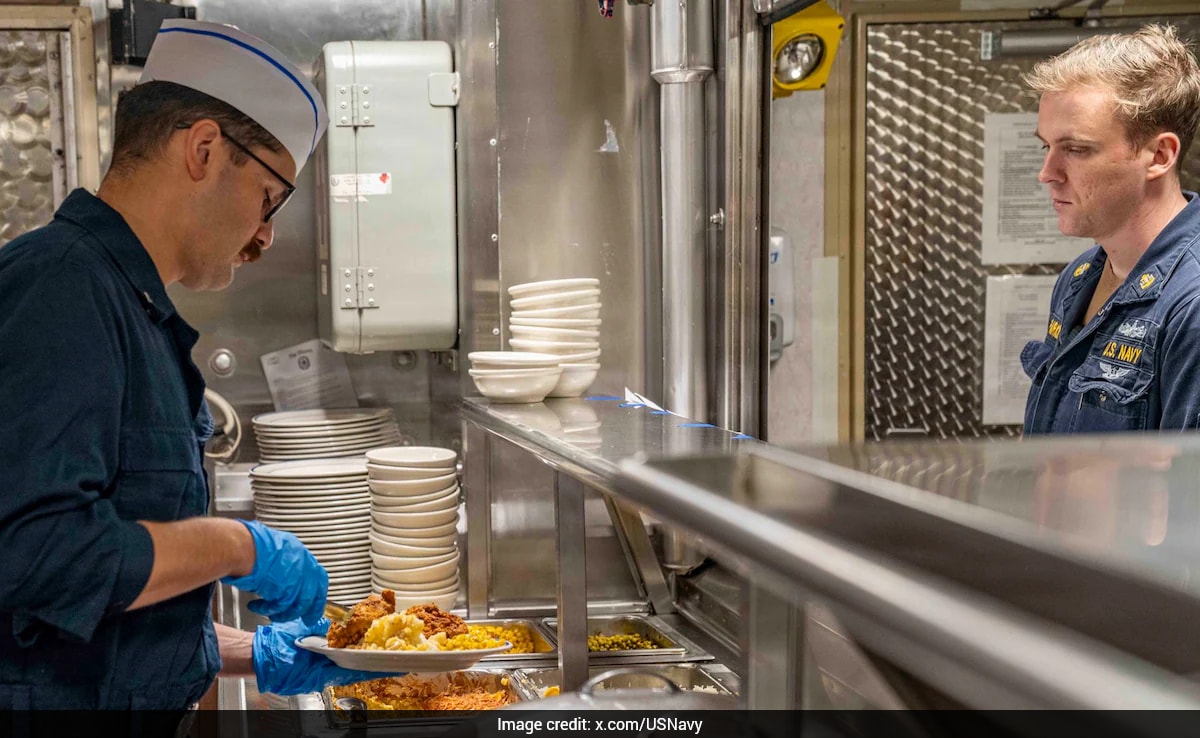
Five thousand people live on the USS Abraham Lincoln. That’s a floating city made of steel, jet fuel, and high-tension nerves. If you've ever tried to plan a dinner party for ten people, you know it's a nightmare. Now imagine doing that four times a day, every day, while moving through the middle of the ocean. The US Navy doesn't use a 21-day meal cycle because they’re lazy or lack imagination. They do it because the alternative is total logistical collapse.
When you’re trapped on a Nimitz-class aircraft carrier, food is more than just fuel. It’s the only way sailors track time. On a ship with no windows and 18-hour workdays, "Taco Tuesday" isn't a cheesy marketing gimmick. It's a psychological anchor. If it’s mid-afternoon and you smell seasoned beef, you know exactly what day of the week it is without looking at a calendar.
The Math Behind Five Thousand Mouths
The sheer scale of the food operation on the USS Abraham Lincoln is hard to wrap your head around. We aren't talking about a couple of pallets of frozen pizza. We’re talking about roughly 15,000 meals served every 24 hours. To make that happen, the ship’s supply department has to manage a supply chain that starts months before the ship even leaves the pier.
Logistics officers have to account for every calorie. A standard 21-day cycle allows the "Culinary Specialists"—the Navy’s term for cooks—to standardize their ordering. They know exactly how many thousands of eggs, gallons of milk, and pounds of dry pasta they need for a three-week block. If they changed the menu every day for six months, the inventory tracking would become an impossible mess.
Supply ships, known as "Combat Logistics Force" ships, meet the carrier at sea for "replenishment at sea" or RAS. They pull up alongside, tensioned wires are thrown across, and pallets of food are swung over the open water. Because space on a carrier is tight—even for a ship that's 1,092 feet long—you can't just stock up on whatever looks good at the pier. You need a predictable, recurring list of items that fit into the massive walk-in freezers and dry storerooms.
Why 21 Days is the Magic Number
You might wonder why they don't go with a 7-day or 14-day cycle. A week is too short. You’d get bored of meatloaf every Monday by the second month of a deployment. 14 days is better, but it still feels repetitive during a long seven-month cruise in the South China Sea. 21 days is the sweet spot. It’s long enough that you don't feel like you just ate the same thing yesterday, but short enough to keep the supply chain lean.
This cycle also accounts for the "freshies." Fresh fruits and vegetables usually run out about two weeks after a resupply. By day 21, the cooks are digging into the frozen and canned goods. This transition is baked into the menu design. The first week of the cycle might feature fresh salads and fruit, while the third week leans more on "shelf-stable" ingredients like canned corn or reconstituted potatoes.
Moral is the Only Real Currency
Food is the biggest morale booster on a ship. It’s also the biggest morale killer. If the food sucks, the crew gets cranky. If the crew gets cranky, mistakes happen. On a flight deck where jets are landing every 45 seconds, mistakes are fatal.
The Navy puts a lot of weight on "Midrats"—midnight rations. This is the meal served from 2300 to 0100 for the sailors working the night shift. Often, Midrats consists of leftovers from the day’s lunch and dinner, but on the USS Abraham Lincoln, the cooks try to spice it up. Even within the 21-day cycle, there's room for "Special Meals."
Think of Steel Beach Picnics. When the ship has been at sea for a long stretch, they’ll pull the crew up to the flight deck for a BBQ. They flip burgers and hot dogs under the sun. It breaks the 21-day monotony. It’s a pressure valve for the stress of deployment.
The Culinary Specialist Grind
Being a cook on the Lincoln is a thankless job. You’re up at 0300 to start breakfast. You’re working in a kitchen that’s constantly tilting and swaying. You’re dealing with massive steam kettles that could cook a whole person.
The 21-day cycle helps these sailors master the recipes. When you're making chili for 5,000 people, you can't really "wing it." You need a standardized recipe card that has been scaled up to industrial proportions. By repeating these meals, the quality stays consistent. You don't want a "new" version of lasagna every time; you want the version that you know tastes decent and won't give the entire reactor department food poisoning.
Trash is the Final Boss
One thing the competitor articles never mention is what happens to the waste. You can't just throw 15,000 people's worth of trash overboard. The Navy has strict environmental rules.
Food waste is pulped. It gets ground down into a slurry and discharged into the sea (where it’s basically fish food). Everything else—plastic, metal, cardboard—has to be processed, melted into "slugs," or stored. A predictable 21-day menu means the waste management team knows exactly how much trash to expect. They know that on "Burger Day," they’re going to have a massive amount of cardboard from the bun boxes. Planning the menu is as much about the exit strategy as it is about the entry.
What You Can Learn From Navy Planning
You don't need to be an Admiral to use these tactics. If you’re struggling with meal prep or a budget, a 21-day cycle is actually a brilliant life hack.
Stop trying to find 30 new recipes every month. It’s exhausting. Find 21 meals you actually like. Group them into three weeks. This lets you buy in bulk, reduces your decision fatigue, and ensures you aren't wasting food. Most of us eat the same five things anyway. Admitting it and systematizing it just makes your life easier.
The USS Abraham Lincoln isn't just a warship; it's a masterclass in efficiency. The next time you're annoyed that it's "Chicken Day" again, just remember that consistency is what keeps that ship's engines turning and its sailors fed in the middle of nowhere. If it's good enough for a nuclear-powered carrier, it's probably good enough for your kitchen.
To start your own cycle, don't overcomplicate it. Pick seven "easy" meals, seven "moderate" meals, and seven "special" meals. Rotate them. You'll save money on groceries and hours of staring at an open fridge wondering what to cook.