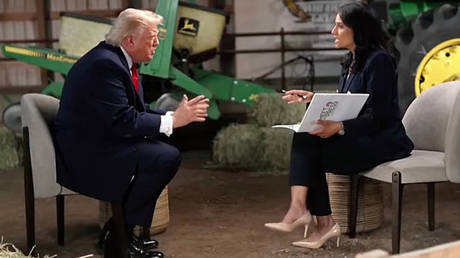
You knew it was going to happen eventually. Put a sitting president in a room with a journalist who actually insists on verification, and the clock starts ticking. On June 7, 2026, the timer ran out in a literal metal barn in Chippewa Falls, Wisconsin.
President Donald Trump sat down with NBC's Meet the Press moderator Kristen Welker for what was supposed to be a standard, wide-ranging policy interview covering everything from immigration to the three-month-old war with Iran. Instead, the entire taping derailed into a shouting match over election integrity, culminating in Trump yanked off his microphone and storming out.
"Let's call it quits because I've had enough," Trump muttered before walking off the set. "Thank you, darling."
This wasn't just a typical media-bashing session. The 50-minute interview, which played out against the backdrop of torrential rain pounding on a tin roof, exposed the structural friction that defines the second Trump administration. It's an aggressive, reality-bending playbook that hits an absolute wall the moment someone asks a basic question: Where is the proof?
The Breaking Point: From War Policies to Wet Ballots
The interview actually started with massive geopolitical stakes. Trump defended his aggressive stance on Iran, openly contradicting his 2024 campaign promise of an era with "no new wars." He bluntly told Welker, "as a candidate, I didn't promise anything," arguing that his military actions were a global service to stop Tehran from securing nuclear weapons.
But things turned hostile when Welker shifted the topic to domestic policy—specifically, the administration's legal agenda and the controversial, stalled $1.776 billion "Anti-Weaponization Fund."
The fund was designed to compensate individuals who claim they were unfairly targeted by the Biden administration’s Justice Department. The Justice Department recently put the brakes on the project after federal judges paused it and lawmakers raised serious concerns about accountability. When Welker pressed Trump on whether the billions would go to Jan. 6 rioters—specifically the 172 individuals who pleaded guilty to assaulting police officers—Trump refused to rule it out.
Instead, he went on the attack. Trump claimed the rioters were "destroyed by dirty cops" and that FBI informants had practically ushered them into the building. When Welker noted that inspector general reports found no such evidence, Trump pivoted to his ultimate defensive shield: the election system itself.
The California Counting Crisis That Isn't
The real explosion happened when Trump asserted that both the 2020 presidential election and the June 2026 California primaries were actively being "rigged."
His logic? The state of California was taking more than four days to finalize its vote tallies.
Because early mail-in trends favored his preferred candidates for governor and Los Angeles mayor, and late-arriving ballots were shifting the margins, Trump declared the entire process a fraud. "It’s a dirty election, and it’s happening again right now in California," Trump insisted.
Welker pointed out the obvious reality of California election law. The state allows mail-in ballots postmarked by Election Day to be counted up to a week later. It's a slow, deliberate system, not a criminal conspiracy.
- Trump: "You know why they're doing that? Because they're cheating on the election."
- Welker: "Do you have evidence?"
- Trump: "All I have to do is look."
That exchange is the entire political era in a nutshell. For Trump, looking at a trend he dislikes is identical to discovering hard evidence of a crime. When Welker refused to accept "looking around" as legal proof, the conversation completely dissolved.
The Crooked or Stupid Trap
When a public official runs completely out of factual road, they usually do one of two things: change the subject or attack the messenger. Trump did both with spectacular force.
He didn't just call NBC unfair. He turned it directly on Welker, telling her, "Your press is crooked and Meet the Press is crooked."
When Welker calmly defended her professional integrity, stating, "To be fair, I'm not crooked," Trump offered a classic false dilemma. "Really? Well, you play right into their hands then. You're either crooked or you're stupid."
This is the core rhetorical strategy of the current administration. If you validate the official institutional processes—whether it's the Justice Department, the courts, or state election boards—you are labeled corrupt. If you simply report what those entities find, you are labeled incompetent. There is no middle ground allowed, no room for nuance, and certainly no tolerance for standard journalistic fact-checking.
Why This Walkout Matters for the Rest of 2026
If you think this was just a flash-in-the-pan television drama, you’re missing the bigger picture. This walkout is highly predictive of how the administration intends to handle governance through the remainder of this term.
First, it signals a complete rejection of institutional oversight. By doubling down on the weaponization fund and attacking the DOJ for stalling it, Trump is signaling that he views independent legal standards as mere roadblocks to be bypassed.
Second, it confirms that election denialism isn't a retrospective grievance from 2020; it’s an active operational strategy for upcoming midterms and state races. If a Republican candidate falls behind during a standard, legal vote-counting period, the official White House narrative will immediately label the process fraudulent.
Finally, it sets a dangerous precedent for press access. Trump later claimed to supporters at an agricultural roundtable that he only got angry because of the rain. Welker even noted that Trump agreed the weather caused complications and tentatively lined up a future appearance. But the tactical utility of the walkout is undeniable. It allows the administration to dominate the news cycle while completely avoiding accountability on complex policy issues like the war in Iran or the collapsing logistics of federal compensation funds.
To protect yourself from getting swept up in the inevitable media circus that follows these blowups, you need to change how you consume political news. Stop focusing on the volume of the insults. Don't get distracted by the spectacle of a political leader walking out of a barn in the middle of a rainstorm.
Instead, look directly at the gaps the spectacle is trying to hide. When an interview ends abruptly after a demand for evidence, the lack of evidence is your actual story. Track the policy rollbacks, watch the federal court rulings on the anti-weaponization fund, and monitor how state election processes actually function. The noise is designed to make you look away from the mechanics of government. Don't let it.