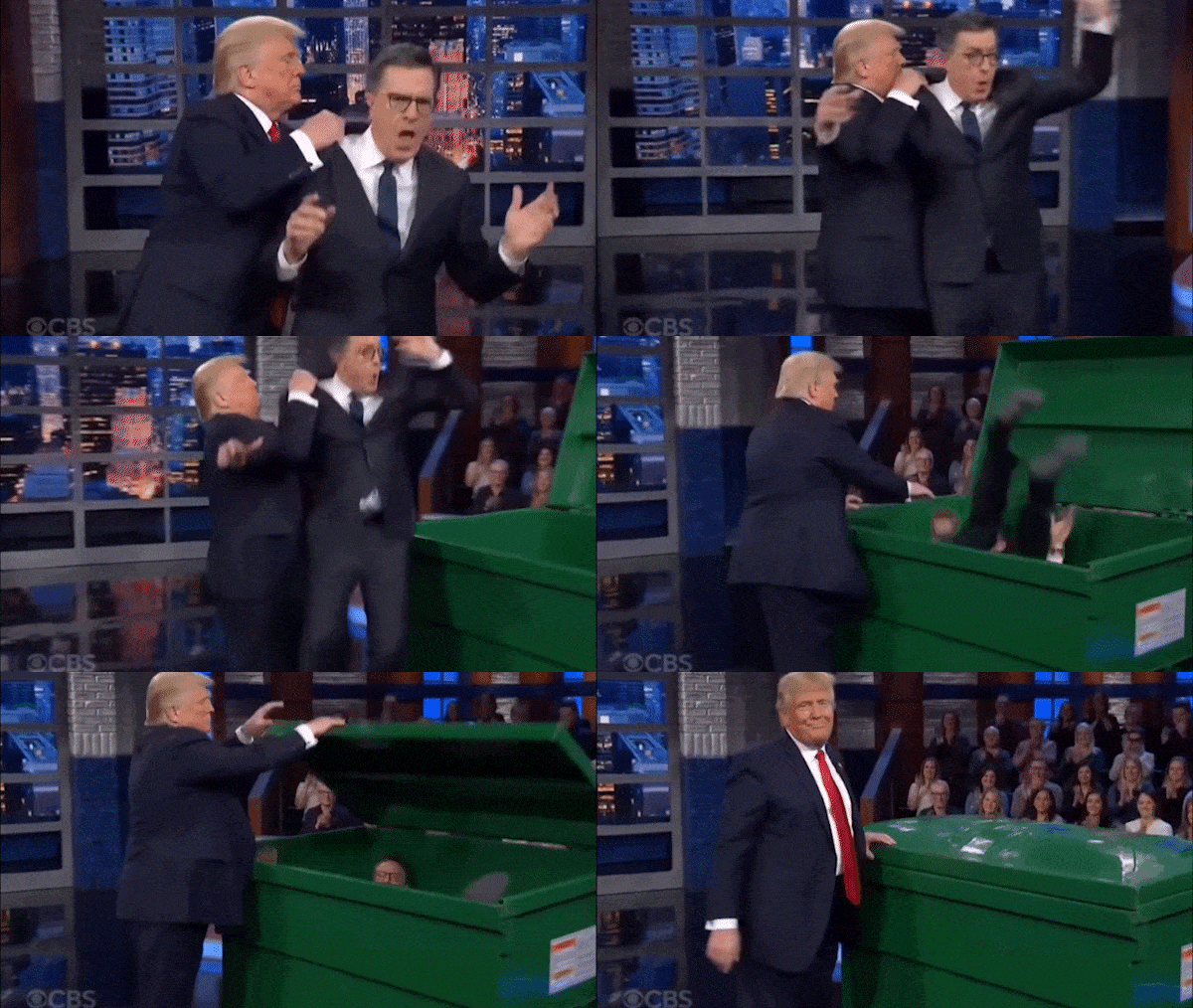
Donald Trump spent his Friday night doing exactly what you might expect a tech-era politician to do. He went online and shared a deeply bizarre, AI-generated video of himself walking onto a late-night set, physically lifting comedian Stephen Colbert, and throwing him headfirst into a giant green dumpster. The video ends with a digital avatar of the president doing his signature rally fist pumps to the beat of "YMCA."
It’s easy to dismiss this as standard, low-brow internet slop. But look closer at the timing. For another view, read: this related article.
The video hit the internet just hours after Colbert signed off from CBS for the very last time. After eleven years hosting The Late Show, Colbert’s program was abruptly axed by the network. While CBS claims the move was strictly a financial casualty of dying linear television revenues, the backdrop is much messier. The network recently shelled out a massive $16 million settlement to Trump after he accused them of maliciously editing a campaign interview with Kamala Harris. Throw in Paramount’s pending $8.4 billion merger with Skydance Media, which requires heavy federal oversight, and the political undertones become impossible to ignore.
This isn't just a petty victory lap. It shows exactly how deepfakes and generative tech are becoming standard tools for political score-settling. Similar coverage on this matter has been published by Entertainment Weekly.
The Petty Art of the Generative Victory Lap
Trump’s Truth Social and X accounts have increasingly become repositories for weird synthetic media. We've seen the AI-generated images of him dressed as a doctor, or flanked by angelic hosts as a modern-day savior. But the Colbert dumpster clip represents a shift from weird self-aggrandizement to active, weaponized mockery.
The video didn't just stay on Trump's personal feed either. The official White House social accounts later reposted the clip with a blunt, two-word caption: "Bye-bye."
When a state-sanctioned communications channel uses synthetic media to celebrate the downfall of a prominent media critic, we cross a weird line. It turns a piece of goofy internet culture into a form of digital exile. Colbert spent a decade using his monologue to rip Trump apart. Trump couldn't fire him, but the moment the network pulled the plug, the administration used generative software to rewrite the narrative, visually dominating a rival in a way that would be impossible in the real world.
Behind the Sudden Death of The Late Show
The real story here is the quiet panic happening inside legacy media boardrooms. Trump blasted Colbert on Truth Social right as the finale wrapped, calling him a "pathetic trainwreck" with "no talent, no ratings, no life."
But Trump’s claims about ratings don't hold up. Colbert actually went out on top. His final episode brought in a massive 6.74 million viewers, more than doubling his normal season average. He was still the king of late-night broadcast numbers.
So why did CBS cancel its most stable late-night franchise?
The entertainment industry is bleeding cash as cord-cutting accelerates. Keeping a massive, multi-million-dollar production running in New York City’s Ed Sullivan Theater is a brutal financial burden when viewers are moving to TikTok and YouTube clips. But you can't ignore the timing of the Paramount-Skydance merger. When a massive media conglomerate needs favors and approvals from antitrust regulators, the last thing they want is a nightly monologue driving the president insane.
Colbert seemed to understand the writing on the wall. His final episode featured a star-studded send-off with Paul McCartney, Jon Batiste, and Ryan Reynolds. He didn't even mention Trump’s name once during the finale. Instead, he used a running gag about a CGI wormhole as a metaphor for the chaotic state of American public life.
Why Traditional Satire is Losing to the Algorithm
The dumpster video highlights a much bigger problem for comedians: traditional satire can't keep up with the sheer speed of algorithmic culture.
For decades, late-night hosts held an incredible amount of cultural power. They got the final word on the day's political news. If a politician made a mistake, Johnny Carson, Jay Leno, or Jon Stewart would mock them, and that joke became the defining narrative.
Generative media completely flips that dynamic. A politician no longer has to sit there and take the joke. They don't even need to write a clever press release. They can just log onto an app, type a prompt, and generate a video that turns their critic into a literal clown. It requires zero wit, takes five minutes to make, and spreads across social platforms faster than a polished network monologue ever could.
We're looking at a future where political counter-programming is entirely automated. If a news anchor breaks a negative story or a comedian lands a sharp joke, the immediate response won't be a factual correction. It will be a wave of synthetic memes designed to muddy the waters and humiliate the messenger.
Navigating the Slop Era of Political Media
We are officially living in the era of political "slop"—high-volume, low-effort synthetic content designed to trigger immediate emotional reactions. It's messy, it's often ugly, and it's not going away. Since we can't stop the proliferation of these tools, the trick is learning how to consume media without losing your mind.
- Look for the real leverage point: Don't get distracted by the visual weirdness of a video. Trump dancing to "YMCA" next to a trash can is the shiny object meant to grab headlines. The real story is the corporate media landscape, the $16 million CBS settlement, and the regulatory approvals happening in Washington.
- Expect the corporate retreat: Media companies are increasingly risk-averse. As political polarization worsens, large networks will likely continue to scale back on sharp, partisan satire to protect their business interests and corporate mergers.
- Verify the source trail: When official government accounts start sharing deepfakes and AI edits, the line between official state communication and internet trolling vanishes. Always check whether a clip is a real broadcast moment or a generated piece of fan-fiction before sharing it.
The late-night format is changing forever, and the tools used to mock it are getting weirder by the day. Colbert got his final massive ratings spike, but Trump got the last word on the timeline.
If you want to understand how deepfakes are shifting from technical oddities into genuine political communication strategies, check out this breakdown on How AI Video is Changing Modern Politics. This video analyzes the rise of unhinged meme-posting and how political figures use synthetic media to bypass traditional press filters entirely.