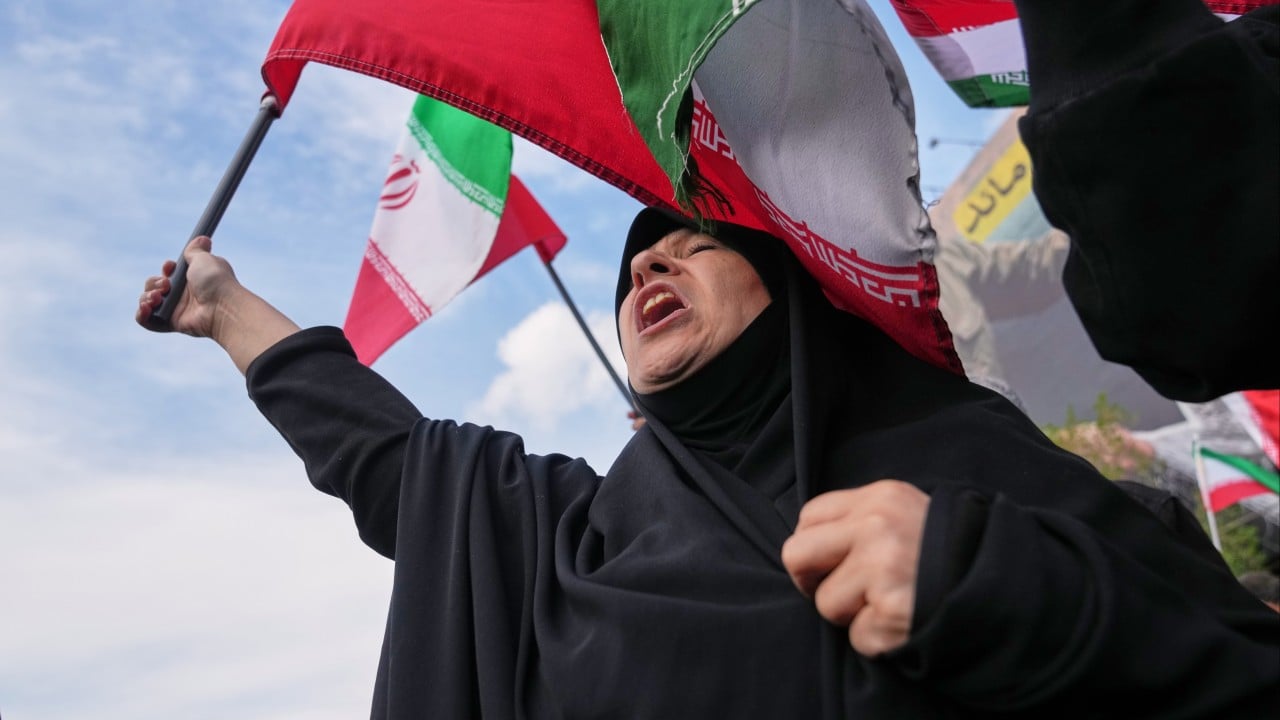
The current shift in Middle Eastern security architecture is defined by Iran’s transition from a doctrine of "Strategic Patience" to a formal "Integrated Deterrence" model, leveraging Chinese diplomatic capital as a structural floor for regional stability. Tehran’s recent assertions regarding ceasefire violations are not merely rhetorical escalations; they represent a calculated recalibration of the risk-reward ratio for US and Israeli kinetic operations. By positioning China as a security guarantor, Iran is attempting to externalize the cost of its defense, moving from a binary conflict with the West to a multilateral framework where any disruption of the status quo triggers economic and diplomatic friction for Beijing’s global interests.
The Mechanics of the Iranian Response Function
To understand the threat of making a competitor "regret" a ceasefire violation, one must quantify the Iranian response function. This is not a chaotic reaction but a sequenced escalation ladder designed to achieve maximum psychological and economic disruption with minimum direct military exposure.
The Asymmetric Kinetic Variable
Iran’s primary mechanism for enforcing a ceasefire is the activation of the "Ring of Fire"—a decentralized network of non-state actors capable of simultaneous multi-axis strikes. This system operates on a cost-asymmetry principle:
- Financial Disparity: The cost of an Iranian-designed Shahed-136 drone (approximately $20,000 to $50,000) vs. the cost of a naval interceptor missile (upwards of $2 million).
- Target Saturation: The ability to launch swarms that overwhelm Aegis or Iron Dome radar systems through sheer volume rather than technological parity.
- Geographic Chokepoints: The tactical capacity to close the Strait of Hormuz or disrupt the Bab el-Mandeb, effectively taxing 20% of global oil transit and 12% of global trade.
The Cyber and Infrastructure Variable
Beyond kinetic strikes, Tehran views critical infrastructure as a legitimate theater for retaliation. A ceasefire violation would likely trigger a shift from "espionage-first" cyber operations to "disruption-first" campaigns targeting desalination plants, electrical grids, and logistics hubs. This serves to erode the domestic political stability of the adversary without crossing the threshold of conventional war.
China as a Security Guarantor: Rationality vs. Reality
The pivot toward China as a guarantor is a strategic move to leverage Beijing’s dependency on Middle Eastern energy. However, the term "guarantor" in this context does not imply a mutual defense treaty or the deployment of the People's Liberation Army (PLA). It refers to Strategic Interdependence.
The Energy-Security Feedback Loop
China currently imports roughly 1.5 million barrels of Iranian oil per day, often processed through "teapot" refineries and settled in Yuan. This creates a structural buffer:
- Economic Shielding: Because these transactions bypass the SWIFT system and the US Dollar, they are largely immune to traditional treasury sanctions.
- Diplomatic Leverage: China’s veto power on the UN Security Council serves as the ultimate procedural roadblock against multilateral "snapback" sanctions.
- The Mediation Premium: By acting as the broker for the Saudi-Iran normalization, China has staked its prestige on regional stability. A violation of a ceasefire negotiated under this umbrella is interpreted by Beijing not just as a local skirmish, but as an affront to Chinese diplomatic credibility.
Limitations of the Chinese Umbrella
The primary constraint of this guarantee is China's "Non-Interference" policy. Beijing seeks the benefits of a hegemon without the security costs. If a conflict escalates to a full-scale regional war, China’s priority remains the protection of its own energy supply lines, not the survival of the Iranian regime. This creates a "Moral Hazard" where Tehran may overestimate the level of protection provided by Beijing, leading to riskier tactical decisions.
The Three Pillars of Regional Recalibration
The current geopolitical friction is held in place by three distinct structural pillars. If any pillar is compromised, the "regret" Iran promises becomes a self-fulfilling prophecy of regional destabilization.
1. The Threshold of Tolerable Attrition
Iran has calculated that the US has a low tolerance for a prolonged, multi-theater conflict in the Middle East while simultaneously managing the Ukraine theater and the Taiwan Strait. Tehran’s strategy is to increase the "Price of Presence." Every violation of a ceasefire is met with a response that forces the US to choose between expensive escalation or a loss of regional face.
2. Technological Proliferation and the "Off-the-Shelf" War
The democratization of precision-strike technology has fundamentally altered the balance of power. Iran no longer needs a fifth-generation fighter jet to threaten an aircraft carrier. The proliferation of solid-fuel ballistic missiles and maneuverable reentry vehicles (MaRVs) means that any US or allied asset within a 2,000km radius is permanently within the "Weapon Engagement Zone" (WEZ).
3. The Yuan-Based Parallel Economy
The integration of Iran into the Shanghai Cooperation Organisation (SCO) and the expansion of BRICS provides a pathway for Iran to survive economic isolation. By diversifying its trade partners and adopting non-Western financial rails, Iran reduces the efficacy of the "economic war" traditionally used by the US to enforce compliance. This makes the threat of "regret" more credible, as Iran feels less vulnerable to the secondary effects of its own aggression.
Strategic Mapping of the Escalation Ladder
If a ceasefire violation occurs, the sequence of events follows a predictable, though dangerous, path.
Phase I: Proxy Activation and Deniable Friction
Initial responses occur through the "Axis of Resistance." This involves increased rocket fire from Lebanon, drone launches from Iraq, and maritime harassment by the Houthis. The goal is to create a "background noise" of insecurity that drains the resources and attention of the adversary without providing a clear casus belli for a direct strike on Iran.
Phase II: The "Grey Zone" Maritime Surge
Iran utilizes its IRGC Navy (IRGCN) to conduct "VBSS" (Visit, Board, Search, and Seizure) operations against commercial shipping. This directly impacts global insurance premiums (Lloyd's of London rates) and forces the international community to pressure the US for a de-escalation. The economic cost of a 1% rise in global oil prices is often more damaging to a US administration than a localized military setback.
Phase III: Direct Kinetic Signaling
This involves the use of the "Fattah" hypersonic missile or similar high-end assets. The intent is not to start a war, but to demonstrate that no target is unreachable. By striking a high-value military installation with precision, Iran signals that the "regret" is no longer theoretical.
The Structural Bottleneck of US Policy
The US faces a "Trilemma" in its Iranian strategy:
- Containment: Requires a massive permanent troop presence that is politically unpopular and strategically draining.
- Engagement: Requires concessions that alienate regional allies like Israel and Saudi Arabia.
- Inertia: Allows Iran to continue its nuclear and conventional buildup, eventually leading to a nuclear-armed Tehran.
The current ceasefire agreements are temporary patches on this fundamental structural flaw. By introducing China as a "guarantor," Iran has effectively added a fourth dimension to this trilemma, forcing the US to consider the "China Factor" in every tactical decision.
The Cost Function of Deterrence
Deterrence is not a static state; it is a dynamic equation where:
$$D = (P \times C) > B$$
Where $D$ is Deterrence, $P$ is the Probability of a response, $C$ is the Cost of that response, and $B$ is the Benefit of the initial violation. Iran’s current strategy is to artificially inflate $C$ through asymmetric warfare and ensure $P$ is perceived as 100% by using China as a political shield.
The risk of this model is "Inadvertent Escalation." If Iran miscalculates the US "Benefit" ($B$) of a specific strike—for instance, if a US service member is killed—the equation collapses, and the resulting conflict bypasses the "regret" phase and moves directly into a total regional war.
Strategic Forecast: The New Bipolarity
The Middle East is no longer a unipolar theater of US influence. The emergence of an Iran-China-Russia axis creates a "Contested Space" where the rules of engagement are being rewritten in real-time.
For commercial and diplomatic entities operating in the region, the strategic imperative is to move away from a reliance on "US Protection" toward a "Multi-Vector" approach. This involves:
- Hedging Political Risk: Establishing communication channels with both Western and Eastern power blocks.
- Infrastructure Hardening: Assuming that the "Integrated Deterrence" model will lead to frequent, low-level disruptions of digital and physical supply chains.
- Currency Diversification: Preparing for a landscape where trade in the Persian Gulf may increasingly be settled in non-dollar denominations to avoid the "Sanction Trap."
The stability of any future ceasefire depends not on the "will" of the participants, but on the continued alignment of China's economic interests with Iran's security requirements. Should Beijing find a more efficient way to secure its energy needs—perhaps through a direct deal with the GCC that excludes Tehran—Iran’s "guarantor" disappears, and the region reverts to a high-volatility state. Until then, the "regret" Iran promises serves as a crude but effective stabilizer in a fragmenting global order.