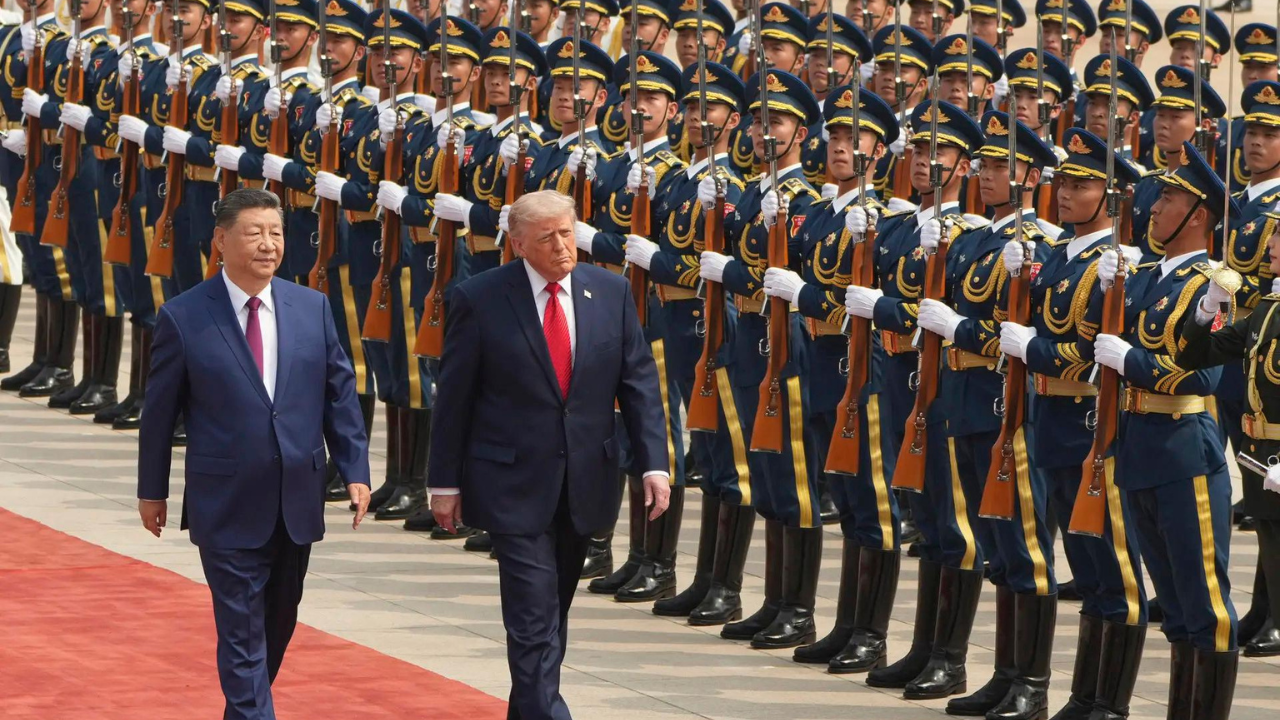
When Xi Jinping stood before American leaders to discuss the "Thucydides Trap," he wasn't offering a history lesson. He was issuing a cold-blooded warning. The term refers to a specific structural stress in international relations that occurs when a rising power threatens to displace an established one. It is a phenomenon where fear and miscalculation lead to a conflict that neither side originally wanted. For the United States and China, this isn't a theoretical exercise for academics. It is the friction underlying every trade tariff, every semiconductor export ban, and every naval maneuver in the South China Sea.
History shows us that this pattern is lethal. Graham Allison, the Harvard scholar who popularized the term, analyzed 16 historical cases where an emerging power challenged a ruling one. In 12 of those instances, the result was a catastrophic war. We are currently watching the 17th case unfold in real-time. This isn't about personality clashes between presidents or specific policy disagreements. It is about the tectonic plates of global influence shifting in ways that historically end in fire.
The Iron Logic of Power Displacement
The core of the Thucydides Trap lies in a simple, brutal psychology. The rising power feels it deserves more respect and a greater say in the rules of the world. Meanwhile, the established power views any change to the status quo as a direct threat to its security and prosperity. When Xi Jinping brought this up in Beijing, he was signaling that China views its ascent as inevitable and that any American attempt to "contain" that growth is an act of aggression.
This creates a spiral. In the fifth century BC, it was the growth of Athens and the fear this inspired in Sparta that made war inevitable. Today, replace Athens with China’s dominance in artificial intelligence and green energy, and Sparta with the American-led financial system. The shift is not just about GDP. It is about who writes the rules for the next century.
If the U.S. restricts China’s access to high-end chips, it sees it as protecting national security. China, however, sees it as a strangulation tactic designed to keep 1.4 billion people from achieving their potential. Both interpretations are technically correct within their own frameworks. That is what makes the trap so difficult to escape.
Why the Tech War is the Modern Front Line
Traditional warfare has been replaced, for now, by a relentless struggle for technological supremacy. Control over the silicon supply chain is the new naval blockade. In this version of the Thucydides Trap, the "territory" being fought over isn't land—it's the capability to compute.
Whoever leads in Artificial Intelligence (AI) will possess the ultimate economic and military advantage. This is why the rhetoric has sharpened. Washington’s "small yard, high fence" strategy—protecting a narrow set of critical technologies while allowing trade in others—is an attempt to manage the trap without triggering a total collapse. But the fence keeps getting higher, and the yard keeps getting bigger.
The Semiconductor Chokepoint
China currently spends more on importing semiconductors than it does on oil. This dependency is a strategic vulnerability that Beijing is moving mountains to erase. By pouring hundreds of billions into "Big Funds" for domestic chip production, China is attempting to decouple from the Western ecosystem.
On the flip side, the U.S. CHIPS Act is a massive industrial policy aimed at clawing manufacturing back to American soil. These are defensive crouches. When both sides are preparing for the worst-case scenario, they inadvertently make that scenario more likely.
The Miscalculation Factor
The greatest danger in the Thucydides Trap isn't a planned invasion. It’s an accident. In a high-tension environment, a minor collision between aircraft or a cyberattack on a power grid can be misinterpreted as the opening shot of a war.
Xi Jinping’s mention of the trap was an invitation to create "guardrails." He was essentially asking if the two nations could find a way to coexist where the U.S. accepts a secondary role in some regions and China accepts certain global norms. But there is little appetite in Washington for what many see as a policy of appeasement.
The U.S. political consensus has shifted toward a hardline stance. Being "soft on China" is a political death sentence in the current American climate. This internal political pressure limits the ability of diplomats to offer the kind of concessions that might de-escalate the structural tension.
The Global Collateral Damage
Every other nation is currently being forced to choose a side. This "bifurcation" of the global economy is the most tangible evidence of the trap’s gravity. We are seeing the emergence of two different internets, two different payment systems, and two different sets of technical standards.
For a global business, this is a nightmare. A company like Apple or Tesla cannot easily exist in both worlds if the regulations become diametrically opposed. We are seeing the end of the era of "efficiency first." It has been replaced by "resilience first," which is just a polite way of saying "war footing."
Supply Chain Reshuffling
Mexico, Vietnam, and India are the temporary winners of this friction. As companies move manufacturing out of China to avoid the crossfire, these secondary hubs are seeing unprecedented investment. However, this move is not without its own costs. It increases prices for consumers and fragments the scale that once made global electronics affordable.
The Myth of the Inevitable Conflict
It is vital to understand that the Thucydides Trap is not a prophecy. It is a warning. Of the four cases Graham Allison identified where war was avoided, the common thread was a radical change in domestic priorities or a massive external threat that forced the rivals to work together.
During the Cold War, the U.S. and the Soviet Union avoided direct conflict partly because of the "Nuclear Trap"—the realization that war meant total annihilation. Today, the "Economic Trap" might be our only saving grace. The U.S. and Chinese economies are so deeply intertwined that a hot war would result in an immediate global depression.
However, history proves that leaders often choose national pride or perceived security over economic sanity. The Japanese attack on Pearl Harbor was economically suicidal, yet they did it anyway because they felt backed into a corner by Western oil embargos.
Weaponizing the Narrative
We must also look at how the "Thucydides Trap" itself is used as a propaganda tool. By frequently citing the term, Beijing places the burden of peace on the United States. The subtext is: "We are rising; you are the established power; therefore, it is your responsibility to make room for us or else history says we will fight."
It is a clever rhetorical move. It frames China's expansion as a natural law of physics rather than a series of deliberate political choices. Washington’s counter-narrative focuses on the "rules-based order," which Beijing views as a set of rules written by the West to keep everyone else down.
The Zero-Sum Fallacy
The most dangerous aspect of the current situation is the belief that one side must lose for the other to win. This zero-sum thinking ignores the possibility of a multipolar world where power is distributed rather than centralized.
The reality of the 21st century is that neither side can truly "win" a confrontation. The U.S. cannot erase China's influence, and China cannot bankrupt the U.S. without destroying its own export markets. We are locked in a room where the floor is covered in gasoline, and both sides are arguing over who gets to hold the matches.
The Failure of Diplomacy
In the past, high-level summits served as a pressure valve. Now, they are often performative. When Xi and Trump—or later, Xi and Biden—met, the goal was often to manage domestic optics rather than solve the underlying structural divergence.
We have lost the "hotline" mentality that kept the Cold War from turning into World War III. There is a lack of deep, functional communication between the two militaries. Without that, a simple navigational error in the Taiwan Strait could trigger the very trap Xi Jinping warned about.
Strategic Empathy as a Survival Tool
To escape the trap, both sides require something that is currently in short supply: strategic empathy. This does not mean agreeing with the opponent. It means understanding their fears and motivations clearly enough to avoid a mistake.
The U.S. needs to understand that for China, the "Century of Humiliation" is the driving force of their national identity. They will never again accept what they perceive as foreign dictates. Conversely, China needs to understand that the American commitment to democratic allies and freedom of navigation is not just a ploy for power, but a foundational element of its global security architecture.
The Cost of the Deadlock
While the two giants are locked in this structural embrace, global problems like climate change and pandemic preparedness are being ignored. The "trap" doesn't just threaten the U.S. and China; it threatens the viability of global cooperation on every front.
If we cannot resolve the Thucydides Trap, we are essentially waiting for a spark to hit the fuel. The historical record is clear: the default setting for this kind of rivalry is tragedy. Breaking that pattern requires more than just "talks" in Beijing or Washington. It requires a fundamental shift in how both nations define their place in the world.
Stop looking at the daily news cycles and start looking at the long-term structural pressures. The trap is set. The only question left is whether the leaders of this generation have the courage to dismantle it before it snaps shut.
Forget the diplomatic niceties and the talk of "win-win cooperation." The Thucydides Trap is a gravity well, and we are currently circling the event horizon.

:max_bytes(150000):strip_icc():focal(819x186:821x188)/Murdaugh-Family-e90854a716884d608fb6fd925e18d840.jpg)