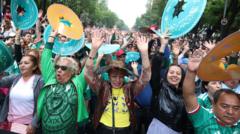
Mexico does not just watch football; it choreographs it. On a blazing Saturday morning on the Paseo de la Reforma, thousands of fans lined the iconic boulevard, transforming a two-kilometer stretch of asphalt into a undulating sea of green national jerseys. The objective was clear: claim the Guinness World Record for the largest human wave ever performed outside a stadium, just days before the country co-hosts the opening match of the 2026 World Cup. Yet beneath the corporate-sponsored pageantry and the synchronized lunges lies a bitter historical dispute. While global broadcasting networks and Anglo-centric sports leagues historically branded this stadium phenomenon as the Mexican Wave, the origin of the ritual belongs to an entirely different continent.
Mexico City’s massive public display serves as a calculated geopolitical assertion of cultural ownership, a response to decades of revisionist sports history that attempts to strip the Global South of its most contagious stadium tradition.
The American Revisionist Claims
For decades, North American sports historians have aggressively claimed credit for inventing the wave. The prevailing American narrative points directly to October 15, 1981, during a Major League Baseball postseason game between the Oakland Athletics and the New York Yankees. A professional cheerleader named Krazy George Henderson energized the Oakland Coliseum crowd into a sequential, section-by-section standing ovation. Henderson has spent forty years defending his title as the undisputed father of the wave, pointing to video footage of that autumn afternoon as empirical proof.
Other American institutions point to the University of Washington’s Husky Stadium, where yell leader Robb Weller led a coordinated crowd ripple during a football game against Stanford on Halloween of the same year. The mechanics were identical: arms raised, a brief leap to the feet, followed by a swift return to the seat as the momentum transferred to the adjacent section.
These early instances are documented, but they were isolated, localized events. They were gimmicks confined to the concrete bowls of American gridiron and baseball stadiums, dependent on a megaphone-wielding ringmaster to spark the fire. They lacked a global philosophy. They lacked the organic, self-sustaining fury that would eventually define the movement on the international soccer stage.
How Mexico Democratized the Stadium Arena
The true transformation of the wave occurred in the summer of 1986. When Mexico hosted the FIFA World Cup, the stadium environment underwent a fundamental shift. Millions of international television viewers watched in awe as the stands of the Estadio Azteca and the Estadio Universitario in Monterrey dissolved into a fluid, perpetual motion machine. This was not the American version, which was often treated as a brief commercial break distraction between innings. This was La Ola.
In Mexican football culture, La Ola became an instrument of collective defiance and artistic expression. It required no cheerleaders with microphones. The crowd itself operated as a singular organism, initiating the swell in the cheap seats and forcing the wealthy corporate suites to participate or face a barrage of whistles and jeers.
The 1986 tournament broadcasted this phenomenon to billions of households across Europe, South America, and Asia. British commentators, experiencing the collective movement for the first time, lazily dubbed it the "Mexican Wave." This linguistic tag stuck, forever anchoring the ritual to the geography of Mexico in the minds of global fans, even as American purists complained that their intellectual property had been stolen.
The cultural ownership of a crowd ritual cannot be settled by a patent office or a timestamped VHS tape from Oakland. It is defined by the culture that gives the movement its soul. In the United States, the wave was a structured exercise in fan engagement, heavily managed from the sidelines. In Mexico, it became an unscripted, democratic takeover of public space, reflecting a deeper communal identity that refuses to be passive spectators.
The Guinness Records and the Corporate Erasure
The fight for the wave is no longer just a barroom debate among sports trivia obsessives; it has turned into a numbers game monitored by corporate arbiters. The official Guinness World Records database reveals a telling tension in how this ritual is quantified and claimed globally.
| Record Category | Current Holder | Participant Count / Time | Location and Date |
|---|---|---|---|
| Largest Human Wave (Inside Stadium) | Bristol Motor Speedway | 157,574 people | United States (August 2008) |
| Longest Human Wave Line | Local Volunteers | 8,453 people | Portugal (2007) |
| Longest Duration Human Wave | Football Fans | 17 minutes, 14 seconds | Japan (2015) |
The fact that the United States holds the record for the largest stadium wave—achieved during a NASCAR event in Tennessee—is an irony that rankles Mexican football purists. It highlights a broader trend where Western sports entertainment operations take a global cultural phenomenon, scale it up through massive commercial infrastructure, and claim statistical dominance.
The weekend gathering on the Paseo de la Reforma was a deliberate strike against this statistical erasure. By taking the wave out of the stadium and onto one of the most politically charged avenues in Latin America—under the shadow of the Angel of Independence—the participants decoupled the ritual from corporate sports venues entirely.
The Tension Between Commercialization and Authenticity
As the 2026 World Cup approaches, FIFA has integrated La Ola into its promotional strategy. The human wave is now marketed as a sanitized symbol of global harmony, a corporate asset used to sell tickets and sponsor packages. The danger of this commodification is that it flattens the distinct political and social contexts that birthed the tradition.
When thousands of Mexicans knelt, stood, and screamed on the pavement of Reforma, they were celebrating a football tournament, but they were also asserting presence in a city frequently altered by tourism and gentrification. The crowd included locals in traditional Day of the Dead attire alongside international tourists, showcasing an elasticity that corporate marketing campaigns try to manufacture but can never truly replicate.
The Western sports apparatus will likely continue to credit Krazy George or Washington state for the mechanical invention of the human wave. They are welcome to the mechanics. The global sports community recognizes that a ritual does not belong to the person who builds the engine; it belongs to the culture that provides the fuel.
Mexico City’s massive street demonstration proved that forty years after the world discovered La Ola, the wave remains an uncontainable act of collective joy, permanently resistant to foreign ownership. The real record was never about the numbers verified by a judge in a suit. It was about proving that the heart of modern football fandom still beats loudest in the streets of Mexico.