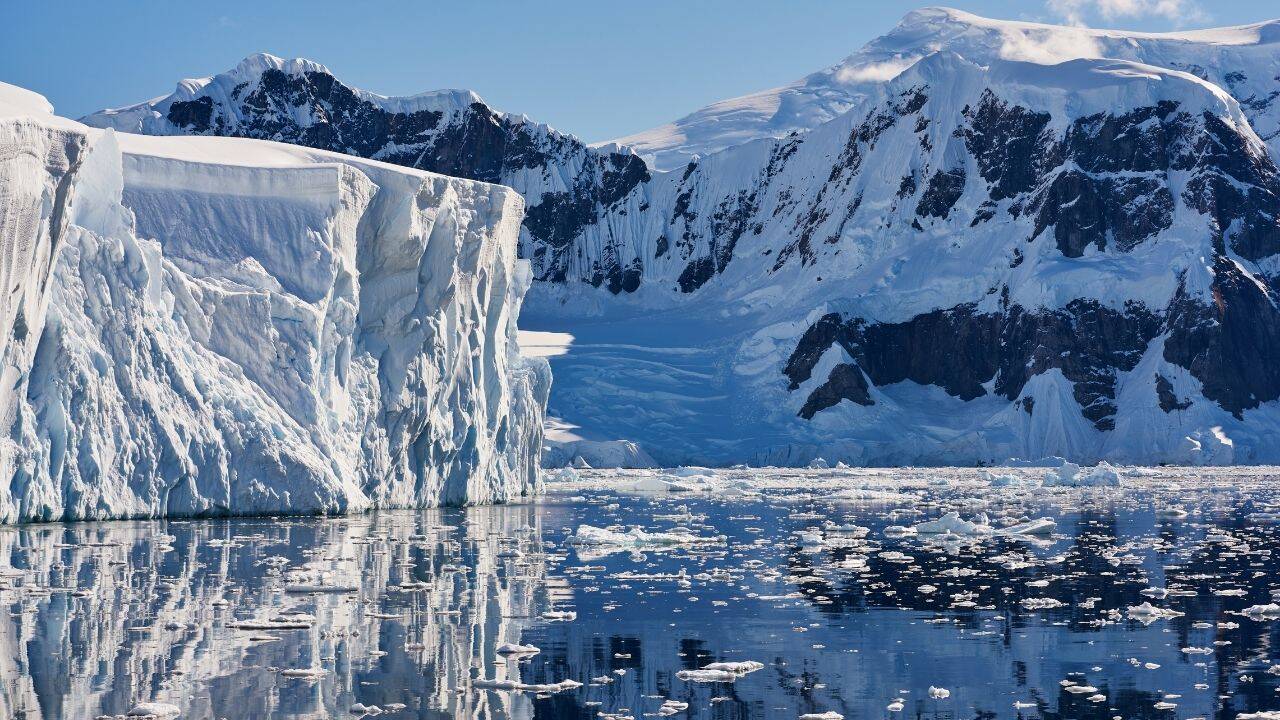
The discovery of the East Antarctic Fan-Shaped Basin Province (EAFBP) redefines the structural understanding of the Antarctic lithosphere, shifting the characterization of East Antarctica from a static, monolithic craton to a region defined by complex crustal deformation. Hidden beneath an ice sheet exceeding three kilometers in thickness, this continent-scale feature links previously isolated subglacial depressions into a single geodynamic system. Mapping this province requires separating the mechanical behavior of the lithosphere from the overlying ice mass, revealing how ancient rifting structures dictate modern glaciological velocity vectors. This analysis deconstructs the geophysical methodologies used to isolate the EAFBP, quantifies the mechanical principles of distributed rotational extension, and evaluates the resulting implications for ice sheet stability and global sea-level models.
The Geophysical Data Stack: Resolving Sub-Ice Topography
Isolating a continental-scale geological structure beneath kilometres of ice requires an integrated geophysical inversion framework. Direct observation is impossible because the Antarctic Ice Sheet obscures more than 99% of the bedrock. To overcome this boundary condition, researchers combined five distinct data streams to construct a coherent model of the subglacial floor.
The primary layer consists of radio-echo sounding data, which provides high-resolution profiles of the ice-bedrock interface. However, raw topographic data fails to reflect the true structural state of the crust due to glaciostatic loading. The sheer mass of the three-kilometer-thick ice sheet exerts immense downward pressure, forcing the lithosphere into the underlying asthenosphere. To reveal the pre-glacial and true structural geometry, geophysicists calculate the isostatic rebound profile. Removing the theoretical mass of the ice sheet yields a bounced or rebounded topography, showing that the bedrock would rise by up to one kilometer in altitude if unloaded.
The isostatic rebound profile can be quantified using the following lithospheric mass balance equation:
$$H_{\text{rebounded}} = H_{\text{bedrock}} + H_{\text{ice}} \left( \frac{\rho_{\text{ice}}}{\rho_{\text{mantle}}} \right)$$
where $H_{\text{bedrock}}$ is the current subglacial elevation, $H_{\text{ice}}$ is the local ice thickness, $\rho_{\text{ice}}$ is the density of glacial ice ($\sim 0.917 \text{ g/cm}^3$), and $\rho_{\text{mantle}}$ is the density of the upper mantle ($\sim 3.3 \text{ g/cm}^3$).
To confirm that the observed topographic variations stem from deep crustal features rather than localized glacial erosion, this rebounded model is cross-referenced with three structural datasets:
- Gravimetric Anomalies: Satellite and airborne gravity measurements identify mass deficits and surpluses within the crust. Wedge-shaped basins exhibit distinct negative gravity anomalies, indicating deep sedimentary infill or thinned crust beneath the troughs.
- Magnetic Striation Mapping: Aeromagnetic surveys isolate variations in the magnetic susceptibility of the basement rock. This maps the continuous fault lines and tectonic lineaments that define the edges of the basins, proving they are structurally controlled rather than randomly eroded carves.
- Seismic Refraction and Reflection: Passive and active seismic profiles constrain the depth of the Mohorovičić discontinuity (Moho), validating whether the upper crust underwent actual lithospheric thinning during the rifting phase.
By applying non-linear filtering algorithms to this multi-layered data stack, researchers identified sharp topographic lineaments corresponding to longitudinal normal faults. These faults trace a coherent radial geometry converging near the South Pole and expanding across a 2,000-kilometer arc along the modern coastline.
The structural mapping of deep lithospheric features beneath ice sheets cannot rely on single-instrument observations. The process of stripping away the signal attenuation caused by three kilometers of solid ice requires a sequential geopotential inversion workflow. Airborne gravity meters measure the vertical component of the gravity acceleration vector. The raw measurements undergo Eötvös corrections to eliminate the accelerations induced by the flight path of the aircraft, followed by a free-air correction to account for elevation above the geoid. The defining step in subglacial mapping is the application of the Bouguer correction, which replaces the known volume and density of the ice sheet with a reference crustal density ($2.67 \text{ g/cm}^3$). This mathematical substitution effectively homogenizes the ice layer, allowing researchers to isolate density anomalies originating within the underlying bedrock and upper mantle.
The resulting Bouguer gravity anomalies provide direct constraints on crustal thickness. Deep, steep-sided negative anomalies align precisely with the V-shaped troughs of the EAFBP, indicating that these basins are not simple structural depressions but deep grabens that have accumulated heavy successions of low-density subglacial sediments over tens of millions of years. To isolate the structural margins of these sediment-filled grabens, geophysicists integrate aeromagnetic data. Magnetic anomalies track variations in the concentration of ferromagnetic minerals, primarily magnetite, within the crystalline basement rock. High-resolution derivatives of the magnetic field reveal sharp, linear truncation lines where highly magnetic basement rocks are abruptly cut off by non-magnetic fault zones. The parallel alignment of these magnetic lineaments with the edges of the topographically resolved valleys confirms that the regional architecture is governed by deep lithospheric faulting rather than localized, superficial ice scouring.
The Kinematics of Distributed Rotational Extension
The geometrical configuration of the EAFBP cannot be explained by orthogonal rifting, where crustal blocks pull apart in parallel paths. Instead, the mathematical and mechanical architecture conforms to distributed rotational extension. This structural regime occurs when a lithospheric block undergoes angular rotation relative to an adjacent, stable cratonic block around a localized pivot point.
To visualize the mechanics, consider a rigid mechanical hand-fan or the spreading of fingers from a fixed wrist position. The pivot point remains stationary or undergoes minimal displacement, while the displacement vector increases linearly as a function of distance from the pivot. The mathematical description aligns with a sphenochasm: a triangular gap in the crust bounded by fault margins that converge at a specific angular vertex.
The mechanics operate through three sequential steps:
- Pivot Anchoring: A localized region of high lithospheric strength or a pinning point prevents lateral translation of the crust. In the case of the EAFBP, this anchor is situated near the South Pole.
- Angular Splay: Tectonic tensile stresses induce an angular rotation of the moving crustal block. The structural tension is accommodated not by a single master fault, but by a series of radiating, fault-controlled normal basins.
- Differential Trough Opening: Because the linear velocity of displacement is proportional to the radius from the pivot, the basins open as V-shaped triangles. Near the pivot, the basins are narrow and shallow; toward the 2,000-kilometer-long ocean boundary, they achieve maximum width and structural depth.
This rotational pulling forces the upper crust to fail along normal faults, creating a classic horst-and-graben morphology arranged in a radial layout. The thinned crust within the grabens (the basins) drops relative to the adjacent horsts (the structural ridges), forming a vast system of internal drainage catchments.
The rotational extension model requires a precise geometric description to differentiate it from linear rifting systems. In linear rifts, such as the contemporary East African Rift System, extension is uniform along the strike of the rift axis. The strain tensor is symmetric. In a rotational extension province, the strain tensor is highly asymmetric and varies as a function of the azimuth and distance from the Euler pole of rotation.
Let $\theta$ represent the total angular opening of the province, and $\mathbf{r}$ represent the radial distance vector from the polar anchor near the South Pole to a given point within the province. The local linear extension velocity $\mathbf{v}$ is determined by the cross product of the angular velocity vector $\boldsymbol{\omega}$ and the position vector:
$$\mathbf{v} = \boldsymbol{\omega} \times \mathbf{r}$$
The total horizontal displacement $E$ at any distance $r = |\mathbf{r}|$ from the pivot can be approximated by:
$$E = 2r \sin\left(\frac{\theta}{2}\right)$$
This linear relationship explains why the southern sector of the EAFBP features tightly constrained, narrow valleys with minimal crustal thinning, while the northern coastal sector exhibits extreme extension. The extreme extension along the coast caused the lithosphere to stretch to its mechanical breaking point, thinning the crust from a standard cratonic thickness of 40–45 kilometers down to less than 25 kilometers in the core of the deepest coastal grabens.
The structural accommodation of this variable extension occurs through a series of stepped normal faults. As the moving crustal block swings away from the stable anchor, the stretching cannot be accommodated uniformly by a single fault plane. The upper brittle crust fractures into a series of radiating fault segments. Each segment accommodates a fraction of the total angular rotation, leading to a distributed network of basins rather than a localized oceanic spreading center. This distributed nature keeps the continental crust intact but thoroughly fractured, preventing the formation of true oceanic crust within the fan itself while creating an expansive province of thinned continental lithosphere.
Structural Components of the Province
The EAFBP is not a single hollow, but an interconnected network of approximately 30 subglacial basins and intervening structural highs. Recognizing this province requires looking at the continuous structural links between systems that were previously categorized as independent geological anomalies.
The first structural component is the Wilkes Basin, a massive low-elevation trough extending inland from the George V Coast. Geophysical data reveals that its eastern boundary is controlled by a major fault system linked directly to the overarching rotational fan matrix. The second major component is the Aurora Basin, situated further west. The Aurora Basin acts as another critical structural slot within this radial system, accommodating immense volumes of ice and subglacial water drainage.
The third major component is the deep structural depression hosting Lake Vostok, the largest subglacial lake on Earth. The position and orientation of the Vostok rift valley fit within the radial fault trends of the EAFBP, demonstrating that the lake's long-term tectonic stability is a direct result of the ancestral rotational strain field.
The bounding walls of the EAFBP provide critical insights into its mechanical limits. To the west, the opening of these basins correlates with the uplift of the Gamburtsev Subglacial Mountains. The mechanical unloading and crustal thickening along the flanks of the rotational system provided the tectonic forces necessary to lift these Alpine-scale mountains, which remain completely preserved beneath the ice sheet. To the east, the structural boundary is defined by the Transantarctic Mountains. Models indicate that as the fan opened, a northern segment of the Transantarctic Range rotated clockwise by approximately 20 degrees. This rotation accounts for the distinct segmentation and differential uplift observed along this major mountain chain.
The province can be divided into three structural zones based on proximity to the rotational axis and the magnitude of crustal strain:
- The Inner Pivot Zone: Located between 85° S and 80° S, this zone is characterized by narrow, deep, tightly spaced V-shaped grabens. The total horizontal displacement here is minimal, but the stress concentration is exceptionally high. The bedrock here remains mostly above sea level when corrected for isostatic rebound, forming a series of confined high-altitude canyons that contain and restrict ice movement.
- The Intermediate Transition Zone: Spanning from 80° S to 72° S, this region contains the subglacial basin hosting Lake Vostok and the surrounding subglacial lakes. Here, the individual arms of the fan begin to diverge significantly. The horsts between the basins form prominent subglacial ridges that act as major topographic barriers to ice flow, forcing the ice sheet to deform around them.
- The Outer Coastal Zone: Extending from 72° S to the modern coastline, this sector represents the maximum extension zone of the EAFBP. It contains the widest portions of both the Wilkes and Aurora basins. In this zone, the crust has been thinned to its absolute minimum, and the rebounded topography indicates that vast swaths of the bedrock would remain far below sea level even without the weight of the ice sheet.
The Geodynamic Timeline and Gondwana Fragmentation
The origin of the EAFBP is intrinsically tied to the multi-stage breakup of the southern supercontinent Gondwana, which originally united Antarctica, Australia, India, Africa, and South America. Resolving the timeline of this structure requires separating intraplate tectonic preparation from active continental drifting.
Gondwana began its initial fragmentation roughly 180 million years ago during the Jurassic period, driven by massive mantle plume activity and regional extension. Antarctica and Australia remained physically joined long after Africa and India detached, forming a stable lithospheric block until the Late Cretaceous. The EAFBP represents an intraplate strain-localization zone that formed during this intermediate period.
The development of the province unfolded across two distinct structural phases:
- Phase 1: Pre-Breakup Lithospheric Weakening: Before the mechanical separation of the two continents, deep tensile stresses concentrated along the southern polar margin. Because the core of East Antarctica is protected by an exceptionally thick and rigid cratonic root, the crust failed along its margins through distributed rotational extension. This process did not immediately cleave the continent; instead, it created a massive zone of crustal thinning and faulting. The semi-circular arc geometry along the northern edge of the fan acted as a major structural line of weakness.
- Phase 2: Guided Separation and Continental Rifting: When Australia finally detached from Antarctica approximately 70 million years ago, the rifting path did not propagate randomly. The pre-existing lithospheric weakness at the northern boundary of the EAFBP guided the propagation of the ocean-continent rifting front. The structural geometry of the modern Antarctic coastline and the corresponding continent-ocean boundary margin are direct artifacts of this guided tectonic breakup. Evidence suggests that the fan may have continued to open slightly even after the initial detachment, accommodating residual intraplate stresses as Australia migrated northward.
The initiation of distributed rotational extension is constrained to the Early Cretaceous, approximately 130 to 110 million years ago. During this epoch, India was actively uncoupling from western Antarctica through rapid seafloor spreading, while Australia and Antarctica remained locked together along their shared continental boundary. This configuration applied a massive rotational torque across the East Antarctic lithosphere. Protected by a thick, cold, rigid lithospheric root in its interior, the continent accommodated this intraplate stress by shearing along its weaker peripheral zones, forcing the upper crust to fan out around the South Pole pivot.
The northern margin of this rotating fan directly intersected the zone where Australia and Antarctica would later split. The extreme crustal thinning and pervasive faulting at the outer edge of the fan created a pre-weakened lithospheric corridor. When the global plate stress field shifted in the Late Cretaceous, around 90 to 70 million years ago, active rifting finally initiated between Antarctica and Australia. The propagating rift tip followed this path of least resistance.
Glaciological Feedback Loops and Ice Sheet Stability
The significance of the EAFBP extends far beyond historical geodynamics; its structural architecture functions as a primary boundary condition governing the modern East Antarctic Ice Sheet (EAIS). Bedrock topography exerts a direct, non-linear control on glacial velocity, basal thermal regimes, and subglacial hydrology.
The first mechanism of control is topographic steering. Glaciers and fast-moving ice streams are gravity-driven fluids whose lateral boundaries are defined by subglacial topography. The V-shaped basins of the EAFBP act as subglacial topographically confined channels that direct ice flow from the high-altitude interior of the continent toward the ocean. Because these basins are deep and interconnected, they focus ice discharge into specific marine outlets, such as Prydz Bay or the Wilkes Land margin. This concentration of flow creates high-velocity ice streams that are highly sensitive to oceanic forcing at their marine termini.
The second mechanism involves basal geothermal heat flux variations. Crustal thinning within the grabens of the EAFBP alters the thermal properties of the lithosphere. A thinner crust allows the warm underlying mantle to sit closer to the bedrock surface, increasing the local geothermal heat flux. This elevated thermal input melts the base of the overlying ice sheet, generating subglacial water. This water accumulates within the deep, structurally controlled troughs, feeding large networks of subglacial lakes, including Lake Vostok. The presence of basal water radically reduces the friction coefficient at the bed, allowing the ice sheet to slide rapidly over the rock rather than moving through slow internal deformation.
The third mechanism relates to marine ice sheet instability. Portions of the EAFBP, particularly within the Wilkes and Aurora basins, sit well below current sea level, with the bedrock sloping downward toward the interior of the continent. This retrograde slope geometry introduces a structural vulnerability. If rising ocean temperatures trigger the retreat of marine-terminating glaciers past their current grounding lines, the ice sheet enters a self-sustaining retreat loop. Because the water depth increases further inland along the V-shaped basin floors, the ice flux at the grounding line rises exponentially as the glacier retreats, leading to accelerated ice sheet collapse.
To quantify the glaciological impact of the EAFBP, we must analyze the coupling between the subglacial bed and the ice dynamics through the lens of ice sheet modeling equations. The depth-integrated ice velocity $U$ is governed by the balance between driving stress $\tau_d$ and basal shear stress $\tau_b$. The driving stress is directly proportional to the ice thickness $H$ and the surface slope $\alpha$:
$$\tau_d = \rho_{\text{ice}} g H \sin\alpha$$
The EAFBP alters both terms of this equation across the continent. Within the deep V-shaped basins, the ice thickness $H$ increases dramatically, reaching up to 3 to 4 kilometers. This concentration of mass increases the local driving stress, forcing the ice to flow at accelerated speeds through the troughs.
Simultaneously, the basal shear stress $\tau_b$ is heavily modulated by the hydrological networks contained within the fan structure. The radiating grabens act as a continent-scale drainage network, gathering basal meltwater and funneling it along the fault lines. This localized accumulation of subglacial water increases basal water pressure $P_w$, which reduces the effective normal pressure $N = P_i - P_w$, where $P_i$ is ice overburden pressure. According to standard friction laws, the basal shear stress drops toward zero as effective pressure decreases:
$$\tau_b = C N^m U^n$$
This mechanical lubrication converts the slow-moving ice sheet interior into fast-flowing ice streams. The structural alignment of the EAFBP means that any changes in the thermal state of the bed—such as an increase in subglacial water production due to climate warming—will immediately be transmitted along these pre-existing structural highways, accelerating the transport of inland ice directly into the warming Southern Ocean.
Strategic Optimization Framework for Subglacial Research
The structural mapping of the East Antarctic Fan-Shaped Basin Province shifts the baseline requirements for predictive ice sheet modeling and sea-level rise projections. Current ice dynamics models often treat the geothermal heat flux and basal friction coefficients of East Antarctica as uniform or smoothly varying fields. The high-density, multi-fault architecture of the EAFBP proves that the subglacial bed is highly segmented, featuring sharp lateral discontinuities in thermal input and topographic confinement.
To minimize the uncertainties in global sea-level forecasts, future field campaigns and ice sheet modeling frameworks must adopt a three-part structural optimization play:
First, ice-sheet models must replace uniform basal sliding laws with fault-bounded friction masks. The coordinates of the 30 identified basins within the EAFBP should be used to define high-resolution gridded domains where basal water accumulation and sediment infill are explicitly modeled as discrete structural grabens. This structural targeting prevents the artificial dampening of ice stream velocities that occurs when basal properties are averaged across continental scales.
Second, airborne radar and seismic surveys must be localized along the interpreted transverse strike-slip and normal faults of the province. High-precision cross-fault profiles are required to accurately constrain the sediment thickness within the V-shaped troughs. Knowing the exact volume and composition of the subglacial sediment is critical, as subglacial deformation of unconsolidated sediments provides the primary physical mechanism for rapid ice stream acceleration.
Third, geothermal heat flux models must be rewritten to incorporate the lithospheric thinning profiles derived from the EAFBP crustal models. Incorporating a localized, high-resolution heat flux mask that mirrors the thinned continental crust of the outer coastal sector will allow models to predict exactly where basal melting will accelerate first under changing climate conditions.
The EAFBP is the foundational structural grid upon which the East Antarctic Ice Sheet is built. Treating this province as an active, interconnected mechanical system rather than a collection of random subglacial valleys is the only path forward for isolating the true vulnerabilities of the world's largest freshwater reservoir.
Massive Hidden Structure Beneath Antarctica's Ice
This analytical broadcast outlines the imaging techniques and tectonic implications of the newly identified subglacial province.