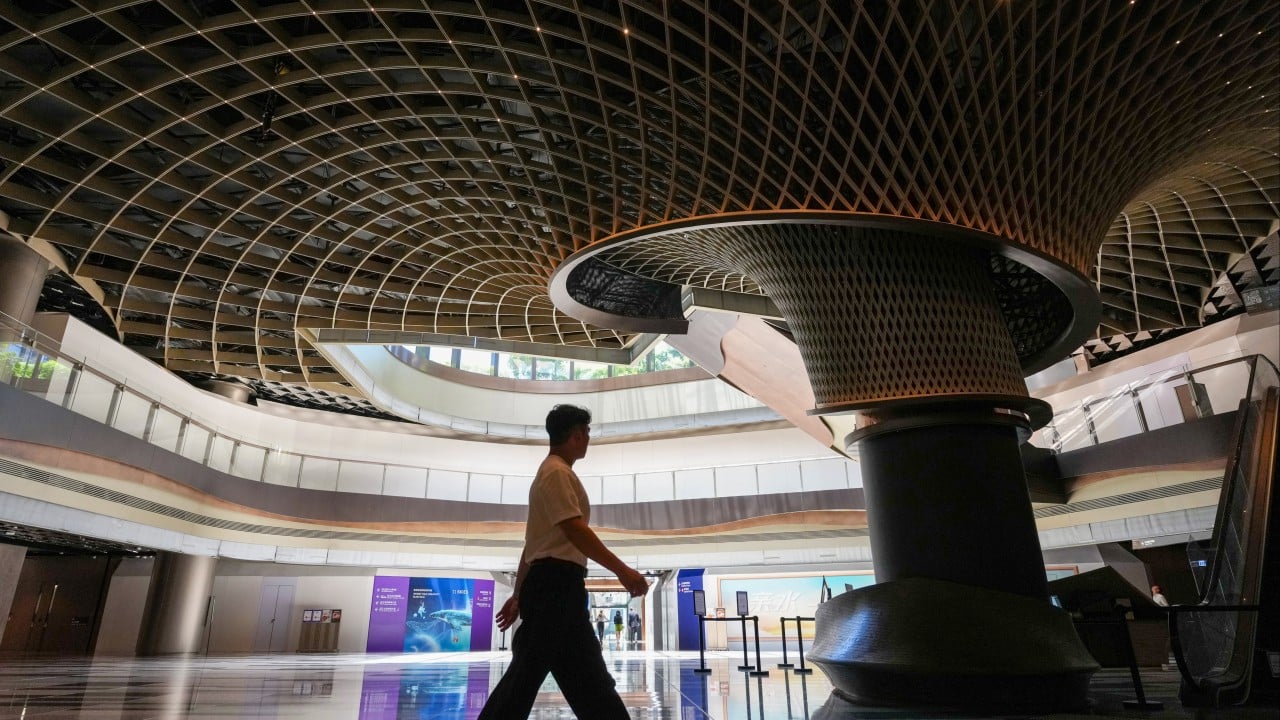
The Airport Authority Hong Kong (AAHK) is moving to seize full control of the retail and commercial portions of 11 Skies, the ambitious HK$20 billion mega-project originally spearheaded by New World Development. This transition marks more than just a change in property management; it represents a fundamental restructuring of one of the largest infrastructure-adjacent developments in Asia. Sources familiar with the negotiations indicate that the AAHK is stepping in to ensure the project’s operational stability as New World Development grapples with a brutal debt profile and a broader strategic pivot away from non-core assets.
The Cracks in the Sky
For years, 11 Skies was marketed as the crown jewel of the SkyCity precinct, a sprawling complex designed to capture the immense foot traffic flowing through the Hong Kong International Airport. It was supposed to be a testament to the "Greater Bay Area" integration, blending high-end retail, medical tourism, and entertainment under one massive roof. But the reality of high interest rates and a sluggish recovery in luxury spending has turned the project into a heavy weight on New World’s balance sheet.
New World Development, led by Adrian Cheng, has been under intense scrutiny for its gearing ratio. The company has spent the last year frantically offloading assets to shore up its cash reserves. When the AAHK decided to buy back the rights to 11 Skies, it wasn't a sudden whim. It was a rescue mission disguised as a strategic realignment. The Airport Authority cannot afford for its primary commercial gateway to sit half-empty or suffer from stalled construction and tenant acquisition.
Debt and the Art of Disinvestment
The math behind the move is stark. New World’s net debt has been a recurring theme in investor calls, and the 11 Skies project required significant ongoing capital expenditure. By handing the reins back to the AAHK, New World immediately clears a massive liability from its books. This isn't a failure of vision, but a failure of timing. The project was conceived in an era of cheap money and endless Chinese tourist growth—two variables that have since evaporated.
The AAHK, being a statutory body wholly owned by the Hong Kong government, has a different set of priorities and a much longer investment horizon. It doesn't answer to shareholders demanding quarterly dividends in the same way a listed developer does. It can afford to wait five or ten years for the retail ecosystem at the airport to reach maturity.
The Mechanics of the Transfer
The deal involves the AAHK taking over the construction costs and the future operation of the 3.8 million square foot site. While the medical towers and some office spaces have already seen activity, the retail and entertainment heart of the project—the part that requires the most aggressive marketing and tenant incentives—will now fall under the airport's direct purview.
This move effectively centralizes the entire airport island’s commercial strategy. Instead of a private developer competing with the airport's own internal duty-free offerings, the AAHK now controls the entire value chain. It’s a monopoly play born out of necessity.
A Warning Shot to the Property Sector
This takeover serves as a sobering indicator for the rest of Hong Kong’s property titans. If a developer of New World's stature is forced to retreat from its flagship project, it signals that the era of "build it and they will come" is dead. The vacancy rates in premium office spaces across Central and Kowloon have already reached historic highs. 11 Skies was banking on a "destination retail" model that requires massive, consistent capital to sustain interest.
The AAHK is stepping into a minefield. They are now responsible for filling millions of square feet of retail space at a time when consumers are increasingly price-sensitive and heading across the border to Shenzhen for their weekend shopping. The Authority will likely have to offer significant rent concessions to lure back international brands that have grown weary of the Hong Kong market’s volatility.
Institutional Safety Nets
The Hong Kong government is quietly signaling that it will not let its major infrastructure projects fail, but the cost of that safety is the "statization" of private enterprise. We are seeing a trend where the government, through various vehicles like the AAHK or the MTR Corporation, is forced to take a more active role in real estate because the private sector is too bruised to carry the load.
Investors are watching the valuation of this transfer closely. If the AAHK paid a premium, it’s a bailout. If they bought it at a steep discount, it’s a fire sale. Either way, the message to the market is that the old guard of Hong Kong developers is no longer invincible. They are in survival mode.
The Medical Tourism Gamble
One of the unique selling points of 11 Skies was its focus on high-end medical services for visitors from mainland China. The idea was simple: fly in, get a health check-up or a cosmetic procedure, shop for a Rolex, and fly out. While the medical towers have seen some uptake, the synergy between healthcare and retail is still unproven on this scale. The AAHK now inherits this experimental business model. They must prove that a government-linked body can manage a sophisticated service-oriented commercial hub better than a private developer with decades of experience in the lifestyle sector.
The Shift in Power Dynamics
The transfer of 11 Skies is the most visible sign yet of a power shift in Hong Kong’s economy. The traditional developers, who for decades dictated the city’s urban landscape, are losing their grip. In their place, state-backed entities are expanding their footprints. This creates a different kind of market—one that is perhaps more stable but certainly less dynamic.
For the tenants of 11 Skies, the change in ownership brings a mix of relief and uncertainty. A landlord with the backing of the Airport Authority is unlikely to go bankrupt, providing long-term security. However, government-run entities are notoriously less flexible than private ones when it comes to lease negotiations and creative marketing pivots.
Operational Realities
Managing 3.8 million square feet of space is an enormous logistical challenge. The AAHK is an expert at moving planes and people, but running a world-class shopping mall is a different discipline. They will almost certainly need to hire a third-party operator or build a massive internal team to handle the day-to-day complexities of retail management. This adds another layer of cost to a project that has already seen its budget swell.
The success of 11 Skies now hinges entirely on the recovery of the aviation sector. With passenger numbers at HKIA still fluctuating below pre-2019 levels, the "captive audience" that the project relies on isn't quite at full strength. The AAHK is betting that by the time the three-runway system is fully operational, the demand will have caught up with the supply.
The Long Road to Recovery
The restructuring of 11 Skies is not an isolated incident but a symptom of a larger recalibration. New World’s retreat allows it to focus on its K11 brand and other more manageable assets, but it leaves a scar on its reputation as a builder of "mega-cities." For the AAHK, this is a forced expansion of its mandate. It is no longer just an airport operator; it is now one of the largest retail landlords in the territory.
This transition highlights the fragility of high-leverage business models in a high-rate environment. The city is watching to see if the AAHK can turn a developer’s ambitious dream into a functional, profitable reality, or if 11 Skies will remain a monument to the excesses of a bygone era. The pressure is on the Authority to prove that it can manage the transition without further draining public coffers. Focus must now turn to the occupancy rates of the retail heart in 2025 and 2026, as these numbers will be the ultimate judge of whether this takeover was a masterstroke of urban planning or a desperate act of damage control.