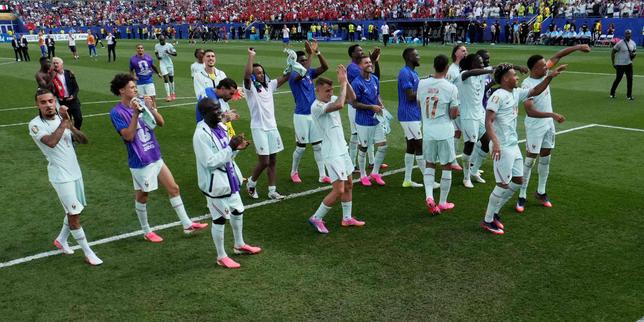
Elite international football tournaments are won by teams that successfully manage the structural tension between rest defense and asymmetric attacking profiles. The knockout match between France and Morocco serves as a definitive case study in how qualitative superiority on the flanks can systematically dismantle a highly disciplined, compact defensive block. Rather than viewing the outcome through the simplistic lens of individual stardom or superficial goal-scoring timelines, a rigorous analysis reveals that France’s progression was the mathematical consequence of space creation, defensive shifting latencies, and controlled transitional isolation.
To understand how France compromised Morocco’s defensive integrity, the match must be deconstructed into specific structural phases: the mechanics of low-block manipulation, the exploitation of half-space vacancies, and the execution of rest defense to neutralize counter-pressing vulnerabilities.
The Structural Architecture of Morocco's Defensive Block
Morocco’s defensive progression throughout the tournament relied on a highly coordinated mid-to-low block, utilizing a 4-1-4-1 or 4-5-1 shape that prioritized central compactness. The primary objective of this system is the elimination of central passing lanes into the half-spaces, forcing opponents into wide areas where the touchline acts as an extra defender.
This defensive framework operates on three strict variables:
- Horizontal Compactness: The maximum distance between the far-side winger and the ball-side winger rarely exceeded 30 meters, compressing the central playing area.
- Vertical Distances: The space between the defensive line and the midfield line was maintained between 8 to 12 meters, denying receiving pockets to opposing central attacking midfielders.
- Touchline Traps: Triggering aggressive double-teams only when the ball entered the wide channels, specifically targeting the opposition full-backs.
The vulnerability of this system is not structural flaw, but structural fatigue. Maintaining this level of synchronization requires immense physical output. When an attacking team possesses elite profiles capable of winning isolated 1v1 duels without requiring numerical overloads, the defensive block is forced to make a compounding series of reactive adjustments. France engineered exactly these scenarios.
Flank Isolation Mechanics and Overload to Isolate
France’s offensive strategy bypassed the dense central core of Morocco’s midfield by executing an "overload to isolate" framework. By overloading the left channel with asymmetric positioning, France forced Morocco’s defensive block to shift its horizontal axis heavily toward that side. This movement created a predictable structural latency on the opposite flank.
The Left-Side Distraction Engine
On the left wing, France utilized a highly aggressive positional pairing. The left-sided winger pinned Morocco’s right-back deep, while an underlapping central midfielder or advancing full-back occupied the half-space.
This configuration generated a specific tactical dilemma for Morocco:
- If the Moroccan right-back stepped out to contest the wide player, a massive gap opened in the channel between the right-back and the right-sided center-back.
- If the central midfielder dropped to cover that channel, Morocco’s central midfield trio lost its horizontal compactness, leaving the center of the pitch exposed.
Morocco chose to respond by shifting their entire midfield unit toward the ball-side left. While this successfully limited immediate penetration on France’s left, it fundamentally compromised their weak-side coverage.
The Right-Side Isolation Phase
The structural consequence of Morocco’s leftward shift was the creation of vast, unmonitored space on the right flank. France exploited this via rapid diagonal switches of play. The objective was not to slowly circulate the ball through the backline, but to execute direct, high-velocity diagonal passes that bypassed Morocco’s shifting midfield before they could adjust their defensive slide.
When the ball arrived on the right flank to profiles like Ousmane Dembélé, Morocco's left-back was left in an isolated 1v1 scenario. Without immediate double-team support from the left-sided central midfielder—who was caught in the transition of shifting back across the pitch—the attacker gained a decisive dynamic advantage. The defender was forced to drop their hips and backpedal, conceding the box entry or allowing a low, driven cross into the penalty area.
The Calculus of Spatial Exploitation in the Penalty Box
Scoring against a low block requires exploiting the micro-seconds of chaos that occur immediately following a broken defensive line or a deflected sequence. When individual attackers like Kylian Mbappé or Dembélé penetrate the outer boundary of the block, the defensive priority shifts from spatial coverage to emergency ball-tracking.
Gravity and Deflection Mechanics
Elite attackers possess "tactical gravity." When Mbappé drives into the penalty area from the left half-space, his individual threat profile draws three to four defensive bodies toward him. This hyper-concentration of defensive pressure creates a structural vacuum in other zones of the box.
The mechanism of France’s offensive success can be broken down as follows:
$$P_{\text{goal}} = f(\text{Gravity}, \text{Latency}, \text{Orientation})$$
Where:
- Gravity represents the number of defenders pulled out of position by a high-threat ball carrier.
- Latency is the time delay required for the defensive unit to re-orient their bodies toward secondary runners.
- Orientation is the physical positioning of the remaining attackers relative to the goal line.
When a shot or a cutback is deflected in these high-density scenarios, the ball rarely lands randomly. It lands in the spaces vacated by defenders who have aggressively collapsed toward the primary threat. France’s secondary attackers, anticipating this collapse, consistently occupied the blind spots of Morocco's center-backs. This allowed them to capitalize on loose balls and deflections, converting high-value opportunities from close range because the defensive unit was physically incapable of reversing its momentum.
Rest Defense and Neutralizing the Moroccan Counter-Press
An attacking framework that commits high numbers forward is inherently vulnerable to the counter-attack unless supported by a flawless rest defense structure. Morocco's primary offensive output throughout the tournament was generated via vertical transitions, utilizing the pace of Hakim Ziyech and Achraf Hakimi on the right flank.
France mitigated this risk through an asymmetric rest defense configuration, typically maintaining a 3+2 or 3+1 structure while in possession.
The Asymmetric Back Three
While the left-back advanced to join the wide overload phases, the right-back remained disciplined, tucking inside to form a temporary back three alongside the two central defenders. This structural adjustment ensured that France always maintained a numerical advantage against Morocco’s isolated forward outlets.
      [Morocco Def Block]

   [FR LH]   [FR LC]   [FR RC]
             [FR DM]
This positioning prevented Morocco from executing direct vertical passes upon winning the ball. The Moroccan ball-carrier, under immediate pressure from France’s counter-pressing forward line, looked up to find all immediate vertical passing lanes occupied by well-positioned French defenders.
Central Access Denial
The defensive midfielder played a critical role in this system by patrolling the space directly in front of the makeshift back three. By occupying the central zone, this player systematically cut off the transition lines to Morocco’s central attacking midfielders. Instead of launching clean counter-attacks through the center, Morocco was forced to clear the ball long into wide channels, where France’s physical center-backs could easily contest and regain possession in the air.
The limitation of this aggressive rest defense is the physical demand placed on the lone defensive midfielder. If that player turns over possession or fails to execute an intentional tactical foul when bypassed, the center of the pitch becomes a highway for the opposition. France accepted this calculated risk, trusting their physical profiles to win ground duels in transition.
The Structural Breakdown of Fatigue
In the final third of the match, the tactical battle shifted from structural positioning to energy depletion. A low block is a high-cost defensive strategy; it requires constant, explosive lateral movement. As the match progressed past the 60-minute mark, Morocco's horizontal shifting latency increased from roughly 1.5 seconds to over 2.5 seconds.
This one-second delay changed the tactical reality of the game:
- The wide attackers for France no longer needed to wait for diagonal switches to find isolation; they could receive the ball via standard lateral passes and still have time to face up their defender.
- The distance between Morocco’s midfield and defensive lines expanded from 10 meters to nearly 18 meters, creating a massive pocket for French substitutes to exploit.
- The accuracy of Morocco’s transitional passes plummeted as physical exhaustion compromised technical execution under pressure.
France capitalized on this fatigue by introducing fresh profiles off the bench who could maintain high-intensity pressing metrics, ensuring that Morocco could never establish sustained possession in the attacking half.
Strategic Play
For elite teams facing structured low blocks in knockout scenarios, the optimization path does not lie in increasing the volume of crosses or attempting low-probability central combinations. The strategic mandate is the deliberate creation of positional asymmetry.
Teams must intentionally overload one zone of the pitch to artificially compress the opponent's defensive block, then systematically exploit the weak-side latency with high-velocity diagonal switches to elite 1v1 profiles. Concurrently, maintaining a rigid 3+2 rest defense structure is non-negotiable to suppress the opponent's transitional outlets. Teams that master this dual-mechanism of structural manipulation and transitional insurance will consistently dictate the outcomes of high-stakes international football.