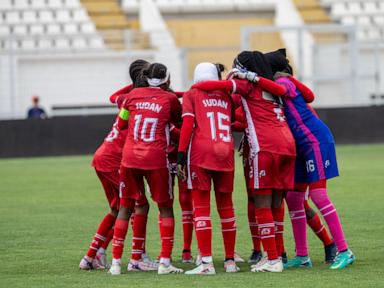
Losing a football match 17-0 sounds like a complete disaster. Losing the next game 13-0 makes it look even worse. But when the under-17 Sudanese women national football team walked off the pitch in Casablanca, Morocco, after a 30-0 aggregate demolition by Comoros, the numbers on the scoreboard didn't actually matter.
For these teenage girls, just showing up was a massive victory. Read more on a connected topic: this related article.
Sudan has been tearing itself apart in a brutal civil war since April 2023. The United Nations considers it the worst humanitarian crisis on the planet right now. Food is scarce, millions are displaced, and organized sports have completely vanished. Yet, in June 2026, a squad made up mostly of schoolgirls wore the bright red jerseys of Sudan at the Larbi Zaouli Stadium, competing in the qualifiers for the 2028 Los Angeles Olympics.
They didn't go to Morocco expecting a trophy. They went to prove that women sports in Sudan aren't dead. Additional analysis by NBC Sports delves into related views on the subject.
Running From Bombs to the Football Pitch
Rebuilding a national team in the middle of a civil war is almost impossible. Veteran coach Burhan Tia, who commands all of Sudan's female national squads, had to start from absolute zero.
The domestic women's league, which launched with immense hope back in 2019 after the fall of dictator Omar al-Bashir, was wiped out by the fighting. You can't run a sports league when artillery fire is leveling your stadiums.
To build this under-17 roster, Tia had to become a detective. He couldn't travel to talent hotbeds like Darfur or Kordofan because the fighting made those regions inaccessible. Even worse, thousands of displaced families had lost their official identification papers during the chaos, meaning Tia couldn't legally verify the ages of local players to satisfy strict FIFA and Olympic rules.
Instead, the scouting network stretched across borders.
Tia ended up recruiting 10 players from diaspora families and refugees who had fled the violence and settled in Cairo, Egypt. The rest of the squad came from parts of Sudan where travel was barely manageable. Girls spent days on dangerous roads, navigating military checkpoints just to get to training sessions.
The lack of preparation showed instantly on the pitch. Comoros brought a seasoned squad with players based in European academies. Sudan fielded schoolgirls who had only trained together for a couple of weeks. During the matches, Sudanese players frequently forgot basic tactical positioning, botched the offside line, and kept staring at the bench for real-time guidance from their coaches. They were visibly exhausted, completely outmatched, and many broke down in tears after the final whistle.
The Cultural Battle Outside the Stadium
It isn't just the war that these young athletes are fighting. They are also playing against decades of deep-rooted social conservatism and institutional pushback.
During the thirty years of Omar al-Bashir’s Islamist regime, strict Public Order Laws severely limited what women could do in public. Playing football was out of the question. Religious bodies even issued fatwas condemning female sports, arguing that women running, sweating, and moving freely in public caused moral chaos.
The 2019 revolution changed the legal framework, but it didn't instantly rewrite the minds of millions.
As soon as the Sudanese Football Association posted updates about the under-17 team on social media, the comments turned toxic. Online trolls relentlessly mocked the teenage girls for the massive double-digit losses. Thousands of users left comments telling the players to "go back to the kitchen."
Every time a Sudanese girl ties her cleats and steps onto a football pitch, she is directly challenging that entire conservative logic. She isn't just playing a game; she is reclaiming her right to move freely, on her own terms, in a society that historically tried to keep her hidden.
Understanding the Political Minefield
Nothing in Sudanese sports happens without political strings attached. The fact that General Abdel Fattah al-Burhan’s military government cleared the funds and paperwork for these teenage girls to travel to Morocco isn't just a sudden act of goodwill.
Human rights organizations and the UN have documented widespread sexual and gender-based violence committed by the Sudanese Armed Forces during this conflict. Many political analysts point out that backing a visible, progressive cause like women’s international football is a calculated move by the military regime to paint a softer, more legitimate face for the international community.
But prominent Sudanese activists, including Hala Al-Karib, argue that fans shouldn't let political games overshadow the players' courage. The real battle isn't about whether the government uses the team for public relations; it's about pushing the Sudanese Football Association to actually invest long-term resources into female athletes instead of treating them as an afterthought to avoid international forfeits.
How to Support the Next Generation of Female Athletes
If you want to see these young women succeed on a level playing field, here is what needs to happen next.
- Fund Grassroots Initiatives: Support non-governmental organizations providing safe spaces, equipment, and sports programs for Sudanese refugee youth in neighboring countries like Egypt, Chad, and South Sudan.
- Challenge the Online Narrative: Counter the digital hostility by actively amplifying the stories of these athletes on social media. Shift the conversation from the lopsided scores to their survival and resilience.
- Pressure Sports Governing Bodies: Advocate for FIFA and the Confederation of African Football (CAF) to earmark specific, transparent development funds for war-torn nations, ensuring the money actually reaches the women's programs rather than getting swallowed by corrupt federations.