The contemporary geopolitical friction between Taipei and Beijing is frequently reduced to a conflict of 20th-century ideologies, yet its functional origin lies in the structural disruption of the Qing Dynasty’s administrative integrity during the late 19th century. To understand the current impasse, one must analyze the Treaty of Shimonoseki not as a mere historical footnote, but as a hard-coded pivot point that initiated a divergent developmental trajectory for Taiwan. This divergence was not organic; it was the result of a deliberate extraction by Japanese imperial forces that fundamentally decoupled Taiwan’s legal, economic, and social systems from the mainland's evolutionary path.
The Mechanics of Sovereignty Transfer
The 1895 cession of Taiwan to Japan represents a definitive break in the "Sovereignty Continuity Model." In standard Westphalian terms, sovereignty is often treated as a binary state. However, the Shimonoseki Partition introduced a prolonged phase of "Structural Alienation" that lasted fifty years. This timeframe is critical because it spans two full generational cycles—enough time to overwrite existing administrative norms with a different legal and educational architecture. Don't miss our recent article on this related article.
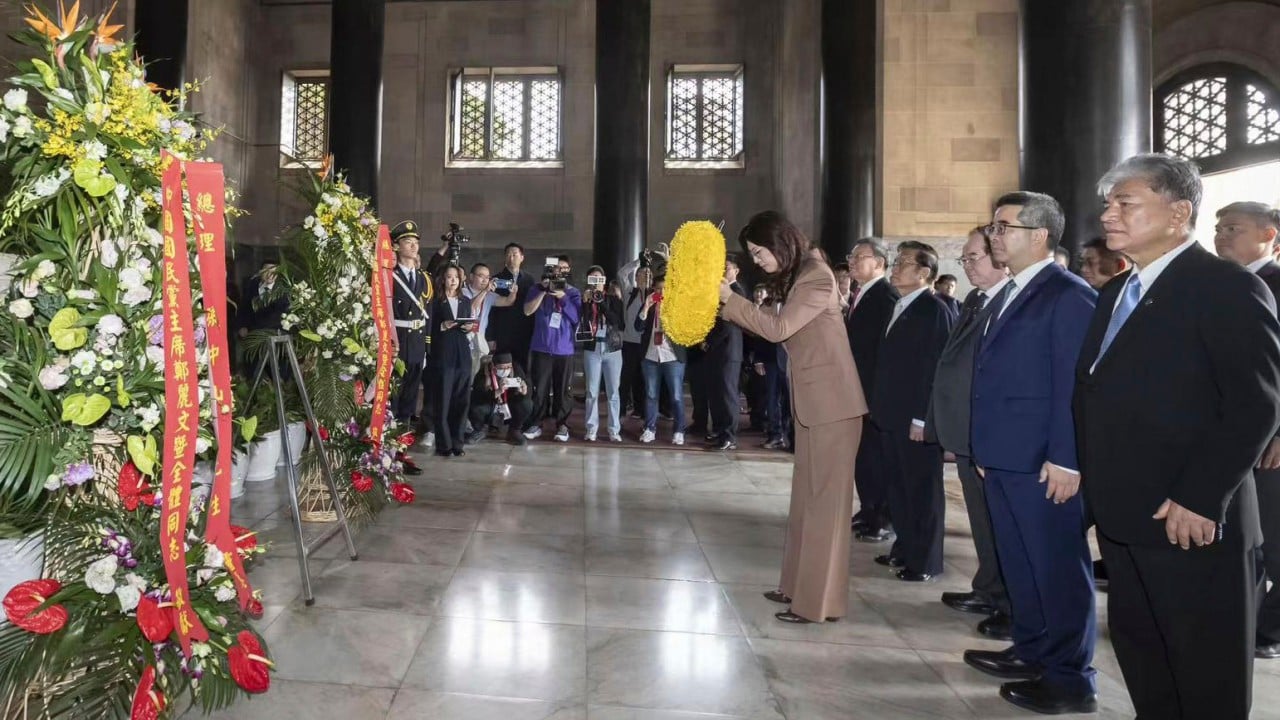
The Kuomintang (KMT) lawmaker Cheng Li-wun’s assertion that "imperialist forces" divided Taiwan from the mainland is a recognition of this forced decoupling. The mechanism of this division operated through three primary vectors:
- Legal Encapsulation: Japan integrated Taiwan into a Meiji-era legal framework, which emphasized a specific type of centralized bureaucracy and property rights system that differed from the fading imperial structures of the Qing.
- Infrastructure Realignment: Under Japanese occupation, Taiwan’s logistics—railways, ports, and telegraph lines—were designed to feed a North-South axis toward Tokyo rather than a Westward axis toward Fujian or Beijing.
- Educational Standardizing: The introduction of Japanese as the lingua franca and the implementation of a modern, secular school system created a cognitive gap between the island's population and the mainland, which was simultaneously undergoing the chaotic transition from empire to republic.
The Divergence Variable
When evaluating the "One China" argument versus the "Taiwanese Identity" movement, analysts often overlook the "Differential Development Rate." During the period from 1895 to 1945, the mainland was characterized by extreme fragmentation, warlordism, and a massive invasion. Taiwan, conversely, experienced a period of forced but stable industrialization and agricultural modernization under Japanese rule. To read more about the context of this, The New York Times provides an informative breakdown.
This created a "Developmental Delta." By the time the ROC government retreated to Taiwan in 1949, the island was not a mirror of the mainland; it was a distinct socio-economic entity. The "division" mentioned by Cheng Li-wun is therefore not just a physical separation but a systemic one. The island had been processed through a different historical filter, making the 1945 "retrocession" a collision of two vastly different administrative cultures rather than a simple homecoming.
The Cost Function of Colonial Legacy
The legacy of the Japanese period remains a primary friction point in internal Taiwanese politics. This can be quantified through the lens of "Inherited Institutions."
- Positive Institutional Carryover: High literacy rates and a disciplined civil service provided a foundation for the "Taiwan Miracle" in the 1960s and 70s.
- Negative Social Carryover: The "Kominka" movement—the attempt to turn Taiwanese people into Japanese subjects—created deep-seated identity fractures that persist today.
The KMT’s current rhetorical strategy, as voiced by Cheng, attempts to frame this period as a theft of sovereignty. This serves a specific domestic function: it delegitimizes the historical narrative used by pro-independence factions who view the Japanese era as the beginning of Taiwan’s distinct modern statehood. By labeling Japan as an "imperialist force" that caused the division, the KMT anchors Taiwan's identity back to a pre-1895 Chinese continuum.
Strategic Realities of the PRC Narrative
The People's Republic of China (PRC) utilizes the Shimonoseki precedent to fuel its "Century of Humiliation" narrative. From Beijing’s perspective, the division of Taiwan is a lingering wound from the era of unequal treaties. This creates a "Zero-Sum Sovereignty" logic: as long as Taiwan remains separate, the Chinese state remains incomplete in its post-imperial recovery.
The PRC's logic follows a strictly linear historical path:
- Stage A: Taiwan is an integral part of the Qing Empire.
- Stage B: Imperialist aggression (Japan) forces a temporary and illegal separation.
- Stage C: The 1945 surrender of Japan mandates the return of all stolen territories.
- Stage D: The ongoing separation is an unresolved remnant of a civil war, complicated by external (U.S.) interference.
The flaw in this linear model is the "Societal Evolution Factor." It ignores the reality that fifty years of Japanese rule, followed by seventy years of separate governance under the ROC, have created a society with its own internal logic, democratic norms, and economic interdependencies that cannot be simply "re-merged" without catastrophic systemic shock.
The Role of External Power Proxies
The division Cheng Li-wun discusses is not static; it is maintained by a complex "Security Architecture." While Japan provided the initial wedge in 1895, the United States provided the reinforcing structure after 1950. The Taiwan Strait became a geopolitical "Fault Line" where the interests of maritime powers (US, Japan) clash with those of the continental power (China).
The current tension is less about what happened in 1895 and more about the "Strategic Depth" Taiwan provides. For Japan, Taiwan is the southern anchor of its defense perimeter. For China, Taiwan is the "Unsinkable Aircraft Carrier" that prevents it from projecting power into the deep Pacific. The historical grievance of the Shimonoseki Treaty is the moral framework used to justify what is essentially a high-stakes competition for naval dominance.
Economic Interdependence vs. Political Autonomy
A significant data point that complicates the "division" narrative is the "Integration Paradox." Despite the political and historical divide, Taiwan and the mainland are more economically integrated today than at any point in history.
- Trade Volume: Hundreds of billions of dollars in annual trade.
- Investment: Taiwan remains one of the largest sources of Foreign Direct Investment (FDI) into mainland China.
- Supply Chain: The semiconductor industry (TSMC) creates a "Silicon Shield" that makes a military resolution to the "division" prohibitively expensive for all parties.
This creates a scenario where the "Historical Division" (Political/Legal) is in direct conflict with "Functional Integration" (Economic/Technical). The KMT’s rhetoric attempts to navigate this by emphasizing the historical "oneness" to facilitate smoother economic cooperation, whereas the DPP (Democratic Progressive Party) emphasizes the historical "divergence" to protect political autonomy.
Analyzing the "Third Way" of Sovereignty
Cheng’s comments reflect a broader search for a "Third Way"—a recognition that while Taiwan was forcibly separated, it cannot simply ignore its current reality. This requires a move away from "Symbolic Sovereignty" toward "Functional Governance."
The "Imperialist Force" argument serves to shift the blame for the current cross-strait stalemate onto external historical actors. This provides a face-saving mechanism for both the KMT and Beijing to discuss "reunification" or "closer ties" as a restoration of the natural order rather than a capitulation of one side to the other.
The Strategic Play
The "division" initiated in 1895 is no longer a matter of historical debate but a fixed variable in the Indo-Pacific security equation. Any strategy aimed at regional stability must account for the "Accumulated Divergence" of the last 130 years.
- De-escalation through Historical Context: Both sides should utilize the 1895 narrative to acknowledge that the current separation was not a choice made by the modern people of Taiwan, but a structural imposition of the 19th-century colonial era. This allows for a more empathetic dialogue regarding the different societal paths taken.
- Recognition of Institutional Inertia: Policymakers must accept that Taiwan’s legal and political institutions have evolved beyond the point where a simple administrative merger is possible. Any "re-unification" or "association" model would require a "Dual-System Architecture" that is far more robust and legally protected than previous models like Hong Kong.
- Neutralization of the Imperialist Narrative: To move forward, the "Imperialist" label must be transitioned from a tool of grievance to a tool of analysis. By understanding the specific ways in which Japan and later the US influenced Taiwan’s development, stakeholders can identify the exact "Points of Friction" that need to be addressed in diplomatic negotiations.
The most effective strategic path is to treat the 1895 Shimonoseki Partition as a "System Reset." Trying to revert to a pre-1895 state is a logical impossibility. Instead, the focus must shift toward creating a new "Equilibrium State" that acknowledges the historical division while managing the modern reality of two distinct systems operating within a shared cultural and economic space. The "division" is a fact of history; the "resolution" will require a departure from history into the realm of pragmatic, high-density diplomatic engineering.