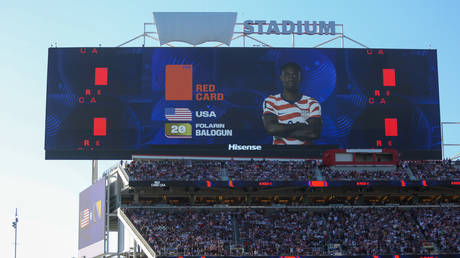
The intersection of sovereign geopolitical influence and international sports governance has reached a critical friction point. The decision by the FIFA Disciplinary Committee to suspend the automatic one-match ban for United States forward Folarin Balogun establishes a radical shift in tournament equity. By invoking a probationary mechanism to bypass a direct red-card suspension mid-tournament, football’s global governing body has exposed a fundamental contradiction within its own regulatory framework. This intervention reveals how external political pressure can exploit systemic ambiguities in sports law, reshaping competitive outcomes under the guise of discretionary justice.
The operational reality of this decision extends far beyond a single match between the United States and Belgium. It alters the risk-reward calculus for on-pitch infractions, challenges the definitive authority of the Video Assistant Referee (VAR) system, and introduces structural volatility into the administration of the 2026 World Cup. To understand the mechanics of this precedent, one must analyze the conflicting statutes within the FIFA Disciplinary Code, the geopolitical dynamics of host-nation influence, and the tactical distortions imposed on the tournament field.
The Regulatory Conflict of Article 27 and Article 66
The primary structural flaw exposed by the Balogun ruling is the direct text-based contradiction between the mandatory penalties for on-pitch misconduct and the sweeping authority granted to FIFA’s judicial bodies. The administrative framework governing player expulsions relies on two conflicting regulatory pillars.
The first pillar is the principle of automaticity. Under Article 66.4 and Article 10.5 of the FIFA Disciplinary Code, a direct red card triggers an immediate, non-appealable suspension from the subsequent match. This rule serves as the bedrock of tournament discipline, ensuring that serious foul play—regardless of intent—receives immediate athletic sanction. When referee Raphael Claus upgraded Balogun’s caution to a red card following a VAR review for serious foul play against Bosnia and Herzegovina’s Tarik Muharemović, the automaticity mechanism was designed to isolate the player from the round of 16 match.
The second pillar is the absolute discretionary power codified in Article 27. This statute states that the judicial body may decide to fully or partially suspend the implementation of a disciplinary measure, subjecting the sanctioned individual to a probationary period lasting between one and four years. The conflict arises because the code fails to establish an explicit hierarchy between the automaticity of Article 66.4 and the discretionary relief of Article 27.
By applying Article 27 to an active World Cup red card, the Disciplinary Committee effectively nullified the immediate operational effect of Article 66.4. The legal rationale relies on a technical loophole: the suspension itself was not erased, but its execution was delayed. Balogun enters a one-year probationary period. If he commits a similar infraction within twelve months, the original one-match ban activates automatically alongside any new sanctions. This creates an asymmetric enforcement model where the immediate competitive penalty is replaced by a long-term conditional threat, directly benefiting the host nation at the expense of tournament consistency.
The Mechanics of Deferral and Institutional Risk
The decision to place a player on a probationary deferral during a knockout stage introduces substantial institutional risk for FIFA. The immediate consequence is the erosion of regulatory predictability. When sports governing bodies allow high-level political figures to act as informal appellate channels, the formal dispute resolution mechanisms—such as the Court of Arbitration for Sport (CAS)—are bypassed.
The timeline of the intervention illustrates this breakdown:
- The infraction occurs during the round of 32 match in Santa Clara.
- A direct communication occurs between U.S. President Donald Trump and FIFA President Gianni Infantino.
- The U.S. Soccer Federation receives formal notification via the FIFA portal days later, confirming the deferral.
This sequence establishes a dangerous operating model. It implies that the severity of a regulatory sanction is variable, dictated not by the rulebook but by the geopolitical prominence of the player's home country. The Royal Belgian Football Association highlighted this vulnerability by stating that the decision stood in direct contradiction to established World Cup customs. The institutional risk manifests as a loss of perceived neutrality. If sports federations cannot guarantee identical enforcement of disciplinary codes regardless of a nation’s economic or political power, the ethical foundation of international competition collapses.
Furthermore, this mechanism distorts the authority of the on-field official. The VAR review process is designed to eliminate clear and obvious errors, rendering a definitive technical judgment. By overriding the automatic consequence of that judgment via an administrative committee, FIFA creates a two-tiered system of justice: one adjudicated on the pitch by certified officials, and another negotiated in executive suites by political leaders and federation presidents.
Historical Variance and the Acceleration of Precedent
While the Royal Belgian Football Association and head coach Rudi Garcia characterized the Balogun ruling as entirely unprecedented, an analysis of recent FIFA disciplinary actions reveals an incremental acceleration toward this highly discretionary model. The governing body has quietly utilized Article 27 to shield high-profile assets in recent qualification cycles, though never before during the advanced knockout stages of a major tournament.
In late 2023, Portuguese forward Cristiano Ronaldo saw the final two games of a three-match suspension deferred under Article 27 following an infraction in a World Cup qualifier, ensuring his availability for subsequent competitive fixtures. Similarly, in early 2026, Argentine defender Nicolás Otamendi and Ecuadoran midfielder Moisés Caicedo received one-game suspensions that were subsequently deferred under the same probationary framework, preserving their availability for critical opening matches.
The critical difference lies in the context of the application. Previous applications occurred during extended qualification windows where the immediate competitive timeline allowed for prolonged administrative review. Applying this mechanism within a compressed tournament format—where teams have less than 76 hours to prepare for specific opponent lineups—introduces an acute tactical shock. The historical data indicates that FIFA is increasingly willing to treat its disciplinary code as a flexible framework rather than a rigid set of laws, prioritizing commercial and political harmony over strict procedural adherence.
Tactical Distortions and Competitive Imbalance
The sudden alteration of player availability less than 24 hours before a knockout match creates immediate tactical imbalances. The preparation models deployed by elite managers rely heavily on predictive analytics, scouting reports, and tactical shapes tailored to the opponent’s expected roster.
For Belgian manager Rudi Garcia, the preparation strategy for the round of 16 encounter was built on the assumption that the United States would lack its primary central attacking threat. Balogun’s three goals during the group stage established him as the focal point of the American transition game. Operating under the assumption of his suspension, the Belgian defensive scheme would logically focus on containing wide threats like Christian Pulisic while deploying a higher defensive line to compress the midfield space.
The sudden reintegration of Balogun forces an immediate recalibration of the Belgian defensive structure. The tactical adjustments require:
- Deeper defensive positioning to mitigate the space behind the center-backs, countering Balogun’s vertical acceleration.
- A shifting of defensive tracking responsibilities, reducing the freedom of full-backs to join the attack.
- An immediate revision of set-piece assignments, altering the physical matchups inside the penalty area.
Conversely, United States manager Mauricio Pochettino gains an unearned strategic advantage. The American squad was forced to absorb a significant physical toll during the final 30 minutes against Bosnia and Herzegovina, playing down a man. The restitution of their leading striker allows Pochettino to maintain his preferred attacking blueprint without exhausting secondary depth pieces. This structural volatility penalizes the team that adhered to the rules while rewarding the squad whose player committed the initial infraction.
The Geopolitical Cost Function of Pitch Governance
The ultimate driver of this regulatory variance is the structural dependence of international sports organizations on host-nation infrastructure and political goodwill. The 2026 tournament represents a massive commercial undertaking heavily reliant on the legal, logistical, and financial cooperation of the United States government. When the executive branch of a host nation intervenes to protest a disciplinary decision, the governing body faces a complex cost function.
The variables in this equation include:
- Commercial Protection: Ensuring maximum viewer engagement and ticket revenue within the primary host market, which drops significantly if the host nation suffers an early exit due to the absence of its star players.
- Political Alignment: Maintaining strong relations with the executive leadership of a global superpower, which influences visa processing, tax exemptions, and security coordination for the duration of the event.
- Institutional Credibility: Preserving the illusion of independent governance and fair play across all member associations.
In this instance, FIFA determined that the cost of alienating the United States executive branch and risking a premature drop in domestic host engagement outweighed the reputational damage suffered by overriding its own disciplinary norms. The long-term consequence of this choice is the formalization of a blueprint for future tournament manipulation. Sovereign nations now recognize that a direct line of communication to the summit of sports organizations can yielded tangible competitive advantages on the pitch.
The strategic play for competing nations facing this altered landscape is immediate and defensive. Member associations must aggressively document every instance of disciplinary variance, utilizing the Court of Arbitration for Sport to challenge the unchecked application of Article 27. If the automaticity of red cards can be suspended for a host nation's star forward, then every subsequent suspension issued in the tournament becomes open to legal contestation. Teams must prepare for a future where sports law is explicitly transactional, and where matches are influenced as much by executive diplomacy as they are by tactical execution on the grass.