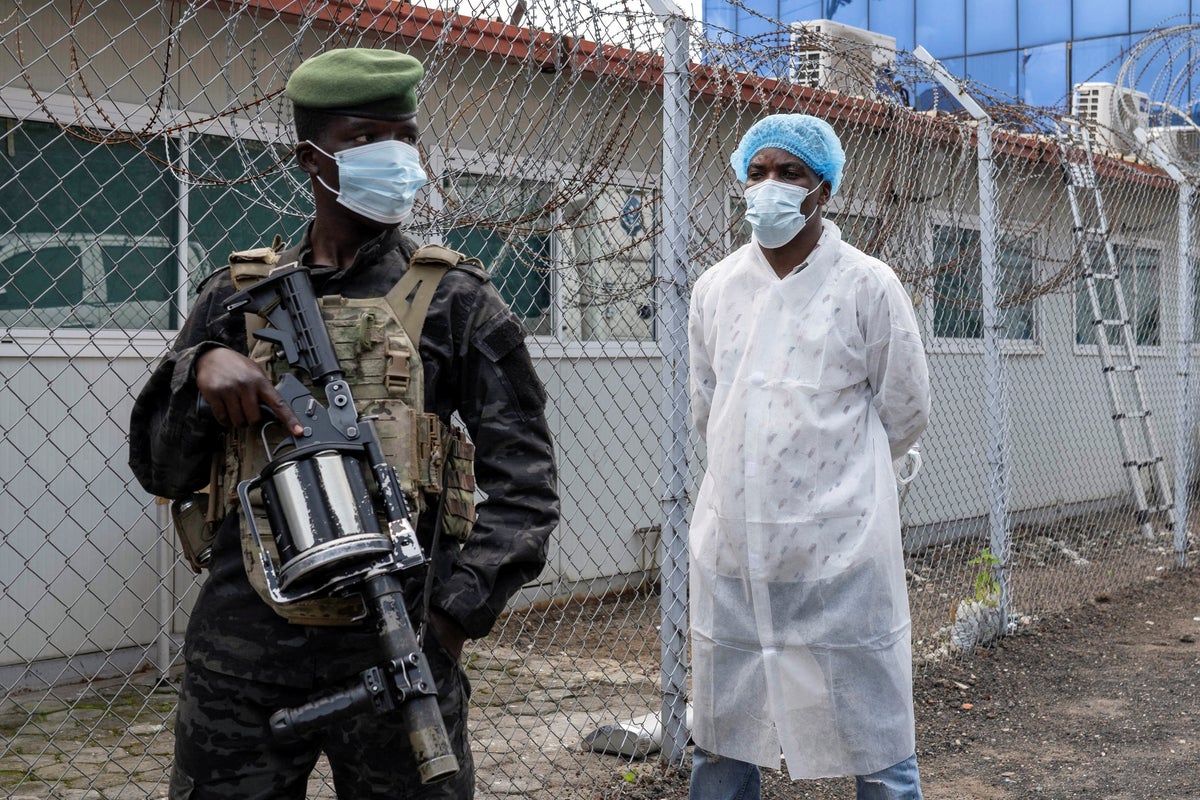
Epidemic containment relies on a predictable mathematical reality: reducing the effective reproduction number ($R_t$) to less than 1. When an Ebola virus disease (EVD) outbreak persists despite the deployment of highly effective biomedical tools, the failure is not viral; it is systemic. The protracted nature of outbreaks in the Democratic Republic of the Congo (DRC) exposes a critical mismatch between standard epidemiological models and the operational realities of active conflict zones.
Traditional public health interventions operate on the assumption of a cooperative, stable environment. In the DRC, containment efforts consistently fracture along predictable fault lines: institutional trust deficits, fragmented security environments, and misallocated operational capital. To shift an outbreak from a state of volatile persistence to definitive suppression requires a diagnostic breakdown of these structural friction points.
The Tri-Border Containment Friction Framework
To understand why standard containment protocols fail in the DRC, the operational ecosystem must be disconstructed into three interdependent variables. When these variables interact, they create an exponential compounding effect that accelerates transmission faster than contact tracing teams can move.
1. The Trust Deficit and Community Resistance Functions
Biomedical efficacy is entirely dependent on community compliance. If a vaccine is 97.5% effective but only 30% of a target population accepts it, the population-level protection drops below the threshold required for herd immunity. In the DRC, historical political marginalization by central authorities creates an environment where top-down health directives from government-aligned or international entities are viewed with inherent skepticism.
This resistance manifests in three distinct operational bottlenecks:
- Concealment of symptomatic cases: Individuals avoid isolation centers (ETC), keeping highly infectious individuals within the community during the peak shedding phase of the disease.
- Unsafe, clandestine burial practices: Traditional washing and preparation of the deceased remain high-amplitude transmission events. Because early symptoms of Ebola mimic endemic pathogens like malaria or typhoid, community members frequently reject the diagnosis entirely, attributing the illness to alternative or spiritual causes.
- Refusal of ring vaccination: Contact tracing relies on mapping a geographic and social ring around a confirmed case. When individuals refuse to self-identify as contacts, the ring fractures, rendering the vaccination strategy blind.
2. The Fragmented Security Infrastructure
Active conflict completely invalidates standard epidemiological timelines. The Zaire ebolavirus strain possesses an incubation period ranging from 2 to 21 days. Effective contact tracing requires daily monitoring of every exposed individual for the full 21-day window.
In regions managed by shifting insurgent factions or armed groups, geographic access is non-linear. A single security incident that forces international or local response teams to suspend operations for 48 hours creates a cascade of untracked transmissions.
[Security Incident]
       │
       ▼
[Tracing Suspended for 48 Hours]
       │
       ▼
[Contacts Become Symptomatic Unmonitored]
       │
       ▼
[Secondary Ring Generation Commences Untracked]
This structural blind spot grows exponentially. By the time security access is restored, the original transmission ring has branched into secondary and tertiary generations, outstripping the personnel capacity of response teams.
3. Supply Chain Disruption and Cold Chain Logistics
The storage and distribution of advanced therapeutics—specifically the Ervebo (rVSV-ZEBOV) vaccine—demand strict ultra-cold chain infrastructure. Maintaining temperatures between $-80^\circ\text{C}$ and $-60^\circ\text{C}$ in an environment with virtually zero grid electricity requires a continuous, highly vulnerable supply of liquid nitrogen or specialized Arktek deep-freeze transport devices.
The physical terrain of the eastern DRC—characterized by unpaved roads impassable during rainy seasons, dense jungle, and lack of bridge infrastructure—functions as a logistical tax. Every mile traveled increases the probability of cold-chain failure, equipment damage from vibration, or ambush. When a transport failure occurs, doses are wasted, creating localized shortages that destroy the momentum of ring vaccination campaigns.
Quantification of Transmission Acceleration Factors
The persistence of an outbreak can be modeled by analyzing the inflation of the effective reproduction number ($R_t$) caused by specific environmental variables. In an optimized setting, $R_t$ is brought down via vaccination, rapid isolation, and safe burials. In the DRC, specific acceleration factors counteract these interventions.
| Interventional Variable | Standard Objective | Operational Friction Factor in DRC | Epidemic Impact |
|---|---|---|---|
| Contact Tracing | Identify $\ge 90%$ of exposed individuals within 24 hours. | Security lockouts; community non-disclosure. | Drop in contact identification to $< 50%$, generating untracked transmission chains. |
| Case Isolation | Isolate symptomatic patients within 48 hours of symptom onset. | Flight from medical teams; delayed healthcare seeking due to fear of Ebola Treatment Centers (ETCs). | Prolonged community exposure during peak viral shedding phases. |
| Deceased Management | 100% of burials conducted by specialized, trained teams. | Secret nocturnal burials to preserve cultural traditions. | Super-spreader events where large numbers of attendees interact with highly infectious deceased tissue. |
Deconstructing the Failure Modes of Top-Down Intervention
The predominant strategy utilized by international health organizations relies heavily on a centralized command structure. This methodology introduces distinct failure modes when deployed in highly volatile ecosystems.
The Institutional Parallelism Problem
When international non-governmental organizations (NGOs) and United Nations agencies establish sovereign operational headquarters in an outbreak zone, they frequently bypass existing provincial health zones (zones de santé). This creates a dual-track healthcare economy.
Local doctors, nurses, and laboratory technicians are poached by international agencies offering higher salaries. This strips the foundational health system of its most competent personnel, causing a degradation in the management of non-Ebola pathologies. When local populations see childhood mortality from malaria or measles spike while millions of dollars are funneled exclusively into Ebola isolation tents, it deepens resentment and fuels conspiracy theories regarding the true economic motives of the intervention.
Decentralization as an Operational Imperative
The alternative to failed centralized interventions is a radical pivot toward decentralized, micro-local response nodes. Rather than relying on large, militarized convoys protecting international experts, the response must be structurally integrated into the pre-existing network of trusted local actors: parish councils, traditional healers, and community micro-finance leaders.
This is not an ideological choice; it is a tactical asset protection strategy. Local actors possess the geographic mobility and social capital required to cross fluid security frontlines where international personnel cannot step. By converting community members from passive targets of intervention into salaried, equipped operators of the response (trained in basic contact tracing and oral rehydration therapy administration), the trust deficit is mitigated.
Technical Metrics for Optimizing Intervention Efficacy
To evaluate whether a containment strategy is gaining ground or losing it, field directors must look beyond raw case counts. Raw case numbers are a lagging indicator, reflecting transmission events that occurred 7 to 14 days prior. Instead, operational decisions must be guided by leading indicators.
1. Proportion of Confirmed Cases from Existing Contact Lists
If a new confirmed case of EVD was already on a contact tracing list and under daily monitoring, the transmission chain is controlled. The individual is rapidly isolated upon symptom onset, limiting secondary exposures. If a new case appears that was not on any contact list, it signifies an invisible transmission chain.
A successful response requires this metric to remain consistently above 85%. A dropping percentage indicates that tracking teams are blind to the true contours of the epidemic.
2. Time Delta from Symptom Onset to Isolation
The viral load in an EVD patient increases exponentially with time, peaking alongside severe gastrointestinal symptoms (vomiting and diarrhea). The risk of transmission is significantly higher on day 5 of symptoms than on day 1.
The mathematical goal of the response must be to compress the time delta between the first self-reported symptom and physical admission into a bio-secure isolation unit to under 36 hours. Any expansion of this timeline directly correlates with an increase in community transmission clusters.
[Day 1: Symptom Onset] ──(Goal: < 36 Hours)──► [Admission to Isolation Unit]
                                              ▲
                                              │
                                   (Current Reality: 4–6 Days)
                                              │
                                      [Massive Community
                                       Exposure Window]
3. Positivity Rate of Post-Mortem Community Swabs
When community surveillance teams perform routine mouth swabs on all individuals who die outside of medical facilities, the positivity rate acts as an unbiased sensor for undetected community spread. A rising positivity rate in community deaths, independent of official hospital data, proves that the outbreak is expanding beneath the surface of the surveillance system.
Resource Reallocation and Strategic Redirection
The persistence of the outbreak demonstrates that continuing with the current resource allocation model will yield diminishing returns. The response must execute an immediate shift in capital and operational deployment.
Hardening the Local Healthcare Base
Funding must be structurally tied to the permanent upgrading of existing health zones. Every Ebola treatment center should be structurally attached to a primary care facility that provides free, high-quality care for malaria, pneumonia, and obstetric emergencies to the general population. This removes the diagnostic isolation of Ebola and aligns the incentives of the local community with those of the outbreak response teams.
Implementation of Targeted Ring Transmissibility Suppression
Rather than deploying massive, broad-spectrum geographic vaccination campaigns that strain the ultra-cold chain infrastructure, resources must focus on targeted ring transmissibility suppression. This involves deploying mobile, rapid-response teams equipped with highly portable, battery-powered refrigeration units to execute immediate micro-vaccination rings strictly within a 500-meter radius of a newly detected case within 12 hours of confirmation. If security issues prevent immediate access, the team deploys pre-negotiated local proxies who have already been trained and vaccinated.
The operational blueprint must shift from an elite international deployment model to a localized, distributed network model. Without this structural transformation, the outbreak will continue to oscillate between temporary containment and explosive resurgence, driven by the structural friction of the environment rather than the biology of the pathogen.