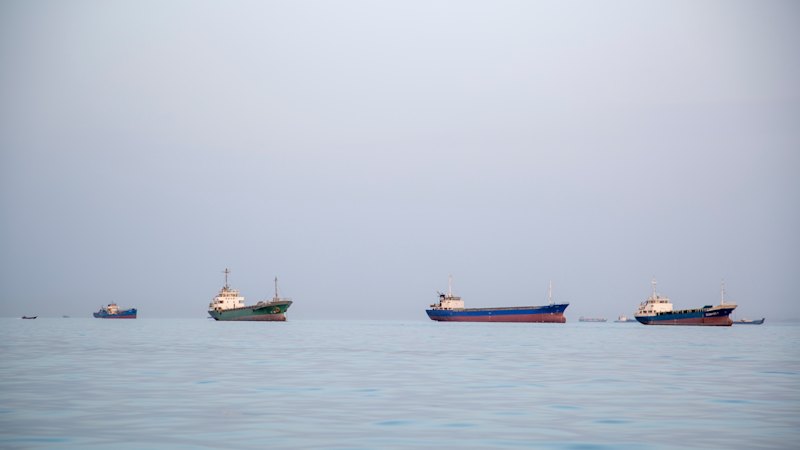
The mainstream media is stuck in a loop. Every time a tanker is diverted or a boarding party drops from a helicopter in the Persian Gulf, the headlines scream about "piracy," "regional instability," and "stalled peace talks." They treat these events like a random bar fight between nations that just can't get along.
They are wrong. They are missing the math.
What we are witnessing in the Strait of Hormuz isn't a breakdown of diplomacy. It is the most sophisticated form of diplomacy currently in play. Iran isn't "seizing ships" because they are bored or desperate; they are recalibrating the global cost of Western sanctions in real-time. If you think this is about "peace talks," you’re playing checkers while the house is playing high-stakes derivatives.
The Myth of the "Crazy Actor"
The biggest lie in geopolitical analysis is that these seizures are erratic. Pundits love the narrative of a rogue state acting out of spite. This ignores the cold, hard logic of maritime leverage.
The Strait of Hormuz is a choke point where roughly 20% of the world's total oil consumption passes daily. When a ship is detained, the actual vessel is almost irrelevant. The real target is the Lloyd’s of London insurance premiums. By demonstrating the ability to intercept a vessel with surgical precision, Tehran effectively places a "risk tax" on every barrel of oil leaving the Gulf.
This isn't a move to start a war. It’s a move to make the status quo too expensive for the West to maintain. I’ve seen analysts in DC sit in air-conditioned offices and talk about "deterrence" while ignoring the fact that shipping companies are the ones actually making the decisions. When the cost of insurance outpaces the value of the cargo because of "instability," the private sector forces the hand of the politicians. Iran knows this. They aren't fighting a navy; they are fighting a balance sheet.
Why "Peace Talks" are a Distraction
The competitor headlines focus on "stalled peace talks" as if a few more hours in a Vienna hotel would stop the boarding parties. This assumes that Iran wants a return to the 2015 baseline. They don't.
The baseline is dead. The global energy market has shifted.
The West views the Joint Comprehensive Plan of Action (JCPOA) as a legal document. Iran views the Strait of Hormuz as a physical veto. Every time a Western court freezes Iranian assets or seizes a tanker carrying Persian crude under sanctions enforcement, a "tit-for-tat" response occurs. It is a predictable, mechanical exchange.
To call it a "provocation" is intellectually lazy. It is a market correction.
If the U.S. enforces a "Maximum Pressure" campaign, Iran enforces a "Maximum Friction" campaign in the water. You cannot expect one side to play by the rules of international trade while the other side is locked out of the global banking system. This isn't about peace; it's about the price of admission to the global economy.
The Invisible Logistics of Liquid Sovereignty
Let’s look at the mechanics. Most people think seizing a ship is an act of war. In the modern era, it’s a legal maneuver backed by a gun.
When the IRGC (Islamic Revolutionary Guard Corps) boards a ship, they usually cite "maritime violations" or "environmental concerns." While the world rolls its eyes, this provides the necessary legal friction to hold a vessel in port for months.
Imagine a scenario where a Suezmax tanker is held for 90 days.
- Demurrage costs: Tens of thousands of dollars per day.
- Supply chain disruption: Refineries in East Asia have to find spot-market replacements at a premium.
- Political pressure: The flag state of the vessel (often a neutral country like Panama or Malta) starts leaning on the U.S. to stop the escalation.
Iran has turned the Strait into a giant regulatory toll booth. They aren't looking for a "win" in the traditional sense. They are looking to prove that the cost of sanctioning them is higher than the benefit of the sanctions themselves.
The Failed Logic of "Freedom of Navigation"
The U.S. Navy's Fifth Fleet talks about "Freedom of Navigation" operations as the antidote. It isn't. You cannot escort every single commercial vessel through a twenty-one-mile wide gap.
The presence of more warships actually increases the "Risk Premium" that insurers charge. The "security" being provided is an illusion that makes the cargo more expensive. It’s a paradox: the more the West tries to secure the Strait militarily, the more they validate Iran’s claim that the area is a high-risk zone.
I’ve watched energy traders navigate these spikes. They don’t care about the morality of the seizure. They care about the $2.00 "Hormuz Premium" added to every barrel. Iran is essentially printing money by forcing the global market to price in the risk they create.
Dismantling the "People Also Ask" Nonsense
People often ask: "Will this lead to a total closure of the Strait?" The answer is a resounding no. Iran needs the Strait open more than anyone else. It is their own primary export route. Closing it would be economic suicide. But threatening to close it? That is pure profit.
Another common question: "Why doesn't the international community just stop them?" Because "the international community" doesn't exist when it comes to oil. China is the largest buyer of Iranian crude, often moved through "ghost fleets" and ship-to-ship transfers. While the U.S. is busy trying to seize ships to enforce sanctions, China is busy building infrastructure. The seizures are a signal to the West, but they are a green light to the East. They say: "The U.S. cannot protect your supply lines, but we can guarantee them if you play ball with us."
The Brutal Truth of Modern Conflict
We are moving into an era of "Grey Zone" warfare where the goal isn't to sink ships, but to make them unprofitable.
If you are waiting for a "peace deal" to settle the waters, you will be waiting forever. The friction in the Strait of Hormuz is the new normal. It is a permanent feature of a multipolar world where energy is the primary currency and the dollar's hegemony is being challenged at every maritime choke point.
Stop looking for a resolution. Start looking at the spread.
The seizures will continue as long as the economic war continues. It’s not a glitch in the system; it is the system. Iran has realized that in a globalized economy, the most powerful weapon isn't a nuclear warhead—it’s the ability to pause a supply chain.
If you want the seizures to stop, you don't need better diplomats. You need a different global financial architecture. Until then, the IRGC is the most effective commodity broker in the Middle East.
Deal with it.