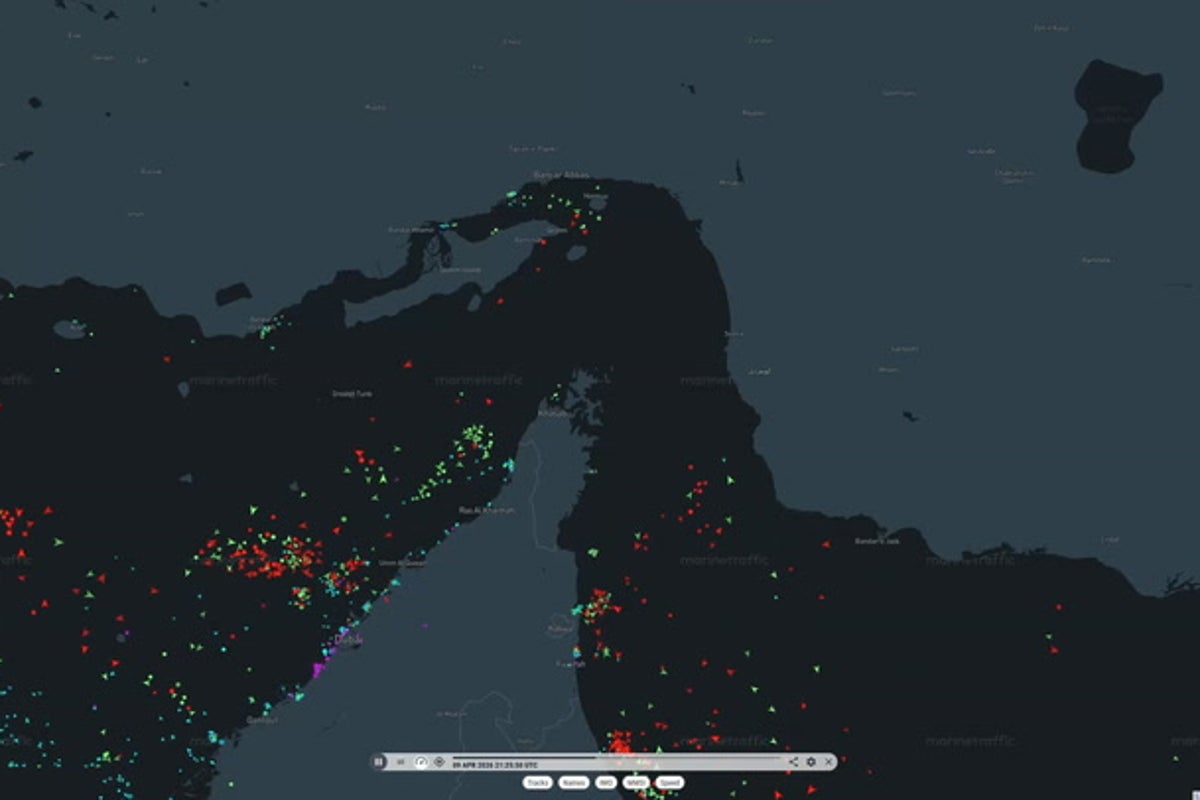
Look at any live maritime tracking map right now and you'll see something that shouldn't exist. Two days have passed since the official ceasefire took effect. In the shipping world, 48 hours is an eternity. Usually, the moment the ink dries on a peace treaty, tanker captains are redlining their engines to make up for lost time and soaring insurance premiums. Instead, the Strait of Hormuz looks like a parking lot. It’s a literal standstill.
If you thought a signed document would immediately unclog the world’s most vital oil artery, you’re looking at the wrong map. The data shows a massive cluster of Ultra Large Crude Carriers (ULCCs) and LNG tankers just sitting there, bobbing in the Gulf of Oman and the Persian Gulf. They aren't moving. They’re waiting for something the politicians haven’t provided yet—certainty.
The data behind the gridlock
The Strait of Hormuz is barely 21 miles wide at its narrowest point. About a fifth of the world’s total oil consumption passes through this tiny gap. When the shipping lanes go quiet, the global economy starts to hold its breath. Right now, MarineTraffic and VesselFinder data indicate that vessel density is down by nearly 70% compared to pre-conflict averages for this month.
You’d expect a surge. You’d expect the "bull run" of tankers rushing to hit their delivery windows in Asia and Europe. But the AIS (Automatic Identification System) signals tell a different story. Ships are transmitting their positions, but their "Speed Over Ground" is reading 0.0 knots.
This isn't a logistical fluke. It’s a calculated stay of execution by shipowners. Even though the shooting has stopped, the risk hasn't evaporated. Capt. Rajesh Gupta, a veteran maritime consultant with decades of experience in Middle Eastern waters, notes that the "ceasefire" on paper doesn't account for drifting sea mines or rogue battery operators who might not have received the stand-down order.
Why captains won't weigh anchor
Shipping companies aren't in the business of being brave. They're in the business of being insured. The London insurance market, specifically the Joint War Committee (JWC), hasn't yet downgraded the risk rating for the Strait. Until those premiums drop, every hour a ship spends in a "listed area" costs the owner a fortune.
There's also the very real problem of "dark" activity. During the conflict, several regional actors turned off their AIS transponders. Now, merchant ships are terrified of colliding with a "ghost" vessel or a patrol boat that’s still operating under wartime protocols.
Security lag and the mine threat
Clearing a waterway after a hot conflict takes more than a handshake. The primary concern right now is "legacy" ordnance. If even one stray mine is spotted, the entire insurance infrastructure collapses for another week. Naval demining teams from the U.S. 5th Fleet and regional partners are likely conducting "quiet sweeps" right now. Ship owners want to see those sweeps finished before they risk a $200 million hull and a billion dollars worth of crude.
The crew factor
We often talk about ships as if they’re autonomous blocks of steel. They aren't. They’re manned by people who have been watching missiles fly overhead for weeks. Crew contracts often have "danger zone" clauses that allow sailors to refuse to enter high-risk waters. Many operators are currently negotiating with their unions and crews to ensure they’ll actually sail into the Strait now that the "official" war is over.
Market ripples you should care about
If the standstill continues for another 48 hours, you’re going to feel it at the pump. Energy markets hate a vacuum. When the map shows no movement, traders assume the worst. They assume the ceasefire is fragile.
- Brent Crude Volatility: Prices usually dip on ceasefire news. This time, they’re holding steady or ticking up because the supply isn't actually flowing.
- Storage Constraints: Tankers stuck at a standstill mean that storage facilities in places like Fujairah are hitting maximum capacity.
- Supply Chain Lag: This isn't just about oil. Think about the empty containers waiting to get out. The delay in the Strait creates a "slug" of cargo that will eventually hit global ports all at once, causing massive congestion in three weeks.
Reading between the lines of the maritime map
Check the "Destination" field on the AIS data for the ships currently anchored. Many have changed their status to "Waiting for Orders." That’s maritime code for "The boss is scared."
You also have to look at the behavior of the Iranian Revolutionary Guard (IRGC) fast boats. Usually, these vessels are active and visible on radar. Their current absence—or their clustering near Bandar Abbas—is being interpreted by some as a tactical reset rather than a true withdrawal. The maritime community is waiting for a signal that the "gray zone" tactics have truly ended.
The immediate checklist for shipping recovery
For the Strait of Hormuz to return to its frantic, normal self, three things need to happen in the next 24 hours. If they don't, the standstill becomes a crisis.
First, the leading classification societies and insurers must issue a formal update. They need to tell the world the water is safe. Words from a diplomat don't matter to a Lloyds underwriter.
Second, we need to see a "lead ship" move. Usually, one of the state-owned tankers—perhaps a Saudi VLCC or an Adnoc vessel—will make the first run to prove the lane is clear. Once that ship clears the Musandam Peninsula without incident, the floodgates will open.
Third, the naval presence needs to shift from a "combat" posture to a "picket" posture. When the destroyers move from the middle of the channel to the outskirts, it sends a psychological signal to merchant captains that the threat of incoming fire has subsided.
Keep your eyes on the AIS heat maps. Don't look for the green and red icons; look for the wake lines. Until you see those long, straight lines cutting through the Strait toward the Indian Ocean, the war isn't actually over for the global economy.
Wait for the first major carrier to break the 12-knot barrier. That’s your real signal. Everything else is just noise. If you're tracking this for investment or supply chain reasons, ignore the headlines and watch the "Speed Over Ground" stats. That's the only truth in a post-conflict zone.