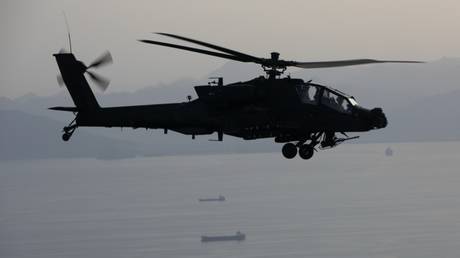
An American AH-64 Apache attack helicopter went down in the strategic waters near the Strait of Hormuz on Monday, triggering an immediate, high-stakes rescue operation. Both Army aviators survived without injuries and were extracted from the Persian Gulf within two hours. While initial reports from the Pentagon labeled the cause as under investigation, President Donald Trump declared on Tuesday that the helicopter had been shot down by Iran, promising an inevitable military response. This downing marks the first combat loss of an Apache gunship since direct hostilities with Iran erupted earlier this year, piercing the fragile, temporary ceasefire negotiated just days ago.
Beneath the standard headlines of a regional skirmish lies a far more significant tectonic shift in modern warfare. The real story is not just that an American helicopter fell out of the sky, but how the crew got back.
For the first time in military history, the Pentagon deployed an autonomous surface drone to execute a combat search and rescue operation in hostile waters. A 24-foot Corsair unmanned surface vessel, operated by the U.S. Navy’s Fifth Fleet Task Force 59, located the pilots off the coast of Oman, pulled them from the sea, and transferred them to a secure location for helicopter extraction.
The Illusion of the Ceasefire
The downing of the Apache exposes the profound fragility of the diplomatic theater currently playing out between Washington, Tehran, and Tel Aviv. Hours before the crash, diplomatic cables praised a tentative agreement to halt direct missile volleys between Israel and Iran.
That political theater is completely detached from the operational reality on the water.
The Strait of Hormuz remains under an aggressive dual blockade. Iran has choked off commercial shipping through the narrow bottleneck, halting the flow of global energy supplies. In retaliation, the United States has enforced a strict counter-blockade of Iranian ports since April, turning away or disabling over 130 vessels.
When a superpower enforces a naval blockade against a regional power, a ceasefire is an abstraction. Pentagon officials have quietly expanded the operational envelope of manned aircraft, pushing Apache gunships and F/A-18 fighters deeper into Iranian-controlled airspace and closer to disputed islands to project an aggressive deterrent posture. You cannot fly heavily armed attack helicopters through an active missile engagement zone and expect a truce to hold.
The Autonomous Rescue Precedent
The successful extraction of the two Army pilots by a Saronic Technologies Corsair drone represents a fundamental pivot in tactical risk calculation. Historically, the downing of an aircraft behind or near enemy lines required a massive, high-risk package of Combat Search and Rescue (CSAR) assets, including heavily armored helicopters, pararescue jumpers, and close-air support.
Task Force 59 changed that framework on Monday night.
- Low Profile: The 24-foot autonomous vessel slipped into the search area undetected by Iranian coastal radar.
- Speed and Range: Operating at speeds exceeding 35 knots, the drone bridged the distance to the downed crew within the critical two-hour survival window.
- Payload Efficiency: Despite its compact footprint, the vessel handled the weight of two fully geared combat aviators and navigated hazardous maritime conditions seamlessly.
This operation validates a $392 million naval bet placed late last year to rapidly field uncrewed surface fleets. By removing the human risk from the initial extraction phase, the military can operate in high-denial environments with far less hesitation.
The Economic Asymmetry of the Drone War
The loss of the Apache highlights a brutal economic reality that the Pentagon is actively trying to reverse. An AH-64 Apache costs roughly $30 million to manufacture, requiring millions more in specialized pilot training and maintenance infrastructure. To counter these assets, Iran has relied on waves of low-cost, one-way attack drones and asymmetric anti-air capabilities. Tehran claims to have downed approximately 30 U.S. MQ-9 Reaper drones over the last four months alone.
The math of trading multi-million-dollar platforms for cheap, mass-produced loitering munitions is unsustainable.
To break this cycle, U.S. Central Command has begun implementing its own asymmetric attrition strategy. U.S. forces are now deploying low-cost, one-way kamikaze drones against Iranian infrastructure. The tactical goal is simple: force Tehran to deplete its limited, expensive air-defense interceptors against cheap American targets.
This is the new reality of the Persian Gulf. It is an environment where human operators are increasingly a liability, and the true contest is being waged by autonomous systems competing on cost-per-kill metrics.
The Diplomatic Chokehold
The political fallout from Monday's shoot-down will likely derail the broader peace negotiations brokered by international mediators. The White House has maintained a firm stance, demanding that Iran permanently forfeit its remaining stockpile of highly enriched uranium before any economic relief is granted. Tehran, conversely, demands the immediate unfreezing of billions in overseas assets before signing a final text.
The downing of an American asset changes the political leverage. While the administration publicly insists that a "very good, strong deal" is close, the president's simultaneous vow to respond militarily to the Apache attack creates a dangerous policy contradiction.
Strategic deterrence cannot coexist with an unyielding diplomatic timeline. If Washington launches a retaliatory strike to avenge the downed helicopter, the fragile maritime truce will collapse entirely, ensuring that the Strait of Hormuz remains closed to the global economy for months to come. The autonomous systems have proven they can save the pilots, but they cannot save the diplomacy.


:max_bytes(150000):strip_icc():focal(665x0:667x2)/gettyimages-50733149-2000-8b129a2475974982a915418ce92a73d8.jpg)