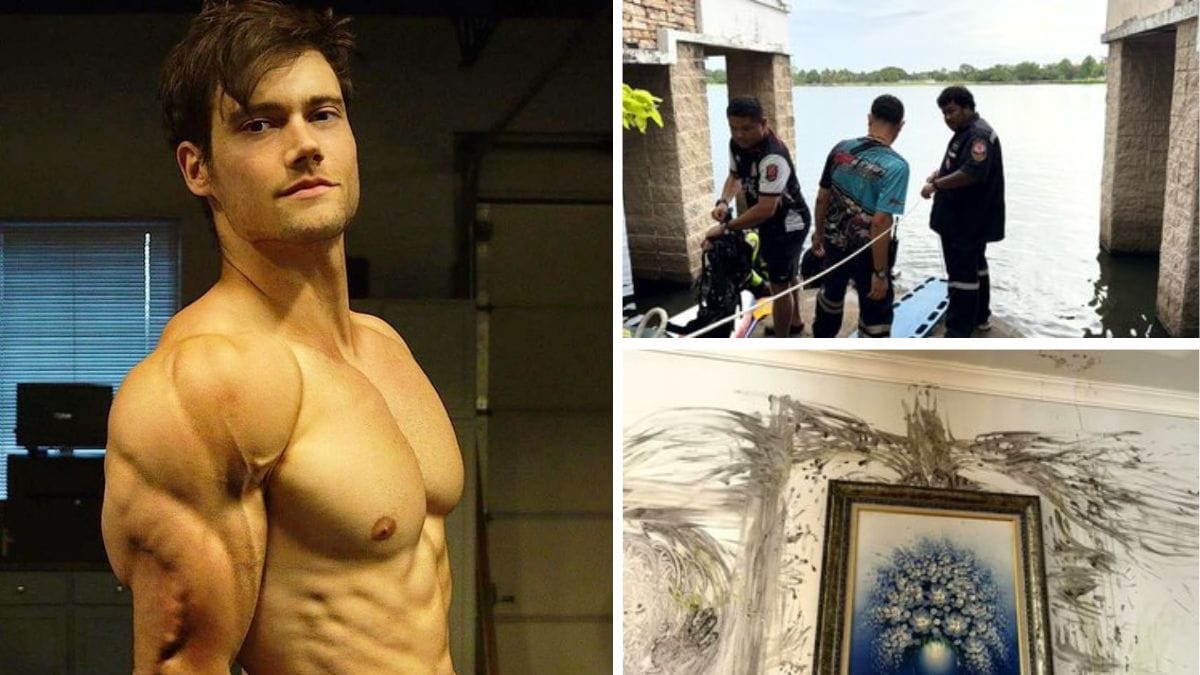
Mainstream media outlets love the safety of the word "rumor." When news broke from Thailand regarding the horrific drowning of 32-year-old fitness influencer Connor Murphy, major publications immediately deployed their standard, algorithmic copy-paste templates. They hyper-focused on the lack of a PR statement from his family, choosing to frame a concrete tragedy as just another piece of digital gossip or a potential "social experiment."
This lazy consensus misses the entire point of the tragedy, sanitizing a brutal, years-long psychological collapse into a sanitised sequence of trending search terms.
The details coming out of Samut Prakan province are not a TikTok hoax. Thai authorities, rescue divers, and local forensic teams confirmed the recovery of a 32-year-old American national named Connor Michael Murphy from a 10-meter-deep residential lake. This followed a severe public psychotic episode where he rolled on the concrete, made prayer gestures, fled from local police, and swam until his body simply gave out from exhaustion. His rented 22-million-baht home was discovered smeared entirely in paint. Investigators recovered syringes and unidentified pills from his vehicle.
To look at this wreckage and write an article asking "Is he dead or alive?" under the guise of journalistic skepticism isn't accuracy. It is a fundamental refusal to look the dark reality of the fitness creator economy in the eyes.
The Myth of the Sudden Breakdown
The superficial narrative surrounding this tragedy paints it as a sudden, shocking turn of events. Commentators look at his 2016 NPC Dallas Europa Games physique, his viral public "shirt-trick" videos, and his 2.3 million subscribers, asking how someone who "had everything" could decline so rapidly.
I have spent over a decade watching creators in this exact niche burn themselves to the ground. The truth is never sudden. The infrastructure for Murphy’s collapse was baked directly into the metrics that made him famous.
The fitness industry operates on extreme, unsustainable neurochemistry. To build an audience that massive, you must reward the algorithm with a constant escalation of physical and psychological extremes. When the returns on a perfect, natural-looking physique diminish, creators are forced to pivot to stay relevant. Murphy didn't just wake up one day in 2020 and decide to trade heavy squats for prolonged fasting, intense psychedelic use, and erratic spiritual manifestos. He was chasing the same high of extreme validation and obsessive optimization that built his channel in the first place.
When you spend your entire twenties treating your body as a hyper-optimized commodity to be judged by millions of strangers, your internal compass breaks. The shift from obsessive physical optimization (bodybuilding) to obsessive mental optimization (extreme biohacking and psychedelic abuse) is a direct, logical line. It is the same sickness with a different aesthetic.
Dismantling the PAA Parasite
The internet's immediate response to this crisis highlights the toxic nature of modern search intent. Look at the primary queries flooding search engines:
- Was Connor Murphy's death a hoax? No. Treating a verified police and rescue recovery operation in Thailand as a potential "prank" shows how thoroughly social media has detached audiences from basic empathy and reality.
- What drugs was Connor Murphy on? While toxicology reports are pending and his girlfriend stated she had not witnessed recent drug use, the focus on specific substances misses the broader structural failure. Whether the psychosis was triggered by synthetic compounds, extreme fasting, or underlying, unaddressed clinical mania, the catalyst was an environment that treats mental instability as "top-tier content."
- Did his fitness protocol cause this? His "Natty Plus" routines and early fitness content did not cause a psychotic break. The relentless isolation of the digital creator lifestyle did.
The internet demands that its heroes remain static characters. When a creator begins to unravel publicly—as Murphy did for years on forums and video platforms—the audience doesn't stage an intervention. They grab popcorn. They label it "schizoposting." They turn a man's psychological disintegration into a meme, cheering on the descent because it provides an ironic laugh. The very people typing "RIP King" today are the ones who treated his clear cries for help over the last three years as performance art.
The Lethal Cost of Optimization Culture
The real lesson here is one the fitness community refuses to admit: the modern biohacking and extreme bodybuilding subculture is actively generating severe psychological crises.
We have created an online ecosystem that glorifies behaviors that are fundamentally indistinguishable from severe mental illness. If you starve yourself for days, obsess over every micro-dose of a compound, isolate from society to maintain an aesthetic, and track every variable of your existence with clinical paranoia, you are celebrated as a "disciplined creator." If you take those exact same obsessive behavioral patterns and apply them to spirituality or metaphysics, you are suddenly viewed as insane.
Imagine a scenario where we treated the mental health of these young men with half the intensity we apply to their macronutrient splits or view counts. The fitness industry is built on a foundation of profound inadequacy. It tells young men that they are never big enough, never shredded enough, never rich enough, and never optimized enough.
Connor Murphy achieved the absolute pinnacle of what that culture promises. He had the elite physique, the millions of fans, the luxury lifestyle in Thailand, and the global recognition. It kept him alive for a few years, but it couldn't save him from the vacuum underneath.
Stop waiting for a polished press release to tell you how to feel about this. Stop looking at a tragedy through the clinical lens of search engine optimization. A young man who spent his life performing for the internet ran out of places to hide, ran from the authorities, and drowned in a lake while onlookers watched. The system worked exactly as intended: it converted a human life into millions of views, right up until the very last second.