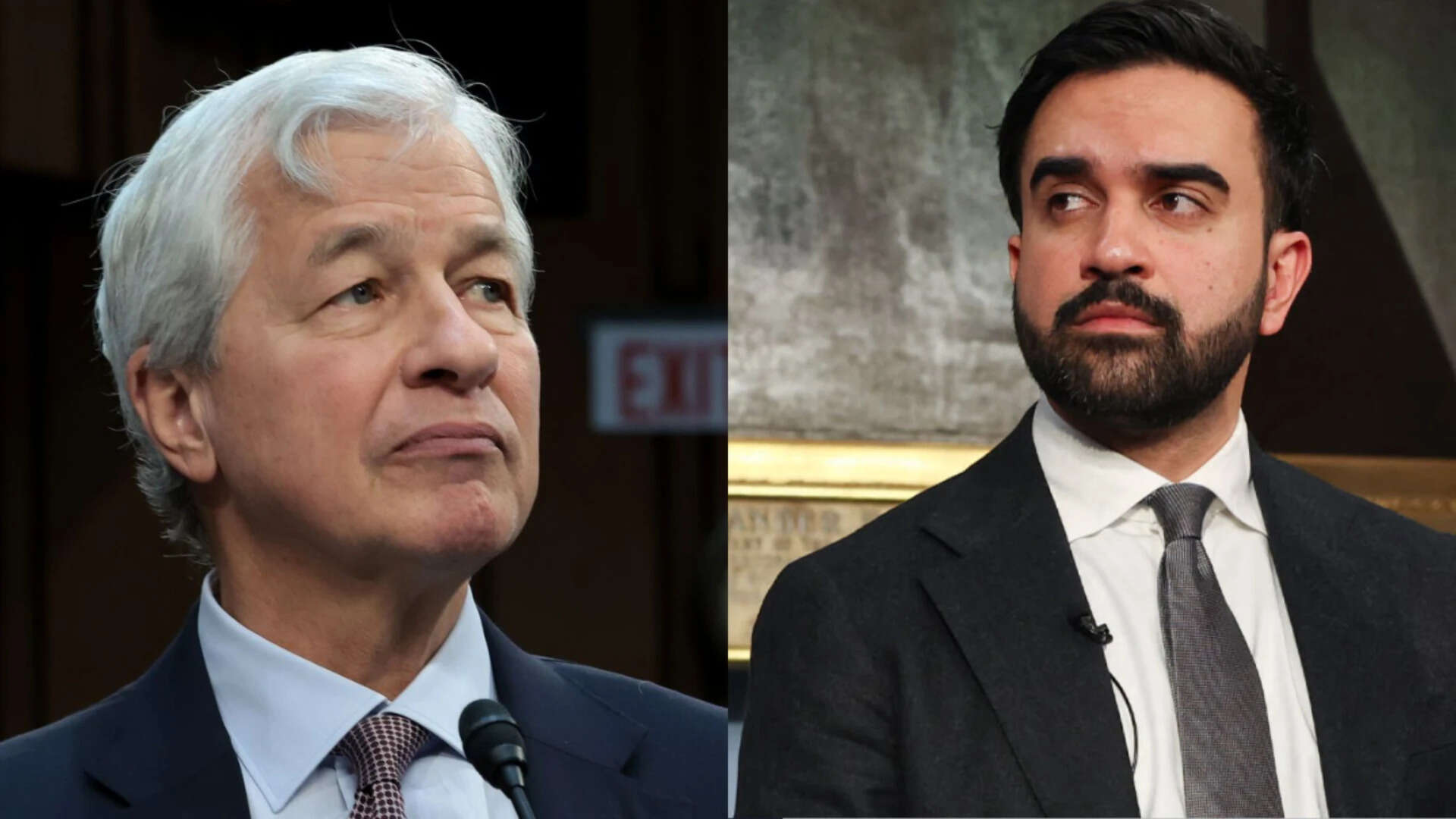
The financial press loves a David and Goliath story. When Jamie Dimon, the long-standing CEO of JPMorgan Chase, gets into a heated, closed-door debate with a progressive political figure or an activist like Zohran Mamdani, the headlines write themselves. The predictable narrative immediately solidifies: a billionaire Wall Street titan is supposedly running scared from grassroots accountability, desperately defending an archaic financial system against the inevitable march of social progress.
This interpretation is completely wrong. It misses the entire mechanics of high-stakes corporate governance.
The lazy consensus among business commentators is that these confrontations represent a PR disaster for big banks. Management consultants wring their hands and issue boilerplate warnings about the "reputational risk" of executives losing their cool or engaging directly with ideological opponents. They advise corporate leaders to hide behind sanitized press releases, vague commitments to sustainability, and layers of public relations handlers.
That cowardly strategy is exactly how companies destroy their own credibility.
When a chief executive steps into a room and forcefully counters a critic by telling them their economic ideas are disastrous if executed poorly, it isn't a failure of diplomacy. It is a masterclass in risk management. The real threat to modern enterprise isn't a fiery debate; it is the slow, suffocating consensus of unchallenged, economically illiterate policies creeping into boardrooms under the guise of stakeholder capitalism.
The Myth of the Bulletproof Corporate Apology
For the past decade, corporate America has operated under a delusion. Chief executives believed that if they just nodded along to every macroeconomic critique, funded enough vague social initiatives, and smiled through hostile town halls, the critics would eventually leave them alone.
I have watched Fortune 500 leadership teams burn tens of millions of dollars on this exact strategy. They hire high-priced crisis management firms to draft groveling public statements. They issue thick, glossy corporate social responsibility reports filled with buzzwords but devoid of economic substance.
The result? The critics smell blood in the water and double down.
Corporate capitulation does not buy peace; it rents it at an astronomical premium. When an executive refuses to push back against flawed economic premises, they are effectively validating them. If a politician or an activist claims that complex financial mechanisms can be dismantled overnight without catastrophic downstream effects on everyday liquidity, and the CEO simply responds with a hollow statement about "valuing the dialogue," the public assumes the activist is right.
Dimon’s willingness to break protocol and engage in raw, unvarnished debate during closed-door sessions reveals a fundamental truth that most executives are too terrified to admit: you cannot manage a multi-trillion-dollar global balance sheet by consensus.
The Mathematical Ignorance of Populist Economics
Let’s dissect the mechanics of these closed-door clashes. The core tension almost always boils down to a fundamental misunderstanding of capital allocation. Activists frequently demand that major financial institutions arbitrarily cut off funding to specific sectors, artificially cap interest rates, or redirect capital based entirely on ideological metrics rather than risk-adjusted returns.
To understand why this is dangerous, we have to look at the cold, hard numbers of banking liquidity.
The return on equity (ROE) for a major global systemically important bank (G-SIB) typically hovers between 11% and 18%. This margin isn't a pool of excess cash meant to serve as a piggy bank for political pet projects. It is the buffer that keeps the global financial system from collapsing during a liquidity crunch.
Imagine a scenario where a major lender yields to political pressure and abruptly restricts capital to traditional energy sectors or heavily regulated industrial markets before viable, scalable alternatives are online. The immediate consequence isn't a cleaner planet or a fairer economy. The consequence is a severe supply-side shock. Credit tightens. The cost of capital skyrockets for mid-sized businesses. The very working-class communities the activists claim to protect are the first to get crushed by the resulting inflationary pressure.
When a CEO tells a critic, "If you do it badly, you ruin the economy," they aren't being dismissive. They are stating a mathematical certainty.
Financial ecosystems operate on highly sensitive feedback loops. You cannot alter one variable—such as forcing a bank to underwrite unprofitable, high-risk loans for political optics—without triggering a cascading failure across credit markets. The Federal Reserve's own stress-testing models consistently demonstrate that sudden, non-economic disruptions to asset portfolios are the fastest way to trigger a systemic capital shortfall.
Why Closed-Door Friction is Better Than Open-Door Performance
The media constantly demands total transparency, insisting that these meetings should be broadcast or transcribed for public consumption. This demand ignores human psychology and the realities of negotiation.
Public forums are not designed for intellectual honesty. They are performance art. When the cameras are rolling, activists are incentivized to score rhetorical points for their base, and executives are incentivized to retreat into defensive legalese. Nothing gets solved. No minds are changed.
True accountability happens when the doors are locked, the smartphones are left outside, and both sides are forced to defend their positions without the benefit of an applause track.
+-------------------------------------------------------------+
|               THE ANATOMY OF CORPORATE ENGAGEMENT           |
+-------------------------------------------------------------+
| PUBLIC TOWN HALLS           | CLOSED-DOOR CLASHES           |
|-----------------------------|-------------------------------|
| • Performance-driven optics | • Raw economic debate         |
| • Focus on soundbites       | • Focus on systemic impact    |
| • Encourages entrenchment   | • Allows for blunt truths     |
| • Zero operational utility  | • Identifies real boundaries  |
+-------------------------------------------------------------+
In a private setting, an executive can look an ideological opponent in the eye and map out the brutal realities of the global markets. They can explain exactly how a well-meaning piece of legislation will inadvertently freeze the municipal bond market, halting infrastructure projects in the critic’s own district. This isn't bullying; it is an educational intervention.
The downside to this approach is obvious: it makes for terrible public relations in the short term. Leaks will happen. Snippets of conversation will be stripped of context and weaponized on social media. The CEO will be vilified by commentators who have never had to manage a profit-and-loss statement, let alone a global financial institution.
But leadership is not a popularity contest. The primary fiduciary duty of a CEO is to ensure the long-term resilience of the institution they command. If maintaining that resilience requires being the villain in a temporary media cycle, then an effective leader accepts that cost without hesitation.
Dismantling the Premise of Corporate Accountability
The public frequently asks: Why shouldn't billions of dollars in corporate profits be directly managed to solve immediate societal crises?
The question itself is structurally flawed. It assumes that corporate profits exist in a vacuum, detached from the millions of retail investors, pension funds, and 401(k) plans that actually own the shares of these institutions. When a bank generates strong returns, those returns flow directly back into the retirement portfolios of teachers, firefighters, and everyday workers.
Directing a private enterprise to act as an unelected arm of social policy is a subversion of both capitalism and democracy. If the public wants wealth redistributed or specific industries shuttered, that mandate must come through the legislative process via elected officials—not by bullying corporate executives into acting as proxy regulators.
When activists bypass the legislative process to pressure individual corporations, they are admitting that their ideas lack the broad democratic support required to pass actual laws. They want the shortcut. They want to use the immense leverage of the financial system to enforce compliance that they couldn't achieve at the ballot box.
A strong corporate leader recognizes this tactic for what it is: an attempt to co-opt the levers of capital for fractional political gain. Standing firm against that pressure isn't just about protecting shareholders; it is about defending the boundaries between private commerce and public governance.
Stop Running from the Fight
The current corporate playbook is broken. The executives who spend their days carefully curating a harmless, neutral persona are the ones who get blindsided when a real crisis hits. They have trained themselves to be so agreeable that they no longer know how to fight for the survival of their business models.
It is time to throw that playbook out.
Do not try to de-escalate every conflict. Do not assume that your critics are acting in good faith or that they understand the intricate plumbing of the global financial architecture. Most of the time, they don't. They are operating on ideology, emotion, and simplified narratives that fall apart under the slightest empirical scrutiny.
When confronted with economic fantasy, your job is to counter it with cold, hard operational reality. Bring the data. Show the stress tests. Explain the mechanics of capital destruction. Do it behind closed doors where the truth can be spoken without a filter, and do not apologize when the details get uncomfortable.
If your corporate strategy relies on everyone liking you, you don't have a strategy—you have a vulnerability. The leaders who survive the next decade won't be the ones who successfully appeased every critic; they will be the ones who had the backbone to stand their ground, lock the door, and tell the hard truths that nobody else wanted to hear.