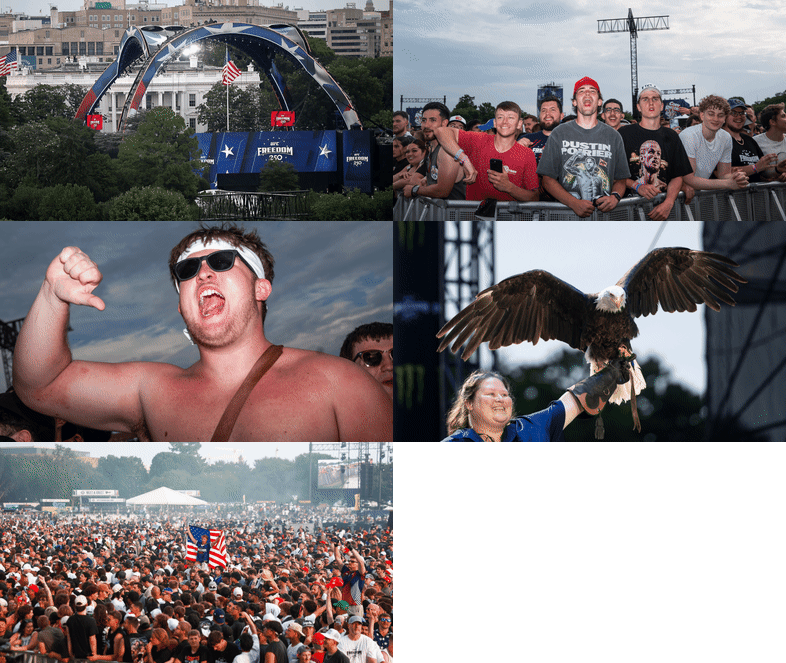
The air in the arena always smells the same before the house lights drop. It is a mixture of stale popcorn, synthetic cooling vapors, and the distinct, electric charge of thousands of people breathing in unison, waiting for a curtain to rise. For the people shuffling into the vinyl seats, this is not just a political rally. It is a pilgrimage wrapped in a carnival.
On this particular evening, the sensory overload is dialed to a maximum. Red, white, and blue banners drape from the rafters, but they compete with a deluge of personal iconography. The numbers 78 and 250 blink from digital screens and T-shirts alike.
Two milestones. One man.
To understand the modern political spectacle, you have to look past the teleprompters and the talking heads on the cable news screens. You have to look at the intersection of personal myth and national identity. Donald Trump turned 78 years old in a room designed to feel like the center of the universe. But the celebration stretching out before him was not merely a personal retrospective. It was a dress rehearsal for a much larger milestone: America’s upcoming semiquincentennial.
The spectacle tells a specific story about power, aging, and the theater of American loyalty.
The Choreography of the Spotlight
The crowd does not gather by accident. They are summoned by a maestro of the medium. When a public figure reaches the late chapters of life, the instinct of the handler is often to shield, to soften the edges, to dim the lights. Not here. Here, the passage of years is not treated as a vulnerability to be hidden, but as a monument to be unveiled.
Consider the sheer scale of the staging. A massive multi-tiered cake, glittering under the hot stage lights, becomes less a dessert and more a political prop. It sits there, heavy and symbolic, demanding attention. The music swells—a familiar, bombastic playlist of seventies rock and patriotic anthems that has soundtracked a decade of these gatherings.
When he steps into the light, the roar is physical. It vibrates in the chest cavity.
This is the art of the self-perpetuating headline. By turning a birthday into a national event, the boundary between the individual and the state begins to blur for the people in the room. The narrative shifts. It is no longer just about a candidate seeking an office; it is about an individual claiming a share of the nation's historical timeline.
The strategy is simple yet deeply effective. You take the anxieties of an aging electorate, the collective nostalgia for a past that feels like it is slipping away, and you anchor it to a single, resilient figure. If he is enduring, the movement is enduring. If he is celebratory, the nation has permission to celebrate.
The Collision of Two Timelines
Every country possesses a sacred calendar. For the United States, the fourth of July is the emotional anchor, a moment of collective reflection on an experiment that began in 1776. The approaching 250th anniversary of the Declaration of Independence is already cast in a long shadow of anticipation. It is a massive, historic weight.
But inside the arena, that national timeline is being systematically braided into a personal history.
The rhetoric on stage does not treat the quarter-millennium of American history as an abstract concept. Instead, the language treats the upcoming 2026 celebration as a personal project, a party that can only be properly thrown if the right host is in the residence on Pennsylvania Avenue. It is a subtle, powerful psychological pivot. The audience is invited to believe that the fate of the country’s landmark birthday is inextricably linked to the survival and triumph of the man standing before the giant cake.
This is where the invisible stakes reveal themselves.
Political power has always relied on symbols, but this is an attempt to merge the symbol with the flesh. The standard political speech answers the question, What will you do for me? This spectacle answers a different question entirely: Who are we?
To the critics watching from the media booths, the display looks like vanity run amok, an ego consuming a national tradition. But to the true believers in the front row, the view is entirely different. They see a refusal to back down. They see a man who refuses to be diminished by time, standing as a proxy for a country they feel is being diminished by the modern world.
The Theatre of Longevity
Aging in the public eye is a brutal business. The camera is unforgiving. Every hesitation is analyzed; every misstep is turned into a loop that plays infinitely on social media feeds. The political landscape has become an arena where vitality is the ultimate currency.
In this environment, the birthday party becomes a weapon.
+----------------------------------------+----------------------------------------+
| The Traditional Approach               | The Spectacle Approach                 |
+----------------------------------------+----------------------------------------+
| Minimize the age factor                | Magnify the milestone                  |
| Soft lighting and controlled settings  | Stadium floodlights and massive crowds |
| Focus entirely on policy futures       | Fuse personal history with national myth|
+----------------------------------------+----------------------------------------+
By leaning directly into the number—seventy-eight—the campaign attempts to defuse it. They turn a potential liability into a badge of endurance. The message is clear: while others may falter or fade under the immense pressure of the public eye, this figure remains, unchanged, unbothered, and utterly dominant in his environment.
The crowd devours this imagery because it feeds their own desire for stability. In a world changing at a terrifying, breakneck pace, where technology and cultural norms shift between sunrise and sunset, there is a profound comfort in the familiar. The pompadour, the long red tie, the grievances, the triumphs—they have remained constant for years. The ritual of the rally provides a sense of continuity that the outside world denies them.
But the real engine of this spectacle is not nostalgia. It is anticipation.
The speeches don't just look back at the triumphs of the past; they project forward to that grand 250th anniversary. The year 2026 is painted not just as a date on a calendar, but as a destination, a promised land of renewal. The narrative promises that the country will find its way back to its original greatness, and that the journey will culminate in a massive, nationwide festival of reassurance.
The Audience as Cast Members
A spectacle cannot exist without an audience that agrees to believe in it. The people filling the arena are not passive observers. They are active participants in the creation of the myth.
Watch the faces in the crowd when the cake is wheeled out. There is a genuine, unforced joy there. They sing along. They wave their signs in rhythm. They have invested their own identities into this movement, and so a celebration for him feels like a celebration for them. It is a collective validation.
This is the element that outside observers often fail to grasp. They analyze the fact-checks, they point out the contradictions in the rhetoric, they tally the costs of the event. But they miss the emotional currency being traded in the room. For an hour or two, the people inside this arena feel seen. They feel like they are part of a grand historical narrative, rather than just citizens drifting through an uncertain economy.
The man on stage understands this intimacy perfectly. He talks to the crowd not like a politician delivering a policy paper, but like a host at a private dinner party who just happens to have fifty thousand guests. He shares inside jokes. He calls out local figures. He turns the entire apparatus of national politics into a personal conversation.
The Final Chord
As the event reaches its crescendo, the distinction between the man, the birthday, and the nation seems to dissolve entirely under the brilliant glare of the stadium lights. The music reaches its peak volume, a wall of sound that blocks out the rest of the world. Streamers drop from the ceiling, a cascading waterfall of paper that coats the shoulders of the faithful.
The giant cake remains on the stage, untouched, a glittering monument to the hour.
Outside the arena doors, the night is quiet and cool. The real world waits there—the complicated, messy world of bills, traffic, and fractured news cycles. The country’s 250th birthday is still a distant point on the horizon, an upcoming challenge for a nation trying to figure out its next chapter.
But inside, under the red glow of the exit signs and the fading warmth of the stage lights, the illusion holds. The crowd begins to file out into the parking lot, carrying their crumpled signs and their memories of the music. They leave with the feeling that they have witnessed something larger than a political event. They believe they have seen the opening chapter of a new American century, written by the man who refused to let the candles blow out.