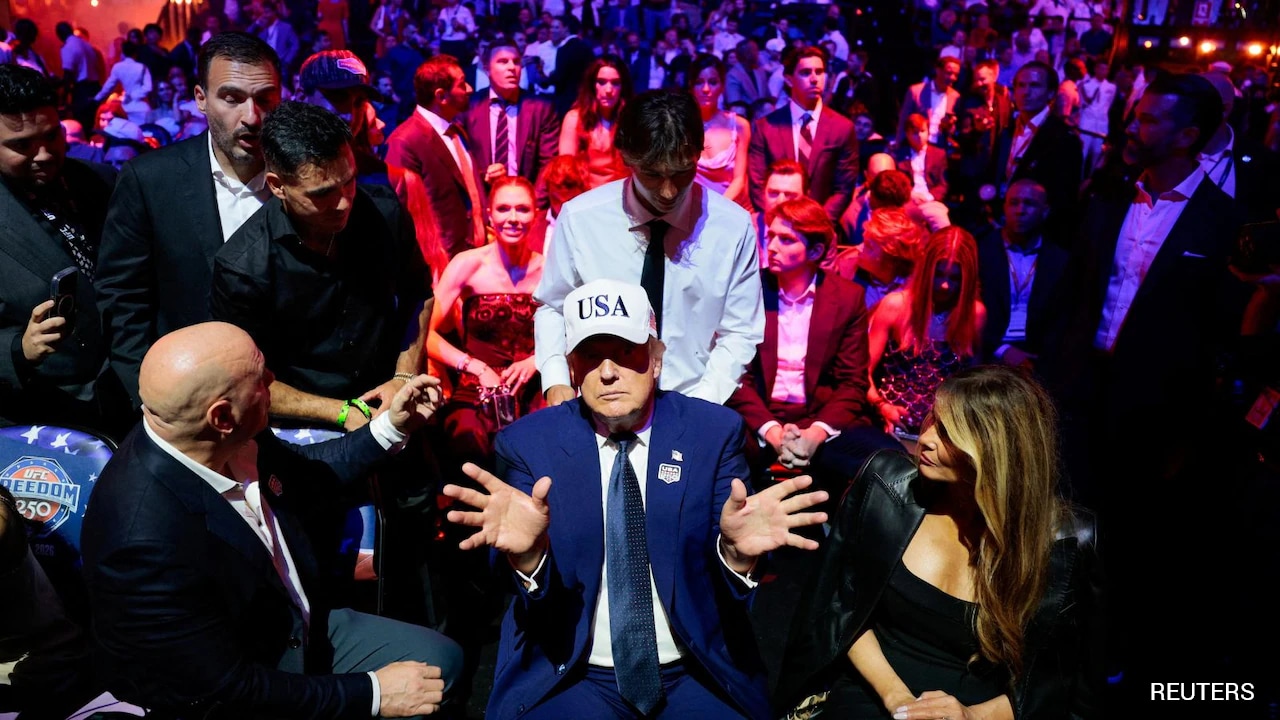
The execution of UFC Freedom 250 on the South Lawn of the White House signals a structural shift in the deployment of executive authority, tradecraft, and state-sponsored distraction. Staged concurrently with Donald Trump’s 80th birthday, the event utilized a multi-layered framework designed to conflate personal branding, corporate monetization, and geopolitical theater. By introducing a professional mixed martial arts cage into the seat of federal governance, the administration established an unprecedented precedent for institutional repurposing.
Understanding this event requires bypassing superficial narratives of cultural friction or personal indulgence. The assembly of a temporary stadium beneath a 92-foot steel canopy known as "The Claw" demands rigorous analysis across three primary dimensions: the exploitation of statutory loopholes for non-governmental events, the mitigation of critical domestic and international vulnerabilities through high-impact media saturation, and the symbiotic economic relationship between executive personnel and a privately held corporate entity.
The Statutory Loophole: Semiquincentennial Exploitation
The primary hurdle for hosting a commercial combat sports event on federal property resides in the stringent regulatory frameworks governing the use of the White House complex. Under standard administrative protocols, the grounds are reserved strictly for official state functions or historical public tours. To circumvent these restrictions, the administration anchored UFC Freedom 250 to Public Law 96-221 and associated executive directives governing the United States Semiquincentennial—the upcoming 250th anniversary of the Declaration of Independence.
By codifying the event as a ceremonial commemoration of the "American fighting spirit" aligned with Flag Day, organizers transformed a private athletic promotion into a federally sanctioned civic exercise. This strategic classification triggered several systemic advantages:
- Injunctive Immunity: When civic watchdogs pursued an emergency injunction to halt the event, the legal defense successfully argued that the gathering constituted a state-recognized cultural celebration rather than a commercial enterprise.
- Infrastructure Absorption: Utilizing the "Freedom 250" framework permitted the logistical costs of constructing a 4,000-seat arena, installing heavy industrial audio-visual equipment, and coordinating military flyovers by the Blue Angels, Thunderbirds, and a B-1 bomber to be absorbed partially under the security and ceremonial budgets of the state.
- Demographic Engineering: The seating configuration directly integrated active military service members. By enforcing strict physical fitness and height-to-weight specifications for attendees in uniform, the event engineered a highly disciplined visual backdrop that reinforced the state’s branding objectives.
This framework successfully decoupled the event from traditional oversight, permitting the installation of an active sports asset on public land.
The Diversionary Calculus: Mitigating Multi-Variable Crises
The timing of the event corresponds with a convergence of severe macroeconomic and geopolitical pressures. A rigorous analysis reveals that the high-density entertainment format serves as an effective mechanism for managing domestic attention spans and suppressing negative media cycles. The diversionary strategy functions to offset four specific friction points:
[Geopolitical Tension: Iranian War / Blockade] ──┐
[Macroeconomic Strain: Core Inflation / Energy] ──┼─> Attention Displacement (UFC Freedom 250)
[Institutional Friction: Naming Rights Loss] ────┤
[Actuarial Risk: Advanced Age Milestones] ───────┘
The ongoing conflict involving Iran has introduced sustained friction into global energy markets, manifesting as elevated domestic fuel prices and sticky core inflation metrics. Simultaneously, a federal court ruling forced the removal of the president's name from the Kennedy Center, delivering a direct blow to the administration's narrative of structural dominance. Furthermore, reaching the age of 80 introduces clear actuarial and political vulnerabilities, prompting unfavorable comparisons regarding cognitive and physical longevity.
UFC Freedom 250 addresses these vulnerabilities through strategic attention displacement. The intense physical confrontation within the cage replaces abstract geopolitical and financial data with raw, digestible spectacles of physical dominance. While complex diplomatic negotiations regarding the opening of the Strait of Hormuz occurred behind closed doors, public-facing channels were dominated by images of the executive entering the octagon alongside championship fighters.
The mechanism relies on psychological substitution. By framing the administration as synonymous with an uncompromising combat culture, the abstract liabilities of high inflation and military stalemates are translated into a narrative of resilient, long-term endurance.
Corporate Symbiosis and Asset Appreciation
The financial architecture underlying UFC Freedom 250 exposes a significant convergence of public power and private capital. The event serves as an unprecedented marketing vehicle for TKO Group Holdings, the publicly traded parent company of the Ultimate Fighting Championship. Financial disclosure reports indicate executive ownership of up to $50,000 in TKO stock, introducing a direct structural connection between executive actions and corporate valuation.
The commercial execution utilized public assets to maximize private corporate equity through specific mechanisms:
- Unprecedented Venue Premium: Staging a fight card on the South Lawn provides a level of brand differentiation that no commercial arena can replicate. The historical prestige of the venue increases the long-term archival and licensing value of the broadcast content.
- Institutional Endorsement: The integration of federal agencies directly elevates the corporate partner’s legitimacy. For example, the formal recognition of fighter consistency under federal drug-testing protocols, administered by the Office of National Drug Control Policy during White House media availability, serves as an official validation of the brand's operational integrity.
- Monetized Global Distribution: The broadcast integrated state rhetoric with pay-per-view infrastructure. While a recruitment presentation for the newly designated Department of War aired during the transmission, the core commercial architecture remained geared toward driving paid subscriptions and global media rights revenue for the private promoter.
This relationship demonstrates a sophisticated evolutionary step in political fundraising and corporate partnerships. Rather than relying on traditional external donations, the political apparatus integrates directly with a media entity to generate cultural capital, while simultaneously driving attention toward a commercial platform in which key actors hold financial stakes.
The Operational Playbook
The execution of UFC Freedom 250 provides a clear operational template for future political maneuvers where institutional norms encounter strategic resistance. The reliance on raw, physical entertainment serves to bypass traditional editorial filters, establishing a direct emotional connection with the target demographic. This approach systematically replaces institutional decorum with a performative display of populist strength.
The long-term risk of this strategy lies in the structural degradation of institutional authority. When the primary symbols of governance are converted into backdrops for commercial sports entertainment, the unique prestige associated with those spaces faces permanent dilution. However, from a purely tactical perspective, the event achieved its core objectives. It successfully neutralized negative news cycles, converted an actuarial vulnerability into a celebration of vitality, and demonstrated a highly effective method for leveraging public infrastructure to achieve private corporate and political goals.
The true metric of success will not be found in public opinion polling, but rather in the degree to which future administrations adopt this integrated framework of populist spectacle and statutory maneuvering to insulate themselves from systemic political accountability.