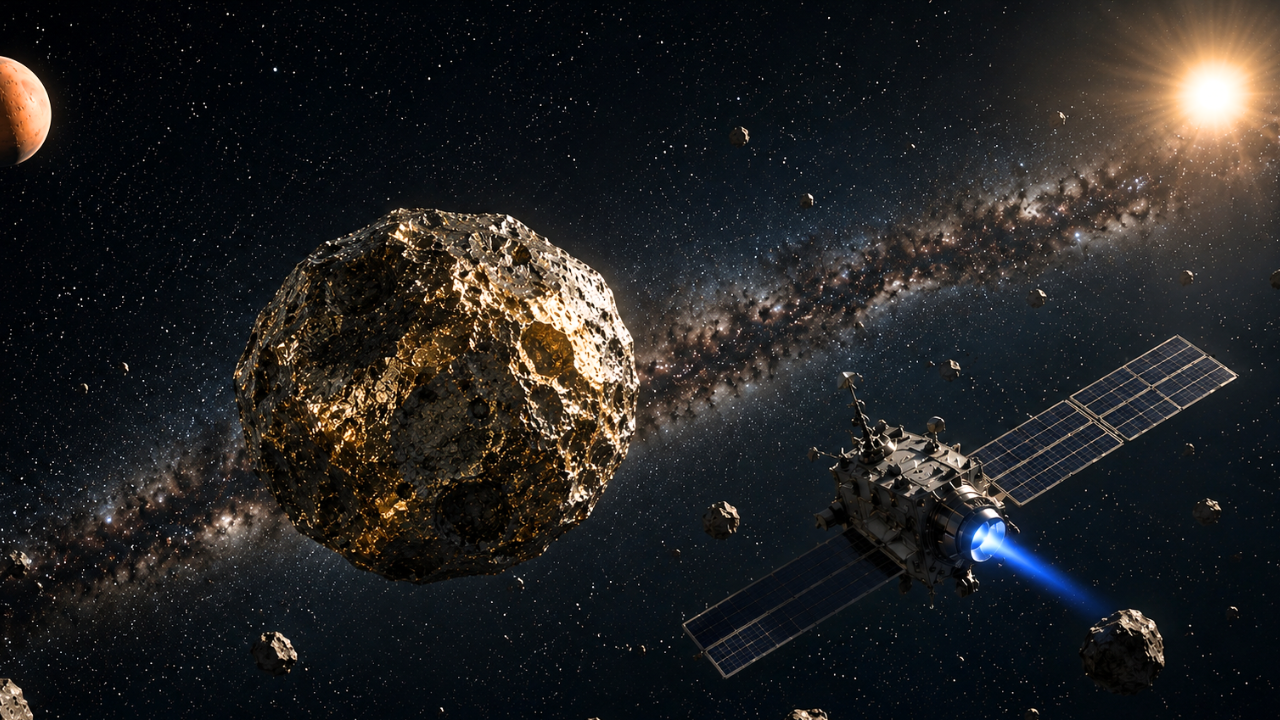
NASA is currently hurtling a spacecraft toward a metallic world known as 16 Psyche, located in the outer reaches of the main asteroid belt between Mars and Jupiter. While breathless headlines suggest this mission is a scouting trip for a $10 quadrillion payday in gold and platinum, the cold math of orbital mechanics and global commodities markets tells a different story. The mission is a scientific inquiry into the exposed core of a dead planet, not a gold rush. Even if we could haul 16 Psyche back to Earth, the sheer volume of precious metals would crash global markets instantly, making the "wealth" worthless.
The Physics of a Trillion Dollar Ghost
The narrative surrounding 16 Psyche often centers on a staggering valuation that exceeds the entire global economy. This figure is calculated by taking the estimated mass of the asteroid—roughly 220 kilometers in diameter—and multiplying it by the current spot price of nickel, iron, and gold. It is a fundamental misunderstanding of value.
Economics operates on scarcity. If a company managed to return even a fraction of the asteroid’s estimated iron content to Earth, the price of iron would plummet to nearly zero. You cannot be a billionaire in a world where the commodity you own is as common as dirt. Beyond the market logistics, the energy requirements to move an object of that mass are currently impossible under any known propulsion system. We are not looking at a floating treasure chest; we are looking at a celestial graveyard that offers a window into how Earth was formed.
Why 16 Psyche Matters More Than Money
Most asteroids are piles of rubble or chunks of silicate rock. 16 Psyche is different because it appears to be composed almost entirely of metal. Planetary scientists believe it is the "planetesimal" remains of a shattered world.
In the early chaos of the solar system, proto-planets collided frequently. 16 Psyche was likely a developing planet that had its outer rocky crust stripped away by violent impacts, leaving the naked metallic core exposed. Because we cannot travel to the center of the Earth to study our own core, 16 Psyche serves as a laboratory. It is the only way to observe the building blocks of a planet without drilling through thousands of miles of pressurized rock.
The Technical Hurdles of the Mission
The NASA Psyche spacecraft, launched aboard a SpaceX Falcon Heavy, is utilizing Solar Electric Propulsion. This system uses Hall-effect thrusters to accelerate xenon ions. It is efficient but incredibly slow.
- The Travel Time: The craft won't arrive until 2029.
- The Gravity Assist: It required a flyby of Mars to gain enough velocity to reach the asteroid belt.
- The Instruments: A multispectral imager, a gamma-ray and neutron spectrometer, and a magnetometer will map the asteroid's composition and magnetic field.
These tools are designed to measure chemical signatures, not to scout for mining sites. If the magnetometer detects a remnant magnetic field, it confirms the theory that 16 Psyche was once a molten core with a "dynamo" effect, much like Earth.
The Industry Analyst Perspective on Space Commodities
Investors looking at the "New Space" sector often get blinded by the shiny objects. True asteroid mining remains decades, if not a century, away from being a viable business model. The current cost to launch mass into orbit is dropping, thanks to reusable rocketry, but the cost to return mass from deep space remains prohibitive.
If we ever do mine asteroids, the materials won't be brought back to Earth. They will stay in space.
The real value in 16 Psyche or any metallic M-type asteroid is for in-situ resource utilization (ISRU). If humans are to build massive structures in orbit or establish permanent bases on the Moon and Mars, we cannot afford to drag every ton of steel and aluminum out of Earth’s deep gravity well. We will mine the asteroids to build the stations, using the asteroid belt as a shipyard rather than a quarry.
The Hidden Complexity of the Metallic Surface
Recent data from the James Webb Space Telescope and ground-based radar suggest that 16 Psyche might be more complex than a simple ball of iron. There are indications of silicate patches on the surface, meaning it might not be a pure core but a mix of mantle and core material.
This variability is a nightmare for potential miners but a dream for geologists. If the surface is a mixture, it tells us exactly how the "hit-and-run" collisions of the early solar system functioned. It provides a timeline of cooling and solidification that we have never been able to verify with physical evidence.
The Geopolitical Gamble
While NASA focuses on science, other nations and private entities are looking at the legal framework of space ownership. The Outer Space Treaty of 1967 prevents any nation from claiming sovereignty over a celestial body. However, the Artemis Accords and various domestic laws in the United States and Luxembourg are carving out a path for private companies to own the resources they extract.
This creates a friction point. If a private entity were to eventually land a craft on 16 Psyche with the intent to "claim" specific minerals, it would trigger a diplomatic crisis regarding the "Global Commons." We are currently seeing the groundwork for a resource war being laid in policy papers, years before a single drill bit touches an asteroid.
The Reality of the "Gold" Content
The claim that 16 Psyche contains more gold than Earth is speculative. While M-type asteroids contain precious metals, they are distributed throughout the mass. Extracting them requires a massive industrial infrastructure—smelters, crushers, and refineries—all operating in zero gravity.
$F = G \frac{m_1 m_2}{r^2}$
Gravity is the enemy of industrial processing. On Earth, we use gravity to separate heavy metals from lighter waste rock. In the microgravity of an asteroid, you have to reinvent the entire metallurgy process. You cannot simply "dig" for gold. You have to capture dust, contain it, and use centrifugal force or magnetic separation to isolate the elements you want.
The Mission as a Mirror
The obsession with the dollar value of 16 Psyche reflects our own terrestrial anxieties. We see a trillion-dollar rock because we are trapped in a mindset of extraction and scarcity. NASA's team, led by Dr. Lindy Elkins-Tanton, is searching for something far more valuable: the origin story of our own home.
The Psyche mission is a test of our ability to navigate the deep dark. It is a test of our sensors, our communication arrays, and our patience. When the spacecraft finally enters orbit in August 2029, the images it sends back won't show gold-paved streets. They will show a dark, cratered, metallic world that has survived billions of years of cosmic bombardment.
The true worth of 16 Psyche is not what we can take from it, but what it can tell us about why Earth is the only planet in the neighborhood that supports life. We are chasing a ghost of a planet to understand our own pulse.
Stop looking for the payday and start looking at the chemistry.