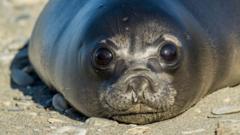
Highly Pathogenic Avian Influenza (HPAI) H5N1, specifically within clade 2.3.4.4b, has breached the ecological isolation of Australia’s sub-Antarctic external territories. Field data published from a dual-voyage assessment by the Australian Antarctic Program reveals that 76.9% of the southern elephant seal (Mirounga leonina) pup cohort on Heard Island died over a six-month window. Out of a baseline population of 17,364 monitored pups, 13,359 carcasses were documented. Because transmission was active when field observations concluded, this figure represents a baseline minimum rather than a final tally. In specific high-density breeding groups, localized mortality scaled to 97%. This structural shock to a vulnerable apex predator demonstrates that geographic remoteness no longer provides biosecurity insulation against hyper-virulent panzootic vectors.
Understanding this mortality event requires evaluating three interconnected operational variables: vector travel dynamics, spatial density multipliers within breeding colonies, and the long-term population bottlenecks caused by low reproductive replacement rates. Discover more on a related topic: this related article.
The Vector Pathway and Ambient Incursion Dynamics
Geographic insulation failed due to migratory wildlife vectors moving along standard seasonal trajectories. Genomic mapping and chronological tracking indicate the virus arrived on Heard Island via infected avian or marine wildlife arriving from the Crozet Islands, located 1,700 kilometers away.
The mechanism of entry relies on a multi-host transmission engine: More journalism by Mayo Clinic highlights similar perspectives on the subject.
- Primary Avian Reservoirs: Migratory seabirds, including brown skuas (Stercorarius antarcticus) and South Georgia diving petrels (Pelecanoides georgicus), serve as mobile viral engines. These species pick up the pathogen in sub-Antarctic staging grounds and transport it across vast open ocean gaps.
- Environmental Persistence Amplifiers: Sub-Antarctic climates present low ambient UV degradation rates and sustained cold temperatures. These factors allow shedding viral particles to remain infectious in guano, mud, and shallow meltwater pools far longer than in temperate zones.
- Interspecies Spillover Interfaces: The virus shifted from migratory avian species to resident marine mammals through shared haul-out sites. Northern giant petrels and skuas actively scavenge dead seal pup tissue, placenta, and aborted fetuses, creating a high-titer environmental loop that re-infects live animals.
+--------------------------+     ~1,700 km Migration     +--------------------------+
|  Crozet Islands Resorvoir | -------------------------> |   Heard Island Outbreak  |
|   (Active H5N1 Clade)    |    (Avian Vector Flux)      | (Environmental Staging)  |
+--------------------------+                             +--------------------------+
                                                                      |
                                                                      v
                                                         +--------------------------+
                                                         | Interspecies Spillover   |
                                                         | (Scavenging & Haul-out)  |
                                                         +--------------------------+
The Density Multiplier and Colony Transmission Mechanics
The spatial organization of southern elephant seal breeding colonies acts as a transmission multiplier. The species relies on a strict harem structure where a single dominant bull defends up to 100 females. These females pack together along narrow cobblestone beaches and glacial outwash plains to give birth and nurse.
This social structure triggers three distinct transmission pathways:
Horizontal Aerosol Transmission
During the spring breeding season, females and pups vocalize constantly, exchanging heavy volumes of respiratory droplets over distances of less than one meter. The high density within harems creates an immediate aerosol saturation zone.
Fecal-Oral and Fluid Exchange
Newborn pups crawl through mud and substrate heavily contaminated with maternal feces, blood, placental fluids, and avian guano. Pups frequently attempt to nurse from non-maternal females, expanding contact networks beyond their immediate biological lineage.
Environmental Contact Loops
The physical restriction of available ice-free beach space forces multiple species into direct contact. Field teams confirmed the presence of H5N1 in king penguins (Aptenodytes patagonicus), gentoo penguins (Pygoscelis papua), and Antarctic fur seals (Arctocephalus gazella) on the same beaches. While the penguins exhibited elevated but non-catastrophic mortality, their high numbers shed significant viral loads into common pathways, maintaining a permanent environmental reservoir that constantly re-exposed the highly susceptible elephant seal pups.
       [Avian Guano / Scavenging Overlap]
                       |
                       v
         +----------------------------+
         | High-Density Beach Harem   |
         +----------------------------+
           /           |            \
          v            v             v
   [Aerosol Drops] [Fluid Exchange] [Shared Substrate]
          \            |            /
           v           v           v
         +----------------------------+
         |  97% Localized Mortality   |
         +----------------------------+
Demographic Bottlenecks and Population Recovery Lag
The loss of more than three-quarters of a year's entire pup production alters the long-term demographic profile of the Heard Island population. Southern elephant seals are defined by a K-selected life history strategy, which prioritizes long-term adult survival over high reproductive output. This framework makes their populations highly vulnerable to sudden, severe drops in juvenile numbers.
The demographic impact follows a rigid biological timeline:
- Late Sexual Maturation: Female southern elephant seals do not achieve breeding maturity until age three to four, while males require five to seven years to compete for territory. The 2025–2026 mortality event will manifest as a sharp drop in breeding recruitment starting in 2029.
- Low Fecundity Ceiling: Females produce exactly one pup per year. There is no biological mechanism for twins or compensatory litter scaling to offset high mortality years.
- Iteroparous Dependence: Population stability depends on steady, repeating reproductive cycles over a female's 10-to-15-year lifespan. If the pathogen shifts from an acute outbreak into an endemic seasonal threat, the persistent loss of annual cohorts will trigger a structural population collapse.
Strategic Mitigation and Mainland Australia Biosecurity Insulation
Because mainland Australia and Tasmania currently remain free from H5N1 clade 2.3.4.4b, the sub-Antarctic outbreaks serve as an early warning system for regional biosecurity infrastructure. The Department of Agriculture, Fisheries and Forestry has committed 113 million AUD to national preparedness efforts. However, managing wildlife disease across thousands of kilometers of ocean requires moving past traditional quarantine models toward a strategy based on targeted intervention and biological surveillance.
The primary limitation of current mitigation plans is the impossibility of open-ocean wildlife containment. Vaccine deployment for wild marine mammals remains unfeasible due to delivery logistics and the lack of an approved oral or single-shot delivery system. Resource allocation must focus on three operational areas:
- Iterative Aerial and Satellite Surveillance: Relying on physical research voyages creates multi-month information blind spots. Biosecurity frameworks must use high-resolution satellite imagery and automated drone surveys to track abnormal mortality spikes along remote coastlines without risking human-vectored cross-contamination.
- Strict Vector Buffering for Human Transit: Research teams, fishing vessels, and eco-tourism operators traveling from sub-Antarctic zones to mainland ports represent a primary risk vector for human-mediated transmission. Current decontamination protocols must be elevated to commercial agricultural standards, requiring mandatory thermal treatment of footwear, gear, and biological transport containers.
- Targeted Agricultural Isolation: Because the H5 strain poses a parallel threat to poultry and dairy systems, internal biosecurity must erect absolute separation boundaries between coastal wildlife interfaces and commercial operations. This requires strengthening bird-proofing infrastructure on commercial farms along migratory flight paths and expanding active surveillance networks within wild avian populations along the southern Australian coastline.
The data from Heard Island shows that geographic distance no longer provides passive protection against globalized pathogens. The survival of Southern Ocean apex predators depends on turning these remote field observations into proactive, structural biosecurity measures before the virus breaches the mainland boundary.