The rain in Antwerp feels different when you are chasing a ghost. It slicks the cobblestones of the Wapper, the grand square where fashion students rush past historic facades, their minds fixed firmly on the future. But if you turn sharply toward the grand Italianate palazzo tucked away from the modern shopping crowds, the noise of the twenty-first century begins to erode. This is the Rubenshuis. For decades, it has stood as a monument to a titan. We know Peter Paul Rubens as the master of scale, the painter of massive, flesh-and-blood epics that dominate the Louvre and the National Gallery. We know him as the diplomat who charmed kings.
But we rarely see him bleed. We rarely see him mess up.
To understand the true weight of a recent, quiet homecoming in Antwerp, you have to look past the grand oil canvases. You have to look at a single, battered piece of paper that spent centuries surviving fires, wars, and the casual disregard of history. A sheet from Rubens’ legendary, lost theoretical notebook has returned to the very rooms where it was filled with ink. To the casual tourist, it looks like a scrap. To anyone who has ever tried to create something out of nothing, it looks like a mirror.
It is easy to look at genius and assume it arrived fully formed. We look at the sweeping drama of The Descent from the Cross and imagine a man striking the canvas with divine certainty. That is a lie we tell ourselves to make our own creative struggles feel acceptable. The reality is far more frantic, far more human.
The Paper That Survived the Flames
Imagine a mid-winter afternoon in 1600. The studio is cold, smelling of linseed oil, turpentine, and the sharp tang of woodsmoke. A young man, not yet the international celebrity he would become, sits with a quill. He is obsessed. He isn't painting for a duke or a pope today; he is trying to decode the universe. He is copying the anatomical studies of Michelangelo and Leonardo da Vinci, trying to figure out how a human shoulder moves when it carries the weight of a dying God.
This notebook was Rubens’ intellectual spine. It contained his thoughts on symmetry, his poetry, his anatomical dissections, and his secret theories on optics. It was the book he carried in his coat pocket. It was his Google, his sketchbook, and his diary all wrapped into one leather-bound volume.
Then, history did what it always does to fragile things.
In 1720, long after the master’s death, a catastrophic fire tore through a collection in Paris. The theoretical notebook was thought to be entirely lost to the flames. For centuries, art historians could only guess at its contents based on later, imperfect copies made by his students. The thoughts of the man himself were gone, reduced to ash.
Except for a few pages that had been separated from the binding before the fire.
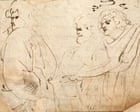
One of those surviving sheets, a double-sided fragment covered in Rubens’ own handwriting and frantic ink sketches, has finally come home. The King Baudouin Foundation acquired it through the Heritage Fund, ensuring that this piece of genetic material from the Baroque era wouldn't vanish into a private billionaire's vault. Now, it sits on display at the Rubenianum, the research institute dedicated to the artist, just a stone's throw from his actual living room.
Reading Between the Ink Lines
When you stand close to the display case, the first thing that strikes you is the scale. It is tiny compared to the monumental works that define Antwerp’s churches. But the density of information is staggering.
On one side, Rubens has meticulously copied figures from Michelangelo’s Sistine Chapel. You can see the scratch of the pen where he corrected a line, pulling the contour of a leg tighter, making the muscle strain against the paper. He wasn't just copying; he was arguing with Michelangelo. He was dissecting the Italian master's work to build his own visual language.
On the reverse side, the text shifts. It is a dense, academic treatise on human proportion, written in Latin.
This is where the subject gets intimidating. For anyone without a degree in seventeenth-century art theory, the text can feel impenetrable. It speaks of cubes, squares, and the mathematical harmony of the human form. But look closer at the handwriting itself. The script is hurried. It leans forward, the ink fading at the ends of words as the quill ran dry before his thoughts could slow down.
Consider the sheer physical effort of this moment. There were no desk lamps. There was no spellcheck. There was only the candle, the inkwell, and a mind moving too fast for the hand to keep pace. The sheet isn't pristine. It has stains. It has the shadows of fingers that handled it while the ink was still wet three hundred and fifty years ago.
That is the E-E-A-T of the art world—the undeniable, physical proof of lived experience. You can fake a style, but you cannot fake the frantic energy of a creator working out a problem in real-time.
Why Antwerp Holds Its Breath
To the rest of the world, this might seem like a minor archival update. A piece of old paper changes rooms. Why should we care when the world is burning, when inflation is high, when our own lives are loud and complicated?
Because Antwerp is a city built on the ghost of this one man.
Walk through the Central Station, look at the architecture, visit the Cathedral of Our Lady—Rubens is everywhere. He is the city's secular saint. But for the people who live here, he can sometimes feel like a statue rather than a person. He is a brand. He is a tourism slogan.
Bringing this notebook sheet back to Antwerp is an act of reclamation. It strips away the gold leaf and the heavy frames. It forces the viewer to confront the young immigrant artist—Rubens had only recently returned from Italy when he was filling these pages—trying to make a name for himself in a city ravaged by the Eighty Years' War.
The stakes were not academic. They were financial, spiritual, and deeply personal. If he failed to master the human form, he failed to secure the commissions. If he failed to secure the commissions, his family’s precarious status in Antwerp society would collapse. Every line on that paper was a rope pulling him out of obscurity.
The Anatomy of an Obsession
There is a common misconception that great artists just look at a model and paint what they see. Rubens didn't work that way. He believed that to paint the skin, you had to understand the bone. To paint the clothing, you had to understand the wind.
In this specific sheet, we see him grappling with the concept of the "cubic" man. He was obsessed with the idea that the human body could be broken down into fundamental geometric shapes to create a sense of monumental stability.
Think of it like modern 3D wireframe modeling used in video games today. Rubens was doing that with a goose feather and iron gall ink. He was building a rendering engine inside his own mind.
- The Left Margin: A series of quick, gestural studies of arms in motion, testing the limits of how far a joint can twist before it breaks the illusion of reality.
- The Main Body Text: A philosophical defense of why Flemish artists needed to study classical antiquity, written with the fierce conviction of a young man trying to revolutionize his hometown's art scene.
- The Bottom Corner: A tiny, almost accidental ink smudge where his thumb caught the page as he turned it over to start a new thought.
It is that smudge that holds your gaze. It breaks the distance of centuries. It is the point of contact between a living breathing human being and an artifact that has somehow slipped through the fingers of time to land in front of you.
The Journey Back to the Light
How does a piece of paper survive three centuries of neglect? It requires a chain of human choices. A student keeps it. A collector hides it during a revolution. An archivist recognizes the handwriting under a layer of dust in a shop window.
The return of this sheet to Antwerp isn't just a win for the museums; it is a reminder of the fragility of our collective memory. We assume the important things will always be preserved, but history is full of holes. The fact that you can walk into a building in Antwerp today and look at the exact lines drawn by a young Rubens is a statistical miracle.
The city understands this. The exhibition of this sheet isn't being treated as a dry academic seminar. It is being celebrated as a homecoming. It arrives at a time when the Rubenshuis itself is undergoing massive renovations, preparing to present a more intimate, accessible version of the artist to the twenty-first century.
The timing is perfect. We live in an era of digital perfection, where images are generated by algorithms and flawless pixels can be summoned with a keystroke. There is a growing hunger for the flawed, the tactile, and the authentic. We need to see the scratches. We need to see the effort.
A Final Look in the Ink
If you find yourself in Antwerp, walk past the grand monuments for an hour. Go to the quiet room where the notebook sheet is kept. Stand there until your eyes adjust to the low, protective lighting required to keep the ancient ink from fading away into nothingness.
Look at the handwriting. Don't worry about translating the Latin or decoding the specific artistic theories. Just look at the rhythm of the pen.
You are looking at a man working late into the night, his fingers stained black, his eyes aching by the light of a single flame, trying to figure out how to make paint look like life. He didn't know he was a master yet. He was just a man with a piece of paper, terrified of failing, trying to build something that would outlast the rain outside his window.