The morning air in southern Lebanon usually smells of two things: drying tobacco leaves and the faint, bitter scent of the sea. But today, the atmosphere has curdled. It is thick with the metallic tang of cordite and the pulverized remains of concrete.
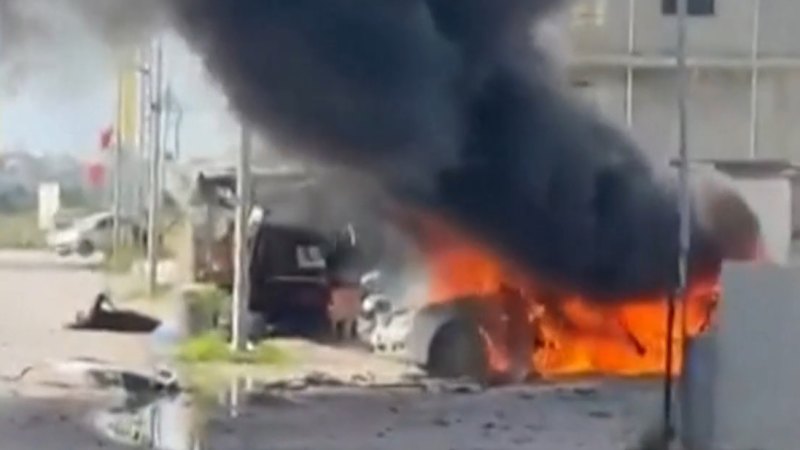
The sound came first. It wasn't the distant rumble one grows accustomed to in a border zone. This was a physical weight, a series of concussions that shook the teeth in their sockets and turned the horizon into a jagged line of fire. In a matter of hours, the rhythm of daily life—the boiling of coffee, the opening of storefronts, the walk to school—was incinerated.
Israel calls it a "proactive" operation. To the people in the basement shelters of Nabatieh or the high-rises of Beirut, it feels like the end of the world.
The Anatomy of an Escalation
War is often described in the clinical language of maps and payloads. We hear about "thousands of targets," "precision munitions," and "degraded capabilities." These terms are useful for generals, but they are useless for the father trying to pack a lifetime of memories into the trunk of a dusty sedan while his children cry in the backseat.
The scale of this offensive is unprecedented in recent history. Within twenty-four hours, the Israeli Air Force conducted hundreds of sorties, striking deep into the heart of Lebanese territory. The objective, according to Israeli military briefings, was to neutralize the vast arsenal of rockets and missiles hidden within civilian infrastructure by Hezbollah.
Consider a hypothetical village in the Bekaa Valley. For years, the tension has been a background hum, like the sound of a refrigerator you eventually stop noticing. Then, a text message arrives on every phone in the district. It is a cold, automated warning from the Israeli military: Leave now. Your house is a target.
Suddenly, the refrigerator has exploded.
The logistical reality of a "huge attack" is a nightmare of displacement. Thousands of families are currently clogging the highways leading north toward Beirut, their cars piled high with mattresses and jugs of water. These are not combatants. They are schoolteachers, shopkeepers, and farmers who have been caught in the grinding gears of a geopolitical struggle they did not choose.
The Invisible Stakes of a Border
Why now? To understand the intensity of this strike, one must look at the stalemate that has defined the last year. Since the events of October 7, the northern border of Israel and the southern border of Lebanon have been a wasteland. Tens of thousands of Israelis were forced to flee their homes under the constant threat of Hezbollah’s anti-tank missiles and suicide drones.
The Israeli government found itself in an impossible position. A sovereign nation cannot indefinitely allow its northern territory to be a ghost town. The pressure to "do something" became a political and social tidal wave. This current offensive is the result of that pressure boiling over. It is an attempt to reset the balance of power through sheer, overwhelming force.
But force has a way of creating its own gravity.
When a missile strikes a residential building because a rocket launcher was allegedly stored in the cellar, the "fact" of the military target is often buried under the human wreckage. Every crater becomes a monument. Every displaced child becomes a future of resentment. The invisible stakes here aren't just about how many missiles are destroyed; they are about whether the region can survive the psychological trauma of another total war.
The Sound of Silence in Beirut
In Beirut, the mood is one of suffocating uncertainty. This is a city that knows how to bleed. It has survived a civil war, an economic collapse that wiped out the middle class, and one of the largest non-nuclear explosions in history at its port. The people here are resilient, but resilience has a breaking point.
As the strikes moved closer to the capital, the sound of the city changed. The frantic honking of traffic was replaced by a heavy, expectant silence, broken only by the roar of jets overhead. These jets are often invisible, hidden behind the glare of the Mediterranean sun, but their presence is felt as a pressure in the chest.
The math of modern warfare is terrifyingly simple.
- 1,600+ strikes in a single day.
- Hundreds of casualties, including women and children.
- Countless homes reduced to gray dust.
These numbers are staggering. Yet, they fail to capture the specific agony of a woman named Fatima (a representative figure of the current crisis) who stands on a balcony in the Dahiyeh suburb, watching the horizon glow orange. She isn't thinking about regional hegemony or the "axis of resistance." She is wondering if the bread she bought this morning will be the last fresh food her family eats for a month.
The Feedback Loop of Violence
The tragedy of the situation lies in its predictability. Both sides are operating under a logic that dictates that only more violence can bring peace. Israel believes that by dealing a "crushing blow," they can deter Hezbollah and allow their citizens to return home. Hezbollah believes that by maintaining a "support front" for Gaza, they are fulfilling a moral and strategic duty.
This is a collision of two unmovable objects.
The logic of the "huge attack" assumes that there is a point at which an opponent will simply give up. History suggests otherwise. In this part of the world, destruction often acts as a fertilizer for more conflict. When you destroy a home, you don't just remove a structure; you remove a person's stake in the status quo.
The technical sophistication of the Israeli military—the intelligence-gathering that allows them to pinpoint a specific room in a specific house—is undeniably "cutting-edge" in the most literal, violent sense of the word. But technology cannot solve the fundamental human problem of two peoples claiming the same sense of security on a narrow strip of land.
The Night No One Sleeps
As the sun sets over the Levantine coast, the fires are still burning. The hospitals in southern Lebanon are overwhelmed, their hallways lined with the wounded and the terrified. Doctors, already exhausted by years of economic crisis, are working by the light of cell phones and aging generators.
There is a specific kind of exhaustion that comes from living through a "huge attack." It is a bone-deep weariness that makes even the act of breathing feel like a chore. It is the realization that the world you woke up in no longer exists, and the one that replaced it is made of fire and glass.
The international community calls for "restraint." Diplomats at the UN craft statements with carefully balanced adjectives. But these words do not reach the basement in Tyre where a mother is covering her son’s ears so he doesn’t hear the next impact.
The tragedy isn't just the loss of life, though that is the ultimate horror. The tragedy is the theft of a future. Every time the jets scream across the sky, a generation of children on both sides of the blue line learns that the only language that matters is the language of the bomb.
The smoke rises, a dark pillar against the darkening blue of the sky. It drifts over the olive trees, over the ruins of ancient Phoenician cities, and over the modern highways. It doesn't care about borders. It just hangs there, a suffocating shroud, waiting for the next dawn.