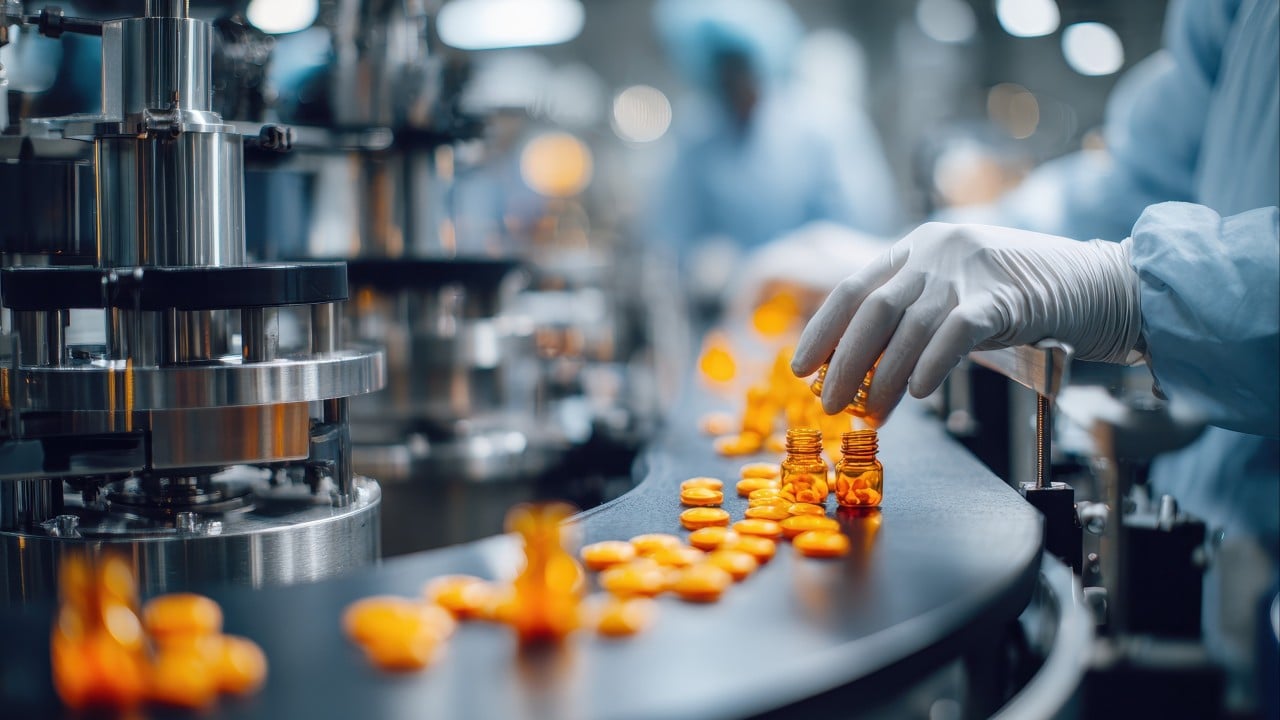
The fluorescent lights of Zhangjiang Hi-Tech Park do not blink. They hum. It is a low, vibrating note that fills the gaps between keyboard clicks and the soft whir of server racks. To a casual observer walking the streets of this Shanghai district, the buildings look like any other corporate monoliths. But inside, a quiet, frantic shift is occurring. It is a transformation that changes how we fight disease, how billions of dollars cross borders, and how human survival is being outsourced to lines of code.
For decades, the global pharmaceutical industry operated on a brutal, almost masochistic math. It takes over a billion dollars and a decade of failure to bring a single new drug to a patient's bedside. Scientists would spend years in wet labs, pipette in hand, manually testing thousands of chemical compounds against a single stubborn protein. It was a lottery where the tickets cost millions and the odds of winning were less than one percent.
Now, the pipettes are gathering dust. The new era is built on prediction.
The Ghost in the Petri Dish
To understand why this matters, consider a hypothetical researcher named Dr. Li. For ten years, Li’s entire professional existence revolved around an aggressive form of lung cancer. Her days were measured in the microscopic growth of cellular cultures. Her nights were plagued by the knowledge that even if her current batch of compounds showed promise, the chances of it surviving clinical trials were microscopically slim.
Then, the algorithms arrived.
Instead of mixing compounds physically, Li’s team began feeding genetic data, molecular structures, and historical trial failures into machine learning platforms. The computer did not just speed up the process. It saw things humans could not. It mapped the complex, three-dimensional geometry of proteins and predicted exactly which digital molecules would latch onto them like a key into a lock.
What used to take four years of physical trial and error happened over a long weekend.
This is not a futurist dream. It is the current baseline of China’s drug industry. The country’s biotechnology sector is undergoing a massive, structural pivot away from simply manufacturing generic medications or tweaking existing Western formulas. Instead, Chinese companies are aggressively positioning themselves as world leaders in discovering entirely new therapeutic candidates using artificial intelligence.
The motivation is not purely scientific. It is survival.
The Deal Flow Shift
The global venture capital market grew cold recently. The easy money that flooded biotechnology firms in the late 2010s evaporated. Investors, burned by long timelines and high failure rates, demanded something else: speed and certainty.
Chinese biotech firms realized that the traditional pipeline was no longer sellable. To attract international pharmaceutical giants, to ink the massive licensing deals that keep laboratories alive, they needed assets that were already optimized. They needed molecules that had already been heavily vetted by digital simulations before a single drop of liquid was spilled in a lab.
Global pharma giants are paying attention. The next wave of multi-billion-dollar licensing deals is not being driven by traditional chemistry. It is being driven by AI-generated assets. Western pharmaceutical companies are actively hunting for these digital candidates, eager to buy into pipelines that promise to cut clinical trial timelines in half. The border between Silicon Valley, Shanghai, and European pharma hubs has blurred into a single, continuous loop of data exchange.
But this reliance on the machine introduces a profound, unsettling vulnerability.
The Uncertainty of the Code
We like to think of computers as infallible arbiters of truth. They are not. An AI model is only as good as the data it consumes. If the historical data fed into a system contains biases—if it ignores certain genetic populations, or misinterprets how a specific protein behaves in a living organism—the machine will simply generate a highly confident, incredibly expensive mistake.
There is a distinct tension in trusting an algorithm with human biology. A computer can tell you that a molecule fits perfectly into a target receptor on a screen. It cannot feel the erratic heartbeat of a patient experiencing an unpredicted side effect. It does not understand the messy, chaotic reality of a human body, where thousands of biological systems interact in ways that no software can fully simulate.
Every scientist using these tools harbors a quiet anxiety. They wonder if we are trading one kind of lottery for another. Are we truly conquering disease, or are we just accelerating our path to more sophisticated failures?
The New Chemistry
Despite the doubts, the momentum is irreversible. The sheer scale of China's computing infrastructure, combined with vast pools of medical data, has created a unique incubator for this digital chemistry. It has transformed the nature of scientific expertise. The most valuable person in a drug discovery company is no longer just the traditional biologist; it is the computational chemist who can speak the language of both amino acids and neural networks.
The implications stretch far beyond corporate balance sheets and international trade agreements. Every accelerated timeline represents a real person waiting for an answer. It represents a parent watching a clock, a patient monitoring a symptom, a family holding onto hope. If an algorithm can shave three years off the development of a life-saving oncology drug, the cold calculus of corporate deals suddenly transforms into something deeply human.
The laboratories in Shanghai remain quiet. The server racks continue to hum, processing petabytes of molecular data through the night. The future of medicine is no longer being written in ink, or even in the physical interaction of matter. It is being calculated, one pixel, one prediction, and one life at a time.