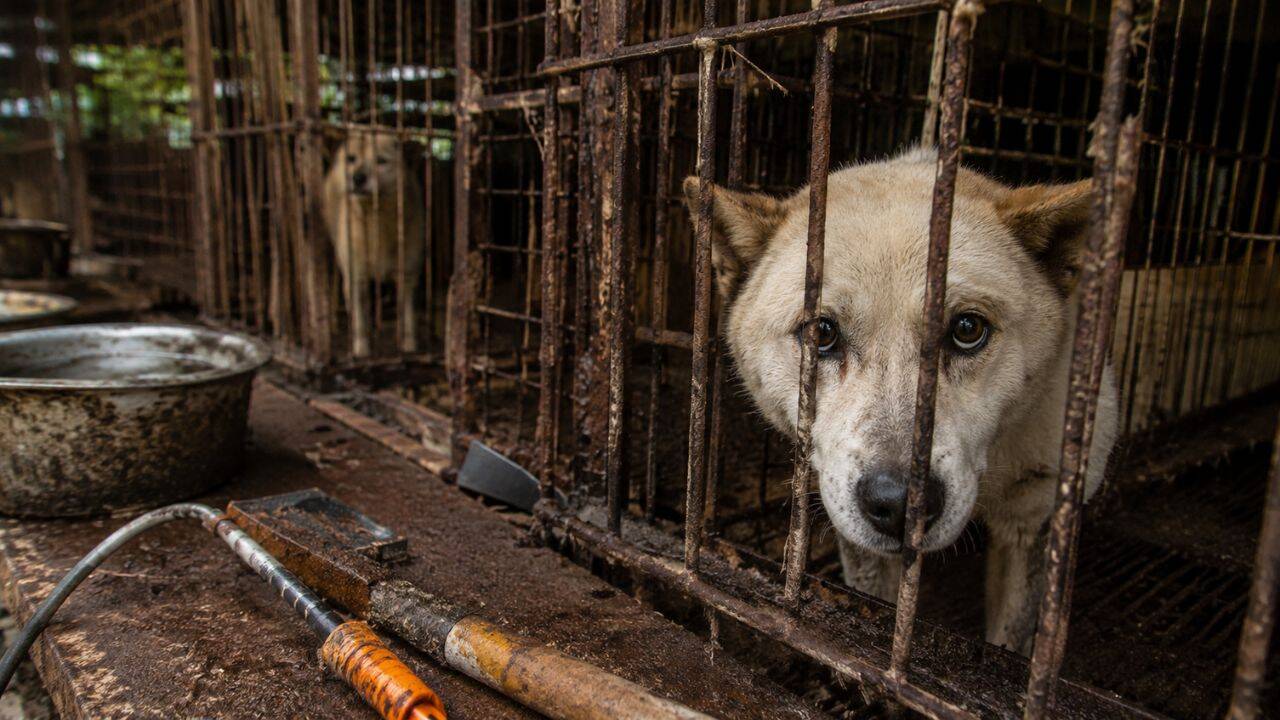
The air inside an abandoned slaughterhouse in Pyeongtaek carries a smell that does not easily wash out of cotton or skin. It is the scent of rust, damp concrete, and the distinct, sour tang of old fear. Against a stained wall rests a pair of heavy iron rods wired to an old car battery. These are electric prods, the standard tool of a trade that is technically breathing its last. Next to them sit three wire cages. They are empty, save for a few sun-bleached canine skulls resting on the wire mesh.
South Korea is currently engineering one of the most significant cultural resets of the modern era. In January 2024, the National Assembly did something once deemed impossible: it passed a law completely banning the breeding, slaughter, and sale of dogs for human consumption. A practice stretching back centuries is legally scheduled to vanish by February 2027. Violators will face up to three years in prison. For a different view, consider: this related article.
On paper, it is a triumph of progressive legislation and shifting generational values. But away from the celebratory press releases, a cold mathematical mystery has begun to haunt the quiet rural towns where the trade actually lived.
The numbers do not add up. Further coverage on this matter has been published by Al Jazeera.
In early 2024, government registries recorded between 400,000 and 450,000 dogs living on intensive meat farms across the country. By mid-2026, official counts showed that the population had plummeted to roughly 20,000. On the surface, it looks like a successful phase-out.
But consider what happens next when you look at the ledger of the living.
Official state data reveals that fewer than 700 of those dogs have been adopted into homes. Fewer than 500 were transferred to public or private shelters. International welfare groups have flown a few thousand more to sanctuary overseas.
That leaves nearly 400,000 living creatures entirely unaccounted for. They are gone.
To understand where they went, one must look past the statistics and look at the people holding the keys to the cages. Consider a man like Ju, a former dog farmer who also serves as a Christian pastor in a small community outside Seoul. Ju did not enter the trade out of malice; he bought his first breeding pairs in 1994 when his tiny ministry could no longer pay for his family’s groceries. For three decades, he operated within a strange legal gray zone. Unlike pigs or cattle, dogs were never officially classified as livestock under South Korean law. This loophole meant the government didn't regulate how they were housed, fed, or killed. But it also meant Ju could build a livelihood on them.
When the ban passed, the government offered farmers financial incentives to exit the market early, promising up to 600,000 won—roughly 390 dollars—for every dog removed from their inventory. The ministry sent inspectors to verify that the pens were empty before cutting the checks.
But the bureaucratic machinery contained a fatal blind spot.
"Our role is to verify that dogs are no longer present at farms or slaughter facilities before providing compensation," a ministry inspector admitted under anonymity. "We are not involved in what was done with the dogs."
The state, in essence, paid for the disappearance, not the preservation.
For a farmer facing the sudden death of their business, the quickest way to "process" an inventory of large, heavy animals is rarely the gentlest. The Nureongi, or Korean Yellow Spitz, is the breed most commonly raised for food. They are big, muscular, and look nothing like the tiny Maltese or Poodles that fill the high-rise apartments of modern Seoul. They are not animals the domestic adoption market knows how to absorb.
When asked directly about where the hundreds of thousands of missing animals went, Ju’s response is quiet, stripped of sentimentality. He noted that the culture has long drawn a sharp line between companion animals and food animals. The missing dogs, he said simply, have likely already been eaten.
The market did not slow down because a law was signed; it accelerated. Anticipating the hard deadline of 2027, many operators liquidated their stock, supplying the remaining traditional restaurants with cheap meat before the shutters came down for good.
Activists who have spent decades fighting for the ban are now grappling with a bitter irony. The law achieved its goal of ending the industry, but the transition period lacked any structural safety net for the specific lives it was meant to protect. Local shelters were already operating at maximum capacity before the legislation was even drafted. Private animal rights groups like CARE have rescued around 2,500 dogs over twenty years—a drop of water in an ocean of four hundred thousand.
"If large numbers of rescued dogs had entered adoption programs, we would know," says Kim Young-hwan, a representative for CARE. There were no mass adoption campaigns. There were no fields converted into state-funded sanctuaries. There was only an empty ledger and a collection of cleared farms.
What remains is a lesson in the friction between lawmaking and reality. It is a reminder that when human systems decide to change their moral heading overnight, the cost of that sudden turn is almost always borne by the silent and the vulnerable.
The trade is dying, and the cages are opening. But for the vast majority of the generation that lived to see the victory, the rescue came too late. The victory belongs to the dogs who will never be born into the wire pens of Pyeongtaek, while the ones who were actually there have largely slipped into the dark.