Imagine standing on the edge of a massive volcanic ravine, the wind whipping past your ears, and needing to tell your friend three miles away that dinner is ready. You don't pull out a smartphone. There's no cell service down in these gorges anyway. Instead, you stick two fingers in your mouth and emit a piercing, melodic shriek that sounds like a tropical bird on steroids.
That is the reality on La Gomera, a tiny, rugged island in Spain’s Canary archipelago. The locals don't just whistle to get someone's attention. They speak an entire language through whistles. It's called Silbo Gomero. It isn't a collection of simple codes or basic signals like "stop" or "go." It is a fully functional, articulated language capable of conveying any spoken Spanish sentence.
Most people treat this phenomenon as a quirky travel trivia fact. That's a mistake. Silbo Gomero is a masterclass in human survival, cognitive adaptability, and cultural preservation. It's a living technology that outlasts the digital tools we rely on today.
The Mechanics of Speaking Without Words
Many outsiders assume Silbo Gomero is a separate language with its own grammar rules. It isn't. It is actually a whistled form of Spanish. The whistlers, known locally as silbadores, substitute the phonemes of spoken Spanish with high-pitched whistling tones.
Think about how complex that is. Spoken Spanish has five distinct vowels and dozens of consonants. Silbo Gomero distills all of that linguistic variety into just two whistled vowels and four consonants.
A high pitch or a low pitch determines the vowels. The consonants are captured by interruptions in the sound, glides, or sudden drops in frequency.
Spoken Spanish Phonemes -> Reduced to Pitch & Interruption -> Silbo Gomero
The human brain does incredible heavy lifting here. When a silbador hears these whistles, their brain processes the sounds not as music or noise, but in the exact same left-hemisphere language centers used for regular speech. Researchers from the University of La Laguna found that native whistlers literally "hear" words in the pitches. It’s an auditory illusion turned into a communication network.
The physical execution requires intense control. You use your fingers, lips, and tongue to manipulate a column of high-pressure air. The resulting sound can reach up to 130 decibels. That is louder than a lawnmower and almost matching a jet engine takeoff.
The Geography That Forced an Invention
People didn't start whistling on La Gomera just because they felt like being musical. They did it because the terrain gave them no other choice.
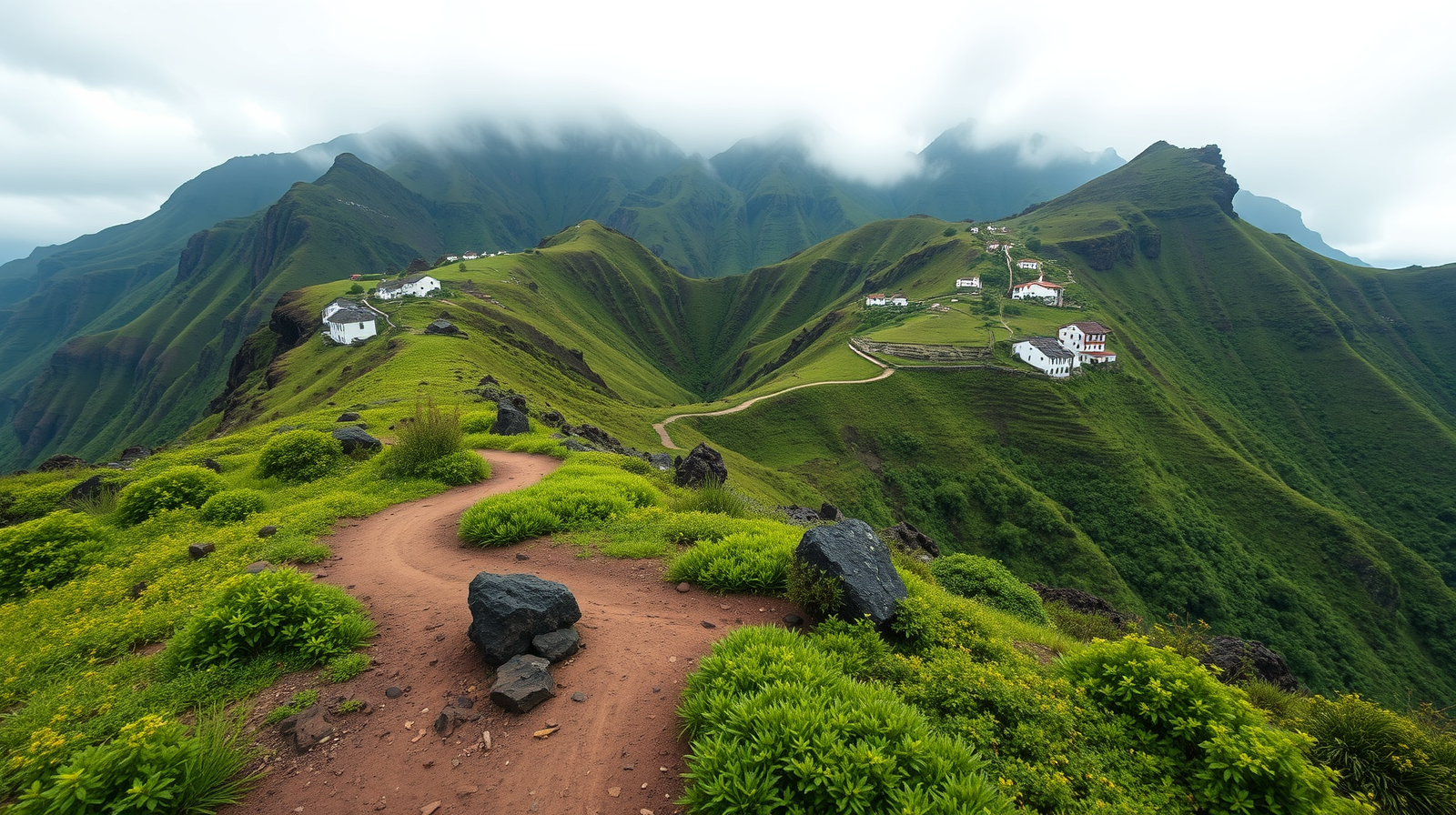
La Gomera is a round island, but its surface is heavily scarred by deep, plunging ravines called barrancos. These valleys radiate from the central mountain peaks down to the sea like the spokes of a wheel. Walking across a single ravine to visit a neighbor could take hours of grueling hiking up and down rocky cliffs.
Sound waves, however, fly.
A strong whistle cuts through the mountain air, bouncing off the rock walls and traveling up to five kilometers across the valleys. If you tried to yell across that distance, your voice would distort and fade into an unrecognizable echo. The pure, focused frequency of a whistle pierces the ambient mountain noise.
Historically, this was the island’s internet. Passersby used it to announce births, deaths, fires, or warnings about arriving tax collectors. If a message needed to go to the other side of the island, people in intermediate valleys would hear the whistle and relay it forward. It was a human-powered fiber optic network running across the mountain peaks.
The Near Collapse and the Classroom Rescue
By the late 20th century, Silbo Gomero was dying. The introduction of roads, the expansion of regular telephone lines, and the economic shift away from agriculture meant that young people were leaving the valleys. They didn't need to whistle across ravines when they could just make a phone call or move to the bigger cities.
By the 1980s, only a handful of elderly silbadores remained. The language faced total extinction.
The turning point came from the local community itself. Recognizing that a piece of their identity was slipping away, islanders pushed the regional government to act. In 1999, the government of the Canary Islands made teaching Silbo Gomero compulsory in all primary and secondary schools on La Gomera.
Every week, school children on the island take mandatory classes to learn how to position their fingers, control their breath, and decode the whistles. They don't just learn it as a historical artifact; they practice it in the hallways and on the playgrounds.
UNESCO stepped in during 2009, placing Silbo Gomero on the Representative List of the Intangible Cultural Heritage of Humanity. This wasn't just an honorary title. It unlocked funding and global recognition, solidifying the language's position in the modern world. Today, you have a generation of tech-savvy teenagers who can text with one hand and whistle a complex sentence with the other.
Why This Matters for the Rest of the World
We live in an age where we assume technology solves every communication barrier. Yet, we remain incredibly fragile. A power grid failure or a dropped cell tower cuts us off instantly. Silbo Gomero reminds us that human ingenuity can build resilient communication channels using nothing but our own bodies and the laws of acoustics.
It also challenges how we think about language itself. It proves that speech isn't locked into vocal cords and mouth shapes. Language is an abstract concept in the mind that can be mapped onto almost anything, even the wind.
If you want to understand how deep this runs, you have to look at how the islanders use it today. It isn't just a performance for tourists stepping off cruise ships. You will still hear older farmers whistling to their goats or neighbors communicating across the terraced fields of Valle Gran Rey. It remains a badge of identity. To be from La Gomera is to know how to whistle.
How to Actually Experience Silbo Gomero Right Now
If you want to witness this without falling into the tourist traps, avoid the staged restaurant demonstrations in the main ports. Instead, head into the interior of the island.
- Visit Garajonay National Park: Walk the trails where the ancient laurel forests meet the sheer mountain drops. Listen closely when you are near the agricultural terraces in towns like Agulo or Hermigua.
- Check the School Schedules: If you visit during the academic year, the local schools often host open days or public cultural events where students showcase their skills.
- Listen to the Relays: Pay attention to the older generation. If you see two elderly men looking across a valley, wait a moment. You might just hear a conversation that has been echoing through these mountains for centuries.
Stop thinking of communication as something that only happens on screens. Next time you find yourself in a place with zero bars of service, remember that on one small island in the Atlantic, they solved that problem hundreds of years ago with a breath of air.