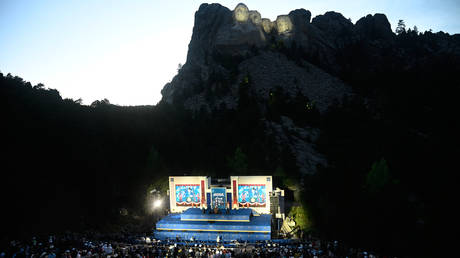
National milestones historically function as mechanisms for civic consolidation, where executive communication prioritizes macro-level unity over micro-level policy differentiation. The executive address delivered at Mount Rushmore to mark the 250th anniversary of the United States departs systematically from this tradition. By reallocating the symbolic capital of the Semiquincentennial toward an explicit ideological confrontation, the administration has executed a deliberate rebranding of the national narrative. This structural pivot shifts the primary function of the anniversary from historical commemoration to active political mobilization ahead of the impending midterm elections.
Understanding this rhetorical architecture requires an examination of the underlying strategic variables. The address functions not merely as a reflection of personal political style, but as a calculated intervention within a highly polarized electoral ecosystem. The structural blueprint of the speech reveals a dual-track strategy: the consolidation of the core populist base via acute threat inflation, and the institutionalization of partisan objectives within foundational civic structures.
The Mechanics of National Ritual Instrumentalization
Executive communication during significant historical anniversaries typically relies on universalist framing. Presidents during previous major milestones—such as the Bicentennial in 1976—utilized historical narratives to establish a baseline of shared democratic values, flattening internal policy disputes to project systemic stability. The current executive strategy replaces this universalist framework with a exclusionary boundary-drawing exercise.
This transformation operates through three distinct structural phases:
- Symbolic Convergence: The selection of Mount Rushmore establishes an immediate visual association with historical executives widely perceived as foundational architects of the nation. This acts as a mechanism to transfer institutional authority directly to the speaker.
- Narrative Bifurcation: The historical trajectory of the nation is framed as an active conflict between internal preservationists and an existential external or ideological threat. Civic history is thus stripped of its consensus function and transformed into a zero-sum asset.
- Electoral Integration: The commemoration of a historical text—the Declaration of Independence—is directly linked to contemporary legislative and electoral mechanisms, specifically the passage of the SAVE America Act and the modification of Senate voting thresholds.
By mapping contemporary legislative battles directly onto the founding myths of the republic, the administration changes the cost-benefit calculation for the electorate. Dissent from specific administrative policies is no longer coded as standard partisan disagreement; it is systematically categorized as a rejection of the foundational national identity.
The Ideological Architecture: Defining the Transformed Adversary Framework
The primary rhetorical mechanism utilized in the address is the inflation of the "communist menace." To analyze this structurally, one must separate the historical definition of communism from its utility as a contemporary political signifier. In the current domestic context, the term does not denote an adherence to Marxist-Leninist state command economics or Soviet-style institutional design. Instead, it serves as a highly flexible collective category for domestic political opposition, administrative regulation, and demographic shifts.
This ideological framework operates through specific structural dimensions:
- Threat Scale Inflation: The assertion that internal ideological shifts pose a greater threat than major twentieth-century kinetic conflicts—including both World Wars—serves to elevate the urgency of immediate political alignment.
- Identity Exclusion: The formulation that an individual can either be a communist or a patriot, but explicitly not both, establishes an absolute logical binary. This eliminates the conceptual space for loyal opposition within the state.
- Cultural Nationalism over Constitutionalism: Exceptionalism is anchored explicitly in an unyielding definition of national culture and heritage rather than an evolving commitment to constitutional protections or procedural rights.
This framework addresses an ongoing structural challenge within the populist coalition. When economic indicators create domestic friction—such as the elevated cost of living driven by inflationary pressures and international entanglements—the utilization of concrete, material metrics can weaken executive approval. Shifting the metrics of evaluation to an abstract cultural conflict protects the administration from material accountability, defining success through ideological victory rather than quantifiable economic optimization.
Electoral Mobilization Mechanics and Institutional Control
The strategic timing of this ideological positioning is directly linked to the upcoming November midterm elections. The administration faces significant structural headwinds, characterized by low public approval ratings linked to systemic inflation and international instability. The Mount Rushmore address serves as the opening framework for an electoral defense strategy built on structural institutional transformation.
The specific legislative mechanisms highlighted in the address—the abolition of the Senate filibuster and the passage of the SAVE America Act—demonstrate how ideological rhetoric is converted into structural policy objectives. The SAVE America Act, which mandates documentary proof of citizenship for voter registration and strict photo identification at the ballot box, is framed not as a procedural reform, but as an existential defense of national identity.
[Threat Inflation: "Communist Menace"]
       │
       ▼
[Cultural Polarization: Binary Identity Split]
       │
       ▼
[Structural Objectives: SAVE America Act / Filibuster Abolition]
       │
       ▼
[Electoral Outcome: Midterm Coalition Mobilization]
The structural bottleneck for the administration’s legislative agenda remains the legislative veto power inherent in the Senate filibuster. By framing the removal of this threshold as an essential countermeasure against an existential threat, the administration attempts to shift public opinion away from institutional norms and toward raw majoritarian execution. This structural prose reveals that the ultimate objective is the accumulation of sufficient institutional power to alter voting procedures permanently, thereby creating a self-reinforcing electoral advantage.
Economic Distractions and Strategic Realignment
The systemic background of this rhetorical escalation is defined by substantial macroeconomic friction. Consumers are currently experiencing prolonged pressure from a elevated cost of living, while public resources are directed toward complex geopolitical obligations. Standard political models dictate that when material conditions degrade, the incumbent party suffers a corresponding loss in electoral viability.
To counteract this vulnerability, the administration executes a strategic substitution of the political agenda:
- Resource Reallocation Narrative: Rather than addressing specific inflationary vectors or fiscal constraints, the executive narrative prioritizes cultural sovereignty and territorial integrity. This shifts the debate from economic management to existential security.
- Institutional Rebranding: The transition of the Semiquincentennial administration from the bipartisan "America250" framework to the politically aligned "Freedom 250" task force allows the executive branch to control the distribution of cultural capital. This transition includes the deployment of mobile museums and state fair partnerships designed to normalize the administration’s specific historical framework at the local level.
- The Spectacle Economy: The emphasis on high-visibility displays, such as military flyovers and massive pyrotechnic exhibitions on the National Mall, functions as a mechanism to generate national prestige. This spectacle acts as a temporary offset to persistent economic dissatisfaction among the middle and working classes.
This substitution carries long-term systemic risks. By decoupling the national celebration from broader demographic and political realities, the events risk alienating large sectors of the population, as demonstrated by the sparse attendance and public critique of the initial state fair installations. When civic rituals are overly politicized, their utility as stabilizing institutional mechanisms decreases, leaving the state more vulnerable to sudden shocks.
Systemic Constraints and the Paradox of Partisan Centricity
The long-term limitation of this strategy lies in its inability to address the core driver of modern political instability: deep structural polarization. While the intensive mobilization of a dedicated populist base can yield short-term electoral victories, it simultaneously reduces the administration's capacity to govern effectively across a fractured polity.
The strategy assumes that institutional structures can be modified through majoritarian pressure without triggering a corresponding loss of systemic legitimacy. This assumption overlooks the structural feedback loops built into the American political system. If a significant proportion of the population views national milestone celebrations and voting access changes as purely partisan exercises, the underlying social fabric degrades. This degradation reduces consumer confidence, complicates long-term corporate planning due to policy volatility, and weakens the state's geopolitical projection of strength.
The final strategic assessment indicates that the Mount Rushmore address represents a shift from defensive political governance to an offensive structural realignment. The administration has determined that the traditional model of broad-based civic consensus is no longer viable or effective given current macroeconomic pressures. The operational focus has shifted entirely to structural consolidation through polarization. The success of this strategy will depend completely on the efficiency with which the administration can translate acute cultural anxiety into concrete legislative control during the upcoming midterm cycle, irrespective of the long-term costs to institutional stability.