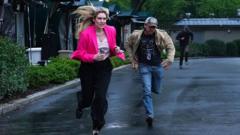
The standard breaking news script played out exactly on cue. A suspect opened fire near the White House perimeter. Secret Service agents engaged, returned fire, and neutralized the threat. The media immediately flooded the airwaves with predictable praise for the "flawless execution" of security protocols. The public nodded along, reassured that the system worked.
The system did not work. The system got lucky. If you found value in this post, you should check out: this related article.
Relying on a human agent to win a chaotic firearm duel at a high-security perimeter is a systemic failure masquerading as a success. Treating a kinetic gunfight on the doorstep of the executive branch as a victory ignores a brutal reality. If a lone actor with basic small arms can get close enough to draw a bead on a perimeter checkpoint, the primary defensive line has already collapsed.
We are addicted to the theater of security. We celebrate the reactive muscle memory of well-trained individuals because it distracts us from a terrifying truth: the architecture of institutional protection is hopelessly obsolete. For another look on this development, check out the latest coverage from USA Today.
The Proximity Fallacy and the Myth of Reactivity
Every standard retrospective on these incidents focuses on response time. Pundits analyze the seconds between the first muzzle flash and the lethal return fire. This metric is entirely meaningless.
In executive protection, reactivity is a losing strategy. Action always beats reaction. A human being making a conscious decision to pull a trigger will always hold a cognitive advantage over a human being forced to recognize the threat, draw a weapon, and return fire. When the Secret Service engages in a shootout at a checkpoint, they are gambling the lives of protectees and bystanders on fractions of a second.
The Physics of Failure
Consider the OODA loop (Observe, Orient, Decide, Act), a concept pioneered by military strategist John Boyd.
- Observe: The attacker knows the target, the timing, and the vector. The agent is scanning a crowd of hundreds.
- Orient: The attacker has already mentally committed to the assault. The agent must shift from a state of vigilance to a state of survival.
- Decide: The attacker has one decision. The agent must assess crossfire, civilian density, and rules of engagement.
- Act: The attacker fires first.
When an incident ends with a dead suspect and an uninjured agent, we credit the agent's superior training. But mathematically, we just witnessed a statistical anomaly. I have spent years analyzing physical security frameworks for high-consequence environments. Relying on an agent's quick-draw reflex to protect the presidency is not a strategy. It is Russian roulette with a badge.
Why Perimeter Defense is an Anachronism
Look at the physical footprint of the modern White House complex. It is a nineteenth-century estate wrapped in twentieth-century concrete, trying to survive twenty-first-century threats.
We keep building taller fences. We add heavier bollards. We deploy more heavily armed tactical units in black SUVs. This is what security experts call "hardening the shell." It creates a comforting visual for the evening news, but it fundamentally misunderstands how modern vectors of attack operate.
[Traditional Model] -> Hardened Shell (Fences/Bollards) -> Reactive Force (Agents) -> Vulnerability
[Modern Requirement] -> Autonomous Interdiction -> Asymmetric Disruption -> Total Isolation
A hardened perimeter merely shifts the point of impact. It creates a choke point where crowds gather, tourists line up, and agents stand exposed. The competitor articles scream about a suspect "opening fire near the White House," as if the distance from the Oval Office is the only metric that matters. The real story is that the perimeter itself has become the soft target.
The Asymmetry of the Lone Actor
The modern threat is not a state-sponsored commando team executing a complex infiltration. It is an unstable individual with a high-capacity rifle and a desire for martyrdom.
Against this threat, traditional intelligence-gathering often fails. There are no intercepted comms, no digital trail of a conspiracy, and no operational footprint. When the security apparatus relies on a physical fence to stop an existential threat, it surrenders the initiative entirely. The adversary chooses the time, the place, and the method. The security detail is reduced to a clean-up crew trying to minimize casualties.
The Taboo Solution: Removing the Human Element
If you want to actually secure a high-value asset in the current threat environment, you have to admit a truth that makes politicians deeply uncomfortable: humans are the weakest link in the security chain.
We need to phase out human-manned stationary checkpoints entirely.
The technology to automate perimeter interdiction exists today. Autonomous weapon systems, advanced computer vision, and non-lethal electromagnetic disruption can detect, track, and neutralize a kinetic threat before a human finger can touch a trigger.
- Computer Vision: AI-driven camera networks can identify the distinct profile of a concealed long gun or an anomalous drawing motion in milliseconds.
- Automated Interdiction: Directed-energy systems or acoustic disruptors can incapacitate an active shooter instantly, without the risk of stray rounds hitting tourists on Pennsylvania Avenue.
- Systemic Isolation: The immediate deployment of physical, automated barriers that seal off zones instantly, removing human panic from the equation.
Why haven't we deployed this? Because of optics.
The public wants to see the stoic agent in the sunglasses. Politicians want the human shield. They are willing to accept the catastrophic risk of a human failure because the alternative—an automated, algorithmic defense net—looks too dystopian. They choose comforting theater over definitive safety.
Dismantling the Consensus
Let's address the inevitable pushback from traditionalists who insist that human intuition cannot be replaced.
"An automated system cannot judge intent. A human agent can read body language and de-escalate a situation before a shot is fired."
This is a dangerous myth. In a crowded public space, human intuition is highly subjective and easily exploited. Studies on cognitive load show that agents stationed at repetitive checkpoint duties experience a rapid decline in situational awareness within just 20 minutes. An automated sensor array does not suffer from vigilance fatigue. It does not get distracted by a tourist asking for directions. It does not blink.
"If we automate defense, the risk of a false positive resulting in lethal force is too high."
This argument assumes that human agents are infallible. They are not. Human agents have fired on unarmed individuals due to misidentified objects, high-stress cognitive distortions, and flawed split-second judgment. An automated system operates on hard, verifiable parameters. Furthermore, an automated response does not need to be lethal; it can deploy localized, non-lethal countermeasures that neutralize the threat without firing a single bullet into a crowd.
The Cost of Compliance
Every time an incident like this occurs, the Secret Service requests a larger budget. They ask for more personnel, more overtime pay, and more traditional gear.
I have watched organizations throw tens of millions of dollars at scaling up broken systems. Adding more agents to a flawed reactive model does not make the model safer; it just increases the target size. It creates a bloated bureaucracy that is highly resistant to structural change because change threatens their headcount and their legacy identity.
The current model is designed to survive the last war. It is optimized for the mid-twentieth century, an era when threats moved slower and weapons were less accessible. Continuing to fund this archaic paradigm is not a measure of devotion to national security. It is institutional cowardice.
Stop celebrating the fact that an agent won a gunfight at the gate. Start asking why we are still forcing human beings to fight duels to protect the most heavily fortified house in the world. The next attacker will not stand in the open and wait for a response. They will use a drone, an improvised explosive, or an asymmetric vector that renders the quick-draw reflex of an agent entirely obsolete.
The clock is ticking on the illusion of safety. Tear down the checkpoints before someone tears them down for you.