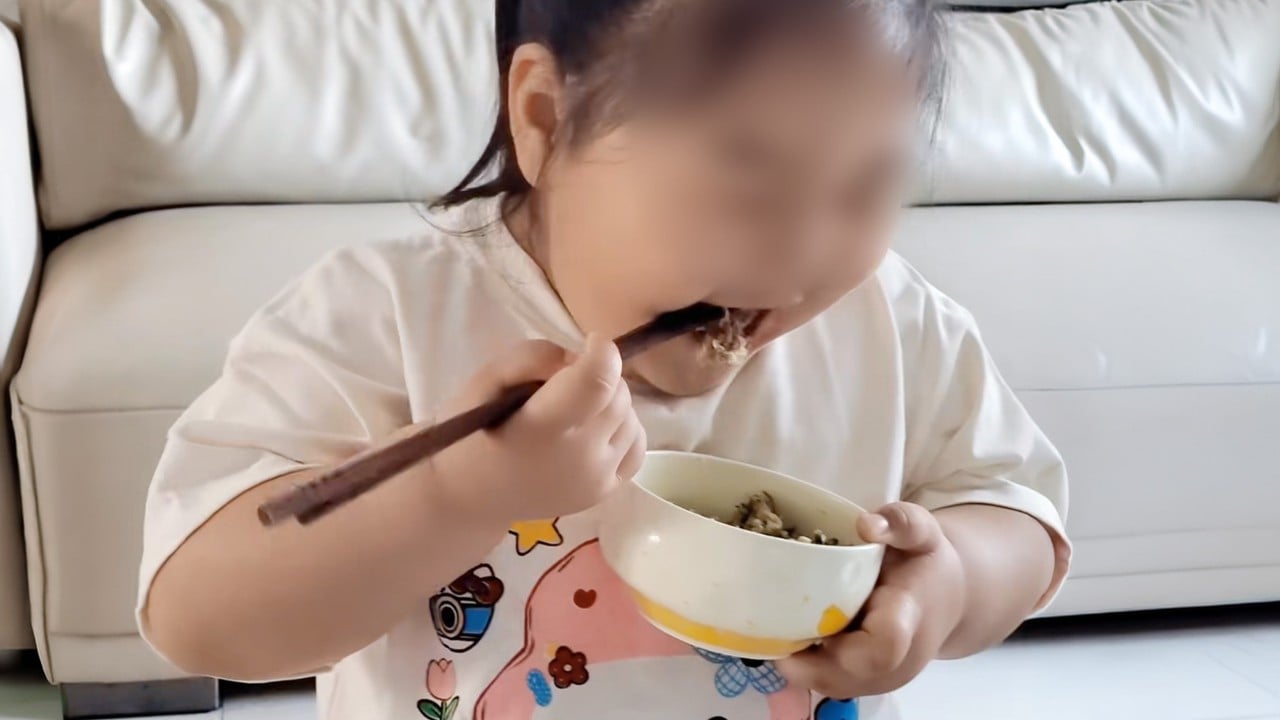
The ring light hums. It is a cold, piercing white circle that reflects perfectly in the eyes of a five-year-old girl sitting on a plush pink rug. Outside the high-rise apartment, the neon-lit skyline of Shenzhen blurs into the evening smog. Inside, the air smells faintly of hairspray and cheap plastic toys.
The girl, let’s call her Nini, is crying. Her cheeks are flushed, her chest heaving with heavy, shuddering sobs because her mother has just told her that her favorite puppy was run over by a car. She wails, clutching a stuffed bear to her chest.
"Perfect. Hold that," a voice instructs from behind the camera. It is her mother. She isn't rushing to comfort Nini. Instead, she adjusts the angle of her smartphone, checking the live comments flooding the screen. Thousands of digital hearts bubble up the side of the display. Gifts worth real yuan are rolling in.
The moment the livestream hits its peak engagement, the mother taps a button. "Alright, cut," she says, her voice instantly dropping its tense, dramatic edge. Nini wipes her eyes with the back of her small hand, her tears drying with terrifying, mechanical efficiency. There was no puppy. There was no car. There was only a script, a meticulously calculated algorithm, and a child who has learned that her mother’s attention—and the family's income—is entirely dependent on her ability to perform misery on demand.
This is the reality behind the screens for millions of viewers across Chinese social media platforms like Douyin and Kuaishou. It is a gold rush built on the backs of children who are not yet old enough to tie their shoes, let alone consent to having their childhoods monetized for a voracious digital audience.
The Factory of Manufactured Innocence
We are witnessing the industrialization of childhood. In the past, becoming a child star required a talent scout, an audition, and a production studio bound by child labor laws. Today, all it takes is a smartphone, a desperate parent, and an audience hooked on micro-doses of domestic drama.
The content follows a strict, highly effective formula. Some videos feature toddlers who possess an "impossible" maturity, cooking elaborate five-course meals using dangerous cleavers and blazing stoves while speaking in rehearsed, adult-like maxims about filial piety. Others lean into toxic emotional manipulation. Parents film themselves intentionally destroying their children’s toys, filming the raw, agonizing grief that follows, only to tack on a sponsored message for a toy brand at the end.
Consider the mechanics of the digital attention economy. The algorithms powering these platforms do not care about the psychological well-being of the creator. They care about retention. They care about watch time. A video of a child quietly playing with blocks gets scrolled past in a fraction of a second. But a video of a child sobbing hysterically, screaming at their parents, or acting out a highly sexualized dance routine? That triggers an immediate spike in engagement.
The algorithm rewards extremity. Parents, acting as talent managers, quickly realize that normalcy does not pay the mortgage. Drama does.
This is where the psychological erosion begins. When a child learns that their parent only looks at them with genuine intensity through a camera lens, the boundary between love and performance dissolves. The child begins to view themselves not as a human being with intrinsic value, but as a product that must be constantly optimized for the market.
The Backlash in the Machine
The scale of this phenomenon has finally cracked the surface of public tolerance. Across China, a massive wave of public outrage has crested, forcing state media and regulators to step in. The Cyberspace Administration of China has begun a sweeping crackdown, blacklisting accounts that exploit children, banning the live-streaming of minors under certain conditions, and penalizing platforms that turn a blind eye to child profiteering.
But the problem runs far deeper than a few banned accounts. The state-run media outlets call it a "distortion of values," arguing that these staged videos pollute the moral landscape of the youth. They are right, but perhaps not for the reasons they think.
The real tragedy is the theft of the mundane. A child needs to be bored. A child needs to fail privately. They need to throw a tantrum without that tantrum becoming a permanent piece of digital architecture archived on a server farm in Hangzhou.
When a parent stages a video—forcing a child to act out a scene where they are abandoned, impoverished, or abused—they are forcing that child to inhabit a reality that is psychologically damaging. The brain of a six-year-old does not possess the sophisticated cognitive scaffolding required to compartmentalize a performance from reality. To Nini, the fear of losing her mother or her pet feels entirely real in the moment, regardless of whether her mother smiles and hands her a candy bar when the recording stops.
The Mirage of the Golden Ticket
To understand why parents do this, we have to look at the immense socioeconomic pressures cooking inside China's hyper-competitive urban centers. The traditional paths to upward mobility are narrowing. The grueling education system, culminating in the brutal gauntlet of the gaokao exam, no longer guarantees a stable, middle-class life.
Against this backdrop, the child influencer economy looks like a lottery ticket.
Parents see stories of top-tier kid influencers pulling in millions of yuan a month through brand partnerships and livestream sales. They convince themselves that they are doing this for the child. They argue that the money earned will fund the child’s future education, buy an apartment in an expensive district, or secure a life of luxury that traditional hard work could never provide.
It is a Faustian bargain wrapped in parental love. The parents become middle managers of their own offspring. The home transforms from a sanctuary into a workplace, complete with production schedules, lighting rigs, and performance reviews based on view counts and click-through rates.
What happens when the child grows up? The shelf life of a cute toddler is agonizingly brief. By the age of eight or nine, the chubby cheeks recede, the voice drops, and the novelty wears off. The audience, always seeking the next hit of dopamine, moves on to a younger, more malleable subject.
These children are left stranded. They possess no traditional social skills, their education has been chronically disrupted by filming schedules, and their entire identity has been built on a digital phantom that no longer exists. They are retired workers before they hit puberty, carrying the psychological scars of a career they never chose.
The Long Shadow
Step back from the specific geopolitics of China for a moment. This is not a uniquely Chinese crisis. It is a human crisis accelerated by a global technology paradigm that converts human emotion into ad revenue. Whether it is a family vlog channel in suburban Ohio or a staged melodrama in a Shanghai high-rise, the underlying exploitation is identical.
We have built a world where the intimate spaces of family life have been thoroughly financialized. The gaze of the parent has been replaced by the gaze of the crowd, mediated through a glowing rectangle of glass.
The room is quiet now. The livestream has ended. The mother is huddled in the corner, illuminated by the blue light of her phone, replying to advertisers and counting the virtual gifts from the night's broadcast. Nini sits alone on the pink rug, surrounded by the discarded props of her evening's labor. She looks at her mother’s back, waiting for a glance, a touch, or a word that isn’t dictated by a script. But her mother is busy calculating tomorrow's engagement metrics. Nini reaches out and quietly takes her stuffed bear, holding it tight in the silence of a room that is no longer a home, but a stage.